DFT-Based Molecular Analysis of Imidazole Derivatives as Additives to Enhance Ionic Conductivity in Polymer Electrolyte Membranes
DOI:
https://doi.org/10.25273/cheesa.v8i1.22136.13-22Keywords:
DFT, imidazole, ionic conductivity, Lithium-ion battery, PEMAbstract
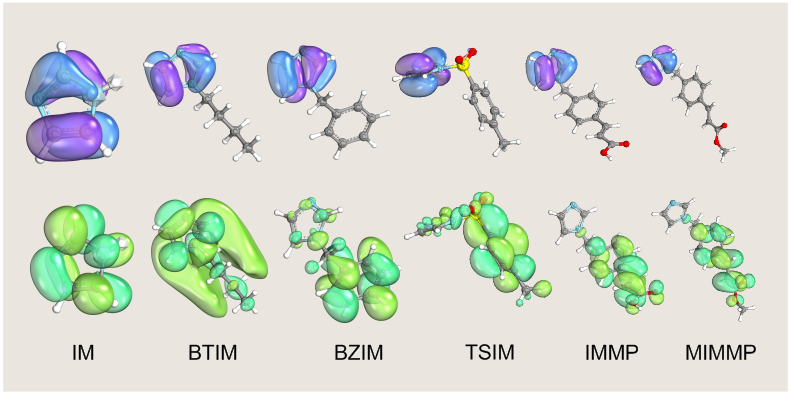
The demand for efficient and stable lithium-ion batteries has driven research on advanced polymer electrolyte membranes (PEM) with improved ionic conductivity. This study investigated imidazole and its derivatives as additives in PEM to enhance battery performance. Using Density Functional Theory (DFT) with the def2-TZVP basis set, key quantum parameters such as HOMO-LUMO energies, energy gap (?Egap), electronegativity (?), softness (?), electron transfer fraction (?N), and net electrophilicity (??) were analyzed. Results showed that imidazole derivatives with electron-withdrawing groups, like acrylate and tosyl, had lower ELUMO and smaller ?Egap, improving lithium ion (Li?) interactions and mobility within the polymer matrix. Additionally, compounds with high ? and ?, such as BTIM and BZIM, enhanced ion stabilization and transport, leading to better electrolyte performance. Thus, modifying imidazole structures through specific substitutions is a promising approach to optimize PEM, supporting the development of more efficient and stable lithium-ion batteries.

References
[2] Choi, S.-Y., Cho, S., Kim, D., Kim, J., Song, G., Singh, R., & Kim, C. (2021). Boosting the proton conduction using protonated imidazole for advanced ion conducting membrane. Journal of Membrane Science, 620, 118904. doi: 10.1016/j.memsci.2020.118904
[3] Zhang, Q., Liu, K., Liu, K., Zhou, L., Ma, C., & Du, Y. (2020). Imidazole containing solid polymer electrolyte for lithium ion conduction and the effects of two lithium salts. Electrochimica Acta, 351, 136342. doi: 10.1016/j.electacta.2020.136342
[6] Liu, X., Ni, Z., Li, W., & Wang, P. (2024). Stretchable, high ionic conductivity dual-network hydrogel-polymer electrolytes containing imidazole ionic liquids for supercapacitor and strain sensor. Journal of Polymer Research, 31(9), 279. doi: 10.1007/s10965-024-04132-y
[10] Ariefin, M., & Pasaribu, M. H. (2023). Theoritical Studies of Corossion Inhibition of Coumarin and Coumarin Derivative on Iron by Density Functional Theory Approaches. Al-Kimia, 11(1). doi: 10.24252/al-kimia.v11i1.38217
[11] Al-Otaibi, J. S., Almuqrin, A. H., Mary, Y. S., & Thomas, R. (2020). Modeling the conformational preference, spectroscopic properties, UV light harvesting efficiency, biological receptor inhibitory ability and other physico-chemical properties of five imidazole derivatives using quantum mechanical and molecular mechanics t. Journal of Molecular Liquids, 310, 112871. doi: 10.1016/j.molliq.2020.112871
Downloads
Published
How to Cite
Issue
Section
License
Copyright (c) 2025 CHEESA: Chemical Engineering Research Articles

This work is licensed under a Creative Commons Attribution-NonCommercial-ShareAlike 4.0 International License.
- Previous License: Creative Commons Attribution-NonCommercial-ShareAlike (CC BY-NC-SA)
- New License: Creative Commons Attribution (CC BY 4.0)
Previous copyright: With the receipt of the article by CHEESA Editorial Board and the decision to be published, the copyright regarding the article will be transferred to CHEESA Journal. CHEESA has the right to multiply and distribute the article and every author is not allowed to publish the same article that was published in this journal.
New Copyright: Authors who publish with this journal agree to the following terms:
Authors retain copyright and grant the journal right of first publication with the work simultaneously licensed under a Creative Commons Attribution License (CC BY 4.0) that allows others to share the work with an acknowledgement of the work's authorship and initial publication in this journal.


