Fluid Flow Rates Regression in Tank Level Control
DOI:
https://doi.org/10.25273/cheesa.v8i1.21400.35-42Keywords:
exponential, fluid flow rate, regression, tank level controlAbstract
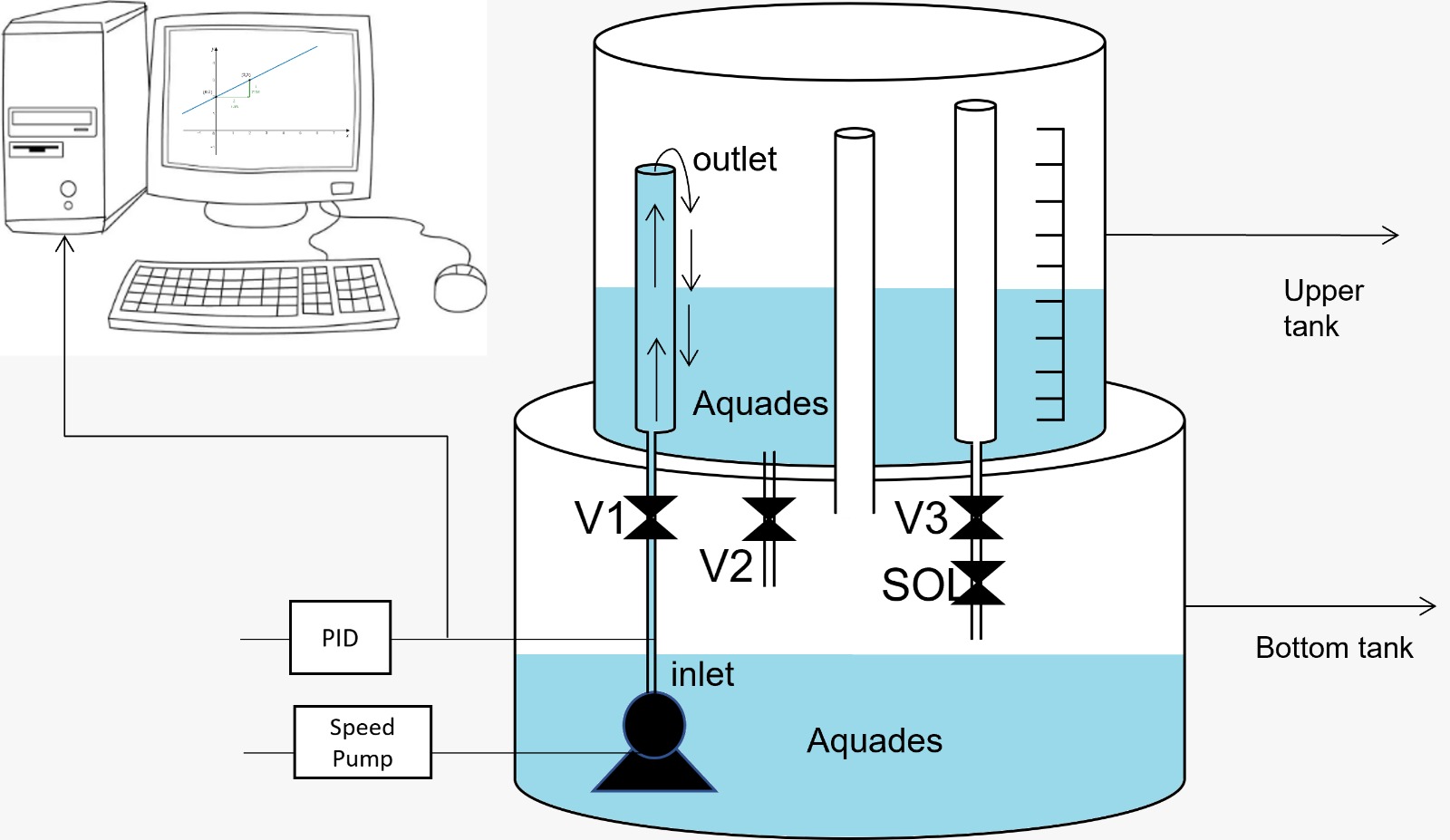
The industrial production process is closely related to control systems, including level control. This is often used to ensure that fluid in the tank is available in the appropriate amount at each stage of the process. The process typically uses an automatic control system such as a Proportional Integral Derivative (PID) Controller that can help measure the accuracy of the data obtained. Therefore, this study aims to examine the effect of flow rate on fluid level control in a tank using linear, exponential, and logarithmic regression analyses. In the process, the effect of the automatic control system (PID Controller) on fluid flow rate was evaluated. The materials used were a 4 mm solenoid and a pump speed variation in the range of 30-50%. Data on fluid level increase were obtained at 0 (n = 1), 60.27 (n = 30), and 180 seconds (n = 61) as the lower, middle, and upper limits. The results showed that fluid flow rate significantly affected the process of controlling fluid level in the tank, and is influenced by the speed of the pump used. Based on the regression analysis, the evaluation of the PID Controller was still classified as good, because the deviation observed in the reading flow rate data was very small.

References
[1] Soeharto. (1984). Undang-Undang RI Tentang Perindustrian. Jakarta.
[3] Koumoutsakos, P., & Mezic, I. (Eds.). (2006). Control of Fluid Flow (Vol. 330). Berlin, Heidelberg: Springer Berlin Heidelberg. doi: https://doi.org/10.1007/978-3-540-36085-8
[4] Bhujade, C. P., Bisen, H. D., Hatwar, G. V, Bharati, A. K., & Sawarkar, N. (2022). Flow Rate and Fluid Level Measurement and Automatic Controlling Unit. International Research Journal of Modernization in Engineering Technology and Science, 04(05), 3257-3263. Retrieved from https://www.irjmets.com/uploadedfiles/paper//issue_5_may_2022/23883/final/fin_irjmets1653202007.pdf
[5] Petru, L. T., Tivlea, M. V., & Popa, S. E. (2023). Water Level Control and Monitoring System in a Tank Made With Arduino Uno and NodeMCU ESP8266 Development Boards. Preprints. doi: https://doi.org/10.20944/preprints202304.0735.v1
[7] Rahayu, P., Putri, D.K., & Indriyani, N. (2021). Pengaruh Diameter Pipa Pada Aliran Fluida Terhadap Nilai Head Loss. Jurnal Agitasi. 2(1), 23-32.
[10] Djalilov, A., Juraeva, N., Nazarov, O., Chulliyev, Y., Sobirov, E., Begmatov, M., & Urolov, S. (2020). An intellectual system for water flow and water level control in water management. In IOP Conference Series: Earth and Environmental Science (Vol. 614). IOP Publishing Ltd. doi: https://doi.org/10.1088/1755-1315/614/1/012044
[12] Puspitarini, E. D., Effendie, R., & Pramudijanto, J. (2015). Desain Pengaturan Level pada Coupled Tank Process dengan Menggunakan Metode Model Predictive Control. Jurnal Teknik ITS, 6(1). doi : https://doi.org/10.12962/j23373539.v6i1.21345
[14] Gaur, A.S., Chauhan, A.S., Sharma, N.K., Kumar, R., Gautam, P., & Gupta, M. (2024). Advanced Fluid Level Control in Interconnected Tank Systems Using Fuzzy Logic and Neural Networks. J. Electrical Systems, 20-3(2024), 3362-3372. Retrieved from https://journal.esrgroups.org/jes/article/view/4971
[15] Azizi, A., & Emira, D. (2023). Perencanaan Reservoir Air Bersih di Wilayah Pelayanan IPA Legong PDAM Tirta Asasta Depok, Jurnal Serambi engineer, 8(3), 6226-6235. doi: https://doi.org/10.32672/jse.v8i3.6123
[16] Wibowo, M. (2001). Pemodelan Statistik Hubungan Debit dan Kandungan Sedimen Sungai Contoh Kasus di Das Citarum-Nanjung. Jurnal Teknologi Lingkungan, 2 (3), 255-260.
[17] Lakovlev, A. P., Erofeev, A. S., & Gorelkin, P. V. (2022, November 1). Novel Pumping Methods for Microfluidic Devices: A Comprehensive Review. Biosensors. MDPI. doi: https://doi.org/10.3390/bios12110956
[18] Chen, J., Chen, X., Li, W., Zheng, Y., & Li, Y. (2024). Research on Two-Phase Flow and Wear of Inlet Pipe Induced by Fluid Prewhirl in a Centrifugal Pump. Journal of Marine Science and Engineering, 12(6). doi: https://doi.org/10.3390/jmse12060950
Downloads
Published
How to Cite
Issue
Section
License
Copyright (c) 2025 CHEESA: Chemical Engineering Research Articles

This work is licensed under a Creative Commons Attribution-NonCommercial-ShareAlike 4.0 International License.
- Previous License: Creative Commons Attribution-NonCommercial-ShareAlike (CC BY-NC-SA)
- New License: Creative Commons Attribution (CC BY 4.0)
Previous copyright: With the receipt of the article by CHEESA Editorial Board and the decision to be published, the copyright regarding the article will be transferred to CHEESA Journal. CHEESA has the right to multiply and distribute the article and every author is not allowed to publish the same article that was published in this journal.
New Copyright: Authors who publish with this journal agree to the following terms:
Authors retain copyright and grant the journal right of first publication with the work simultaneously licensed under a Creative Commons Attribution License (CC BY 4.0) that allows others to share the work with an acknowledgement of the work's authorship and initial publication in this journal.


