Modeling and Simulation of Biomass Gasification with Aspen Plus for Different Types of Local Biomass from Riau Province
DOI:
https://doi.org/10.25273/cheesa.v8i1.20024.1-12Keywords:
aspen plus, gasification, modelling, palm solid waste, simulationAbstract
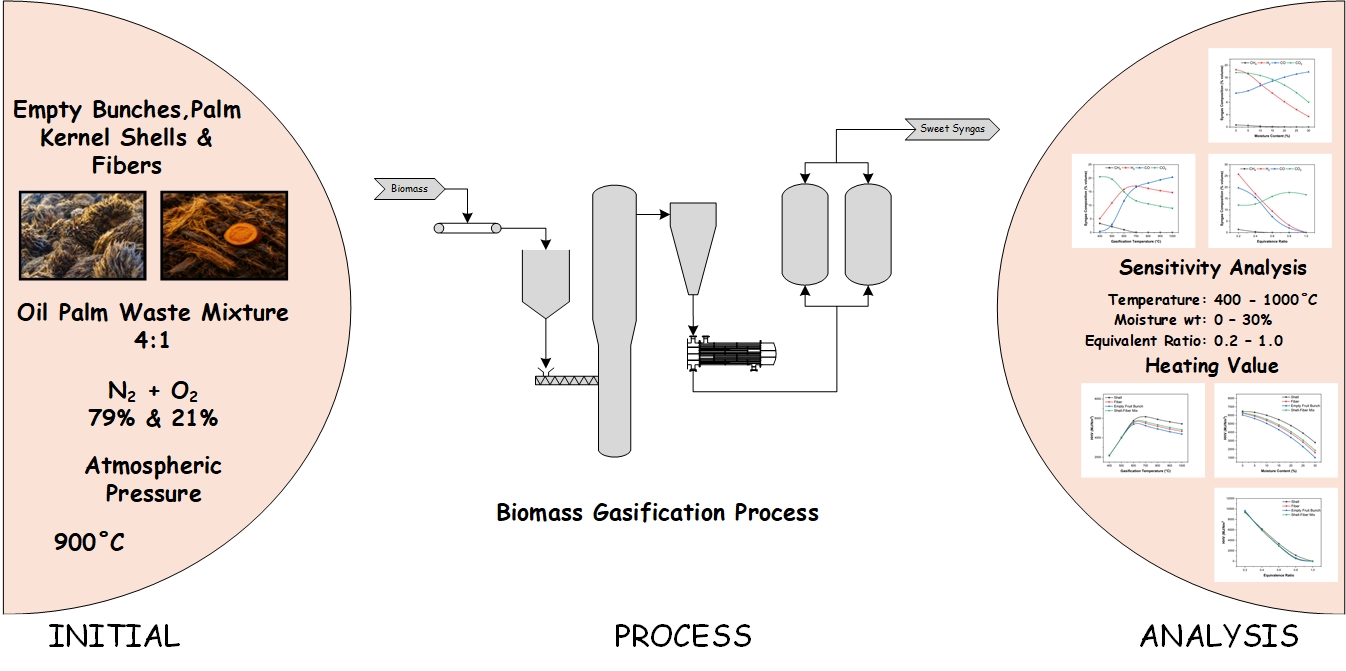
Gasification is a promising technology for electrical energy generation systems in palm oil mills. The syngas components, namely CH4, H2, and CO, produced from gasification can be used as fuel to produce steam, which will be applied in turbine generators to produce electricity. Therefore, this study aimed to simulate and validate a flowsheet model of gasification process for oil palm mill waste using Aspen Plus to achieve an optimal syngas composition, and conduct sensitivity analysis by varying gasification temperature, equivalent ratio, as well as correlating biomass moisture content to syngas composition. Biomass moisture content, equivalent ratio, and gasification temperature are important parameters that affect the chemical composition and heating value of syngas analyzed using the sensitivity analysis method. The results showed that the syngas composition was sensitive to the parameters of temperature, moisture content, and equivalent ratio. The operating conditions of gasification process to obtain a high heating value of syngas include 650?C gasification temperature, 0% moisture content, and 0.2 equivalent ratios.

References
Badan Pusat Statistik. (2023). Statisitk Kelapa Sawit Indonesia (Indonesia Oil Palm Statistics) 2022 (Vol. 16). Jakarta: Badan Pusat Statistik.
Meng, F., Meng, J., Zhang, D. (2018). Influence of higher equivalent ratio on the biomass oxygen gasification in a pilot scale fixed bed gasifier. J. Renewable Sustainable Energy, 10(5), 053101.
Sivalaban, K., Hassan, S., Ya, H., & Pasupuleti, J. (2021). A review on the characteristic of biomass and classification of bioenergy through direct combustion and gasification as an alternative power supply. Journal of Physics: Conference Series, 1831, 28-29 December 2019
Mohammed, M. A. A., Salmiaton, A., Azlina, W. A. K. G. W., & Amran, M. S. M. (2012). Gasification of oil palm empty fruit bunches: A characterization and kinetic study. Bioresource Technology, 110, 628-636, doi: 10.1016/j.biortech.2012.01.056
Aktawan, A., Maryudi, Siti, S., & Erna, A. (2020). Gasification of Oil Palm Shells and Empty Fruit Bunches to Produce Gas Fuel. Key Engineering Materials, 849, 3-7, doi:.4028/www.scientific.net/KEM.849.3
Paiva, M., Vieira, A., Gomes, H. T., & Brito, P. (2021). Simulation of a Downdraft Gasifier for Production of Syngasfrom Different Biomass Feedstocks. ChemEngineering, 5(2). doi: 10.3390/chemengineering5020020
Samiran, N. A., Jaafar, M. N. M., Ng, J., Lam, S. S., & Chong, C. T. (2016). Progress in biomass gasification technique - With focus on malaysian palm biomass for syngas production. Renewable and sustainable Energy Reviews, 62, 1047 - 1062, doi: 10.1016/j.rser.2016.04.049
Singh, D. K., & Tirkey, J. V. (2022). Process modelling and thermodynamic performance optimization of biomass air gasification fuelled with waste poultry litter pellet by integrating Aspen plus with RSM. Biomass and Bioenergy, 158. doi: 10.1016/j.biombioe.2022.106370
Bertling, M., & Milstig, A. (2022). Electrified Reforming of Biogas to Hydrogen for Industrial Furnaces with Negative Carbon Emissions : A Feasibility Study Sammanfattning. KTH Royal Institute of Technology.
Downloads
Published
How to Cite
Issue
Section
License
Copyright (c) 2025 CHEESA: Chemical Engineering Research Articles

This work is licensed under a Creative Commons Attribution-NonCommercial-ShareAlike 4.0 International License.
- Previous License: Creative Commons Attribution-NonCommercial-ShareAlike (CC BY-NC-SA)
- New License: Creative Commons Attribution (CC BY 4.0)
Previous copyright: With the receipt of the article by CHEESA Editorial Board and the decision to be published, the copyright regarding the article will be transferred to CHEESA Journal. CHEESA has the right to multiply and distribute the article and every author is not allowed to publish the same article that was published in this journal.
New Copyright: Authors who publish with this journal agree to the following terms:
Authors retain copyright and grant the journal right of first publication with the work simultaneously licensed under a Creative Commons Attribution License (CC BY 4.0) that allows others to share the work with an acknowledgement of the work's authorship and initial publication in this journal.


