Hexavalent Chromium Reduction of Artificial Waste Using Resin Immobilized Photocatalyst TiO2
DOI:
https://doi.org/10.25273/cheesa.v8i2.23078.86-92Keywords:
hexavalent chromium, photocatalyst, reduction, resin immobilizedAbstract
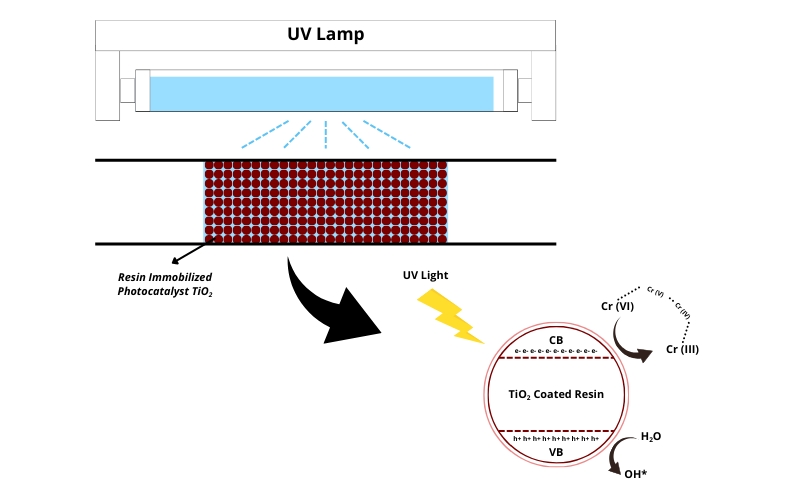
Photocatalysis is a process that can be used to reduce hexavalent chromium in wastewater. Therefore, this study aimed to analyze the effect of a semiconductor in the form of Resin Immobilized Photocatalyst (RIP)-TiO2 on the reduction of Cr (VI), as well as the effect of pH and catalyst mass. In the process, RIP-TiO2 was produced using rutile crystal TiO2 and cation resin. The study was conducted in a column bed with continuous flow and UV lamp irradiation. Sampling was performed every 5, 15, 45, and 60 minutes, as well as the use of 30 and 40 g of RIP-TiO2. The statistical results from a Two-Way Analysis of Variance (ANOVA) showed no significant differences in pH variation and catalyst mass. However, the best operating conditions were obtained at pH 5 and a catalyst mass of 40 g with a removal rate of 21.32%. These results suggested that pH adjustment had no significant effect on the reduction of Cr(VI) to Cr(III) using RIP-TiO₂ catalyst in the photocatalytic process. Further studies are needed to evaluate other factors, such as UV light intensity, contact time, and physical characteristics of the catalyst, capable of improving the efficiency of the RIP-TiO₂ system.

References
References
[1] Yusron, M., & Asroul Jaza, M. (2021). Analisis Jenis dan Kelimpahan Mikroplastik serta Pencemaran Logam Berat pada Hulu Sungai Bengawan Solo. Environmental Pollution Journal, 1(1), 41–48. doi: 10.58954/epj.v1i1.6
[2] Gibbons, C. F., Sasso, A. F., Angrish, M. M., Arzuaga, X., Bateson, T. F., Christensen, K. Y., … Kaupas, G. (2024). IRIS Toxicological Review of Hexavalent Chromium [Cr(VI)] CASRN 18540-29-9. Washington (DC): U.S. Environmental Protection Agency.
[3] Tezcan, U., Eroglu, S., & Ozel, E. (2017). The treatment of chromium-containing wastewater using electrocoagulation and the production of ceramic pigments from the resulting sludge. Journal of Environmental Management, 200, 196–203. doi: 10.1016/j.jenvman.2017.05.075
[4] Kangralkar, M. V., Manjanna, J., Momin, N., Rane, K. S., Nayaka, G. P., & Kangralkar, V. A. (2021). Photocatalytic Degradation Of Hexavalent Chromium And Different Staining Dyes By Zno In Aqueous Medium Under UV Light. Environmental Nanotechnology, Monitoring & Management, 16(April), 100508. doi: 10.1016/j.enmm.2021.100508
[5] Wang, N., Zhang, F., Mei, Q., Wu, R., & Wang, W. (2020). Photocatalytic TiO2/rGO/CuO Composite for Wastewater Treatment of Cr(VI) Under Visible Light. Water, Air, and Soil Pollution, 231(5). doi: 10.1007/s11270-020-04609-8
[6] Minas, F., Singh, B., & Leta, S. (2017). Chemical precipitation method for chromium removal and its recovery from tannery wastewater in Ethiopia, 3(4), 291–305.
[7] Assefa, H., Singh, S., Olu, F. E., Dhanjal, D. S., Mani, D., Khan, N. A., … Ramamurthy, P. C. (2024). Advances in adsorption technologies for hexavalent chromium removal_ Mechanisms, materials, and optimization strategies. Desalination and Water Treatment, 319(June), 100576. doi: 10.1016/j.dwt.2024.100576
[8] Kabdaşlı, I., & Tünay, O. (2023). Hexavalent Chromium Removal from Water and Wastewaters by Electrochemical Processes: Review. Molecules. doi: 10.3390/molecules28052411
[9] Wang, H., Song, X., Zhang, H., Tan, P., & Kong, F. (2020). Removal of hexavalent chromium in dual-chamber microbial fuel cells separated by different ion exchange membranes. Journal of hazardous materials, 384, 121459.
[10] Gao, X., & Meng, X. (2021). Photocatalysis For Heavy Metal Treatment: A Review. Processes, 9(10). doi: 10.3390/pr9101729
[11] Navidpour, A. H., Abbasi, S., Li, D., Mojiri, A., & Zhou, J. L. (2023). Investigation of Advanced Oxidation Process in the Presence of TiO2 Semiconductor as Photocatalyst: Property, Principle, Kinetic Analysis, and Photocatalytic Activity. Catalysts, 13(2). doi: 10.3390/catal13020232
[12] Song, Y., Lu, X., Liu, Z., Liu, W., Gai, L., Gao, X., & Ma, H. (2022). Efficient Removal of Cr(VI) by TiO2-Based Micro-Nano Reactor via the Synergy of Adsorption and Photocatalysis. Nanomaterials, 12(2), 1–15. doi: 10.3390/nano12020291
[13] Hidayah, E. N., Pachwarya, R. B., & Cahyonugroho, O. H. (2022). Immobilization Of Resin Photocatalyst In Removal Of Soluble Effluent Organic Matter and Potential For Disinfection By-Products. Global Journal of Environmental Science and Management, 8(3), 437–448. doi: 10.22034/gjesm.2022.03.10
[14] Al-Nuaim, M. A., Alwasiti, A. A., & Shnain, Z. Y. (2023). The Photocatalytic Process In The Treatment of Polluted Water. Chemical Papers. Versita. doi: 10.1007/s11696-022-02468-7
[15] Sato, M., Furukawa, M., Tateishi, I., Katsumata, H., & Kaneco, S. (2025). Development of Photocatalytic Reduction Method of Cr (VI) with Modified g-C3N4. Chemistry Proceedings, 17(1), 3. doi: 10.3390/chemproc2025017003
[16] Lu, W., Wang, C., Bai, Y., Xie, C., Zhang, Z., Song, W., & Wang, J. (2024). A novel covalent organic framework for efficient photocatalytic reduction of Cr(VI) and synergistic removal of organic pollutants under visible light irradiation. Environmental Science: Nano, 11(1), 229–240. doi: 10.1039/D3EN00734K
[17] Djellabi, R., Su, P., Elimian, E. A., Poliukhova, V., Nouacer, S., Abdelhafeez, I. A., … Contreras, S. (2022). Advances In Photocatalytic Reduction Of Hexavalent Chromium: From Fundamental Concepts to Materials Design and Technology Challenges. Journal of Water Process Engineering, 50(August 2022). doi: 10.1016/j.jwpe.2022.103301
[18] Qin, S., Xu, R., Jin, Q., Wang, S., Ren, Y., Huang, Y., … He, Z. (2024). Efficient Photocatalytic Reduction of Hexavalent Chromium by NiCo2S4/BiOBr Heterogeneous Photocatalysts. Coatings, 14(12). doi: 10.3390/coatings14121492
[19] Zhao, B., Zhang, K., Huang, Y., Wang, Q., Xu, H., Wang, Y., … Liu, J. (2021). A novel visible light-driven TiO2 photocatalytic reduction for hexavalent chromium wastewater and mechanism. Water Science and Technology, 83(9), 2135–2145. doi: 10.2166/wst.2021.116
[20] Jie, X., Shiu, B.-C., Wu, H., Zhang, Y., Ye, Y., Lin, C., & Fang, R. (2023). Adsorption and Recovery of Cr(VI) From Wastewater by Chitosan–Urushiol Composite Nanofiber Membrane. e-Polymers, 23(1). doi: doi:10.1515/epoly-2023-0157
Downloads
Published
How to Cite
Issue
Section
License
Copyright (c) 2025 CHEESA: Chemical Engineering Research Articles

This work is licensed under a Creative Commons Attribution-NonCommercial-ShareAlike 4.0 International License.
- Previous License: Creative Commons Attribution-NonCommercial-ShareAlike (CC BY-NC-SA)
- New License: Creative Commons Attribution (CC BY 4.0)
Previous copyright: With the receipt of the article by CHEESA Editorial Board and the decision to be published, the copyright regarding the article will be transferred to CHEESA Journal. CHEESA has the right to multiply and distribute the article and every author is not allowed to publish the same article that was published in this journal.
New Copyright: Authors who publish with this journal agree to the following terms:
Authors retain copyright and grant the journal right of first publication with the work simultaneously licensed under a Creative Commons Attribution License (CC BY 4.0) that allows others to share the work with an acknowledgement of the work's authorship and initial publication in this journal.


