Biofoam Cassava Starch and Sugarcane Bagasse Cellulose with the Addition of Polyvinyl Alcohol and Chitosan
DOI:
https://doi.org/10.25273/cheesa.v8i2.22973.93-102Keywords:
Bagasse, biofoam, Cassava Starch, cellulose, chitosan, PVAAbstract
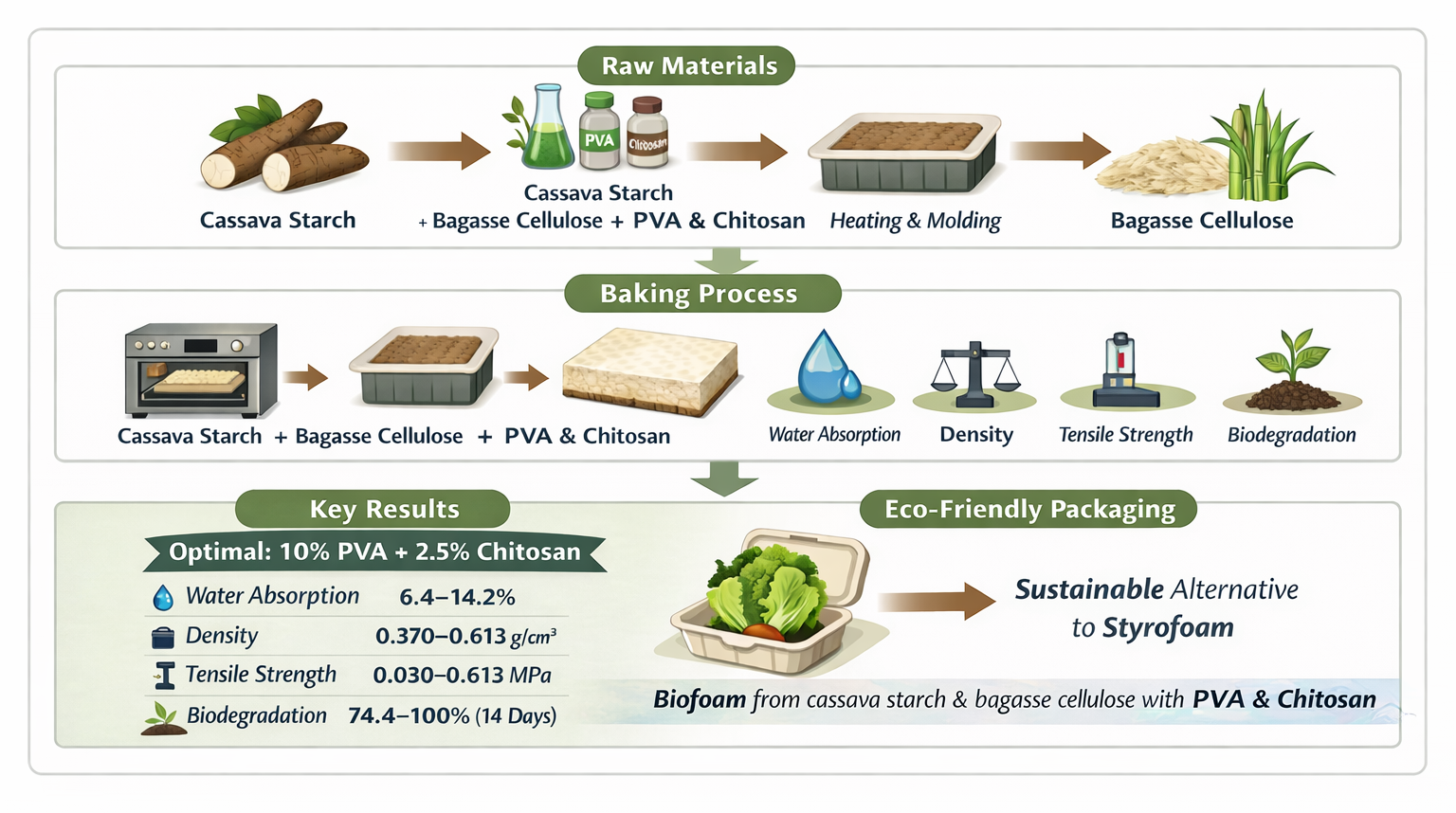
The persistence of non-biodegradable styrofoam waste is contributing to the development of sustainable packaging materials from renewable resources, such as biofoam from natural biopolymers. Therefore, this study aimed to develop biofoam based on cassava starch and cellulose isolated from sugarcane bagasse, modified with polyvinyl alcohol (PVA) and chitosan. The biofoam was synthesized using a baking process and evaluated for physical and mechanical properties, including water absorption, density, tensile strength, and biodegradability. To examine the effect of formulation, PVA concentrations ranged from 10% to 15%, while chitosan was added at 1.5%, 2.0%, and 2.5%. The result showed that water absorption values ranged from 6.4–14.2%, with densities at 0.370–0.613 g/cm³, tensile strengths 0.030–0.613 MPa, and biodegradability levels 74.4–100% within 14 days. Although the optimal formulation was achieved with 10% PVA and 2.5% chitosan, all samples met the Indonesian National Standard (SNI) for biodegradability, showing potential to replace conventional styrofoam.

References
[1] Hendar, H., Rezasyah, T., & Sari, D. S. (2022). Diplomasi Lingkungan Indonesia Melalui ASEAN dalam Menanggulangi Marine Plastic Debris. Padjadjaran Journal of International Relations, 4(2), 201. doi: 10.24198/padjir.v4i2.40721
[2] Dinanti, P.S, Siregar, S. A., & Putri, F. E. (2024). Faktor-Faktor yang Berhubungan dengan Perilaku Penggunaan Styrofoam sebagai Kemasan Makanan pada UMKM Sektor Makanan di Kota Jambi Tahun 2023. Jurnal Kesmas Jambi, 8(1), 38–47. doi: 10.22437/jkmj.v8i1.31324
[3] Hendrawati, N., Dewi, E. N., & Santosa, S. (2019). Karakterisasi Biodegradable Foam dari Pati Sagu Termodifikasi dengan Kitosan Sebagai Aditif. Teknik Kimia dan Lingkungan, 3(1), 47–52. doi: 10.33795/jtkl.v3i1.100
[4] Ruscahyani, Y., Oktorina, S., & Hakim, A. (2021). Pemanfaatan Kulit Jagung Sebagai Bahan Pembuatan Biodegradable Foam. Jurnal Teknologi Technoscientia, 14(1), 25–30. doi: 10.34151/technoscientia.v14i1.3295
[5] Al Mukminah, I. (2019). Bahaya Wadah Styrofoam dan Alternatif Penggantinya. Majalah Farmasetika, pp. 32–34. Sumedang, Jawa Barat. doi: https://doi.org/10.24198/farmasetika.v4i2.22589
[6] Hamine, N., Rodrigues, P., Souza, J. T. De, Rodrigues, R. L., Helene, M., Canteri, G., … Francisco, A. C. De. (2020). Starch-Based Foam Packaging Developed from a By-Product of Potato Industrialization ( Solanum tuberosum L .). Applied Sciences, 10(7), 2235. doi: https://doi.org/10.3390/app10072235
[7] Muhharam, F. I. (2020). Penambahan Kitosan pada Biofoam Berbahan Dasar Pati. Edufortech, 5(2), 119–127. Retrieved from http://ejournal.upi.edu/index.php/edufortech
[8] Etikaningrum, Hermanianto, J., Iriani, E. S., Syarief, R., & Permana, A. W. (2016). Pengaruh Penambahan Berbagai Modifikasi Serat Tandan Kosong Sawit pada Sifat Fungsional Biodegradable Foam. Penelitian Pascapanen Pertanian, 13(3), 146–155.
[9] Hwang, E., Yang, Y., Choi, J., Park, S., Park, K., & Lee, J. (2025). Biodegradable Plastics as Sustainable Alternatives : Advances , Basics , Challenges , and Directions for the Future, 18(18), 1–33. doi: https://doi.org/10.3390/ma18184247
[10] Harunsyah, Sari, R., Yunus, M., & Fauzan, R. (2020). Pemanfaatan Serat Ampas Tebu sebagai Bahan Biodegradable foam Pengganti Styrofoam sebagai Bahan Kemasan Makanan yang Ramah Lingkungan. Proceeding Seminar Nasional Politeknik Negeri Lhokseumawe, 4(1), 135–140.
[11] Kartikasari, S. N., Sari, P., & Subagio, A. (2016). Characterization of Chemical Properties, Amylograpic Profiles (RVA) and Granular Morphology (SEM) of Biologically Modified Cassava Starch. Jurnal Agroteknologi, 10(1), 12–24.
[12] Hendrawati, N., Lestari, Y. I., & Wulansari, P. A. (2017). Pengaruh Penambahan Kitosan dalam Pembuatan Biodegradable Foam Berbahan Baku Pati. Jurnal Rekayasa Kimia & Lingkungan, 12(1), 1. doi: 10.23955/rkl.v11i2.5002
[13] Hevira, L., Ariza, D., & Rahmi, A. (2021). Pembuatan Biofoam Berbahan Dasar Ampas Tebu Dan Whey. Jurnal Kimia dan Kemasan, 43(2), 75. doi: http://dx.doi.org/10.24817/jkk.v43i2.6718
[14] Yoseva, P. L., Akmal, M., & Halida, S. (2017). Pemanfaatan Limbah Ampas Tebu Sebagai Absorben Untuk Peningkatan Kualitas Air Gambut, 2(3), 321–329. doi: 10.7868/80424857017030112
[15] Isabella, H., & Hendrawati, N. (2022). Perbandingan Karakteristik Biodegradable Foam dari Pati Ubi Jalar dan Pati Kentang dengan Penambahan Serat Selulosa. Jurnal Ilimiah Teknik Kimia, 6(2), 104–111. doi: 10.32493/jitk.v6i2.21940
[16] Khanoonkon, N., Yenpirun, P., Chotineeranat, S., & Chatakanonda, P. C. (2022). Development of Biofoam Trays from Cassava Starch Blended with Citric Acid- modified Starch and Sugarcane Bagasse Cellulose Fiber. Journal of Food Science and Agricultural Technology, 6(1), 40–45.
[17] Firdausi, F., Fanni, U. N. Al, Widayoko, A., & Yuliani, Y. (2024). Pembuatan Styrofoam Ramah Lingkungan Dari Pati Singkong (Amilum manihot) Dengan Penambahan Serbuk Cangkang Telur (Ova) Sebagai Filler. Integrasi Sains dan Qur’an, 3(2), 300–307.
[18] Purnavita, S., & Rastono, N. K. (2021). Modifikasi Pati Aren dengan Crosslinking Agent STPP (Sodium Tri Poly Phospate) dan Penambahan Poli Vinil Alkohol terhadap Karakteristik Bioplastik. Seminar Nasional Teknik dan Manajemen Industri, 1(1), 256–261. doi: 10.28932/sentekmi2021.v1i1.73
[19] Wu, K., Yan, Z., Wu, Z., Li, J., Zhong, W., Ding, L., & Zhong, T. (2024). Recent Advances in the Preparation , Antibacterial Mechanisms , and Applications of Chitosan. Functional Biomaterials, 15. doi: https://doi.org/10.3390/jfb15110318
[20] Aritonang, S., Rhomadon, F. I., & Hapsari, A. K. (2024). Pemanfaatan Limbah Biomassa Sebagai Plastik Biodegradable Yang Diaplikasikan Pada Food Packaging Ransum Tni. Rekayasa Material, Manufaktur dan Energi, 7(2), 289–297. doi: https://doi.org/10.30596/rmme.v7i2.18455
[21] Sarlinda, F., Hasan, A., & Ulma, Z. (2022). Pengaruh Penambahan Serat Kulit Kopi dan Polivinil Alkohol ( PVA ) terhadap Karakteristik Biodegradable Foam dari Pati Kulit Singkong. Pengendalian Pencemaran Lingkungan (JPPL), 4(2), 9–20.
[22] Rusdianto, A. S., Amilia, W., Choiron, M., Wiyono, A. E., Hidayati, U. N., & Kunci, K. (2022). Karakteristik Biodegradable Foam Berbasis Pati Singkong Dengan Variasi Penambahan Tepung Ampas Tebu dan Polyvinyl Alcohol Characteristics of Biodegradable Foam Based on Cassava Starch with Variations of Additional Powdered Bagasse and Polyvinyl Alcohol. Journal of Food Engineering, 1(3), 140–150.
[23] Sari, G. F. (2022). The effect of proportion of ganyong starch and waste of straw rice on biodegradable foam production as sustainable packaging. IOP Conference Series: Earth and Environmental Science, 1041(1). doi: 10.1088/1755-1315/1041/1/012003
[24] Utami, A. N., Purnamasari, I., & Jaksen. (2024). Isolasi Selulosa Pada Tandan Kosong Kelapa Sawit Sebagai Material Pengisi Biodegradable Styrofoam. Inovasi Teknik KImia, 9(2), 80–86.
[25] Hakim, R. A., Darni, Y., & Lismeri, L. (2024). Sintesis Produk Biofoam Berbahan Baku Pati Sorgum dan Jerami Padi sebagai Filler. Teknologi dan Inovasi Industri, 05(01), 18–26.
[26] Weng, J., Durand, A., & Desobry, S. (2023). Chitosan-Based Particulate Carriers: Structure, Production and Corresponding Controlled Release. Pharmaceutics, 15(5). doi: 10.3390/pharmaceutics15051455
[27] Putri, S. S., Harsojuwono, B. A., & Anggreni, A. A. M. D. (2023). Pengaruh Konsentrasi Polivinil Alkohol dan Magnesium Stearat terhadap Karakteristik Bahan Pengemas Biokomposit Foam Tapioka dan Glukomanan. Ilmiah Teknologi Pertanian, 8(2), 2–8.
[28] Berutu, L. F., Rozanna, D., Muhammad, Zainuddin, G., & AZ, N. (2022). Biofoam Berbahan Pati Sagu ( Metroxylon rumphii m) Dengan Bahan Pengisi (Filler) Serat Batang Pisang dan Kulit Pisang Menggunakan Metode Thermopressing. Chemical Engineering Journal Storage, 1(Mei), 61–70.
[29] Febriani, H., Kurnia, K. I. F., & Pangarso, Z. D. (2021). Pembuatan Dan Karakterisasi Fisik Biodegradable Foam Pati Kulit Pisang Dan Selulosa Ampas Tebu. Ilmiah Penalaran dan Penelitian Mahasiswa, 5(1), 1–13.
[30] Bergel, B. F., Araujo, L. L., & Santana, R. M. C. (2021). Effects of The Addition of Cotton Fibers and Cotton Microfibers on The Structure and Mechanical Properties of Starch Foams Made From Potato Starch. Carbohydrate Polymer Technologies and Applications, 2, 100167. doi: 10.1016/j.carpta.2021.100167
[31] Coniwanti, P., Mu’in, R., Saputra, H. W., & R A, M. A. (2018). Pengaruh Konsentrasi NaOH Serta Rasio Serat Daun Nanas dan Ampas Tebu pada Pembuatan Biofoam. Teknik Kimia, 24(1), 1–7.
[32] Dayaka, Y. A., & Indrastuti, Y. E. (2023). Karakterisasi Biofoam Berbasis Pati Sagu dan Ampas Tebu dengan Penambahan Polivinil Alkohol ( PVA ) Characterization of Sago Starch and Sugarcane Baggasse Based Biofoam with Polyvinyl, 19(02), 125–131.
[33] Darni, Y., Anandati, G. M., Mayanti, E., Lismeri, L., Utami, H., & Azhar, A. (2023). Synthesis of Biofoam Based on Starch Mixture of Cassava Peel and Kepok Banana Peel with Chitosan Additive to Improve Mechanical and Physical Characteristics. Jurnal Rekayasa Kimia & Lingkungan, 18(1), 37–44. doi: 10.23955/rkl.v18i1.28089
[34] Limbong, F. Sando, ., Harsojuwono, A. B., & Hartiati, A. (2024). Pengaruh Konsentrasi Polivinil Alkohol dan Lama Pengadukan pada Proses Pemanasan terhadap Karakteristik Komposit Biotermoplastik Maizena dan Glukomanan. Jurnal Ilmiah Teknologi Harapan, 12(1), 33–40.
[35] Amaraweera, S. M., Gunathilake, C., Gunawardene, O. H. P., Dassanayake, R. S., Fernando, N. M. L., Wanninayaka, D. B., … Kulatunga, A. K. (2022). Preparation and Characterization of Dual-Modi fi ed Cassava Starch- Based Biodegradable Foams for Sustainable Packaging Applications. ACS Omega, 7(14), 12345–12356. doi: 10.1021/acsomega.2c01292
Downloads
Published
How to Cite
Issue
Section
License
Copyright (c) 2025 CHEESA: Chemical Engineering Research Articles

This work is licensed under a Creative Commons Attribution-NonCommercial-ShareAlike 4.0 International License.
- Previous License: Creative Commons Attribution-NonCommercial-ShareAlike (CC BY-NC-SA)
- New License: Creative Commons Attribution (CC BY 4.0)
Previous copyright: With the receipt of the article by CHEESA Editorial Board and the decision to be published, the copyright regarding the article will be transferred to CHEESA Journal. CHEESA has the right to multiply and distribute the article and every author is not allowed to publish the same article that was published in this journal.
New Copyright: Authors who publish with this journal agree to the following terms:
Authors retain copyright and grant the journal right of first publication with the work simultaneously licensed under a Creative Commons Attribution License (CC BY 4.0) that allows others to share the work with an acknowledgement of the work's authorship and initial publication in this journal.