Binary System Adsorption of Methylene Blue and Congo Red Using Magnetic Activated Carbon
DOI:
https://doi.org/10.25273/cheesa.v9i1.25102.64-76Keywords:
Adsorption, Binary system, Congo red, Durian peel, Methylene blueAbstract
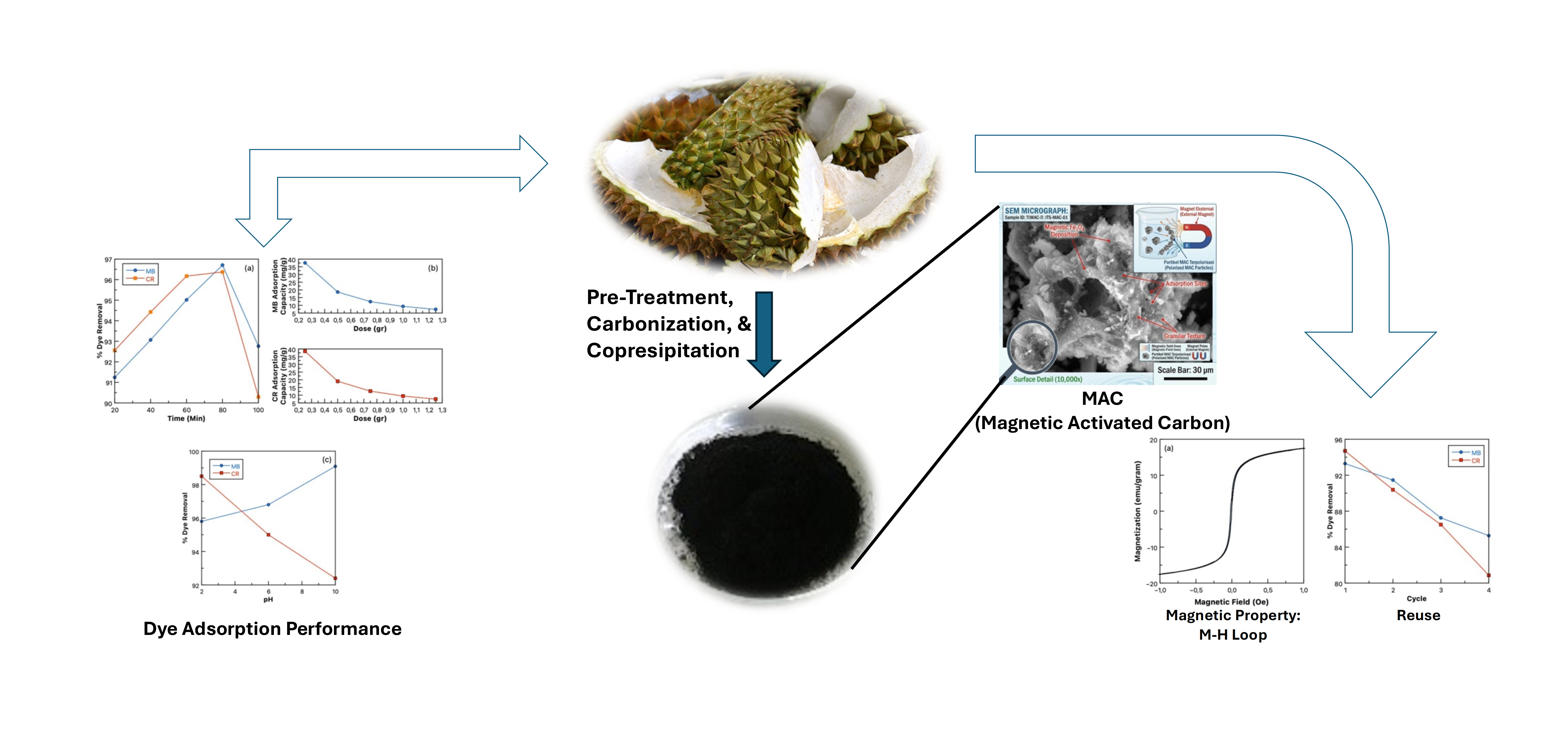
Dye pollution is an environmental concern posing significant risks to human health and water quality, showing the need for effective methods to reduce dye concentrations in contaminated water. Therefore, this study aimed to explore the reduction of dye concentration in a binary system through adsorption using magnetic activated carbon derived from durian peel. To assess the properties relevant to adsorption, the adsorbent was characterized using Fourier Transform Infrared Spectroscopy (FTIR), Scanning Electron Microscopy coupled with Energy-Dispersive X-ray Spectroscopy (SEM-EDX), X-ray Diffraction (XRD), Vibrating Sample Magnetometry (VSM), and Brunauer–Emmett–Teller Analysis (BET). The adsorption process was evaluated based on contact time, dose, and pH. The results showed that the reduction in the concentrations of Methylene Blue (MB) and Congo Red (CR) was influenced by contact time, dose, and pH, with an efficiency of approximately 97%. The observed behavior was best described by the pseudo-second-order kinetic model and Langmuir isotherm for MB and CR removal, respectively. However, intraparticle diffusion had no effect on the adsorption process because the C value was greater than 0. This study showed that magnetic activated carbon derived from durian peel possessed promising potential as an effective adsorbent for reducing dye concentration in a binary system.

References
[1] Kumari, U. (2024). Textile Dyes and Their Impact on the Natural Environment (pp. 17–30). doi: 10.1007/978-981-97-5341-3_2
[2] Oladoye, P. O., Bamigboye, M. O., Ogunbiyi, O. D., & Akano, M. T. (2022). Toxicity and decontamination strategies of Congo red dye. Groundwater for Sustainable Development, 19, 100844. doi: 10.1016/j.gsd.2022.100844
[3] Phan, K.-H., Le, L.-T., Ninh, T.-T. N., Tran, C.-S., Nguyen, T.-T., Nguyen, D.-T.-D., … Bui, X.-T. (2024). Decolorization and degradation of azo dyes in thermophilic biological wastewater treatment process: A mini-review. Case Studies in Chemical and Environmental Engineering, 10, 101018. doi: 10.1016/j.cscee.2024.101018
[4] Lellis, B., Fávaro-Polonio, C. Z., Pamphile, J. A., & Polonio, J. C. (2019). Effects of textile dyes on health and the environment and bioremediation potential of living organisms. Biotechnology Research and Innovation, 3(2), 275–290. doi: 10.1016/j.biori.2019.09.001
[5] Chand, M., Kumawat, A., & Srivastava, S. (2026). Zeta potential-mediated comparative adsorption study of cationic (Methylene blue) and anionic (Congo red) dye onto spent tea (Camellia sinensis) leaves powder. Surfaces and Interfaces, 80, 108271. doi: 10.1016/j.surfin.2025.108271
[6] Abbas, S. H., Younis, Y. M., Rashid, K. H., & Khadom, A. A. (2022). Removal of methyl orange dye from simulated wastewater by electrocoagulation technique using Taguchi method: kinetics and optimization approaches. Reaction Kinetics, Mechanisms and Catalysis, 135(5), 2663–2679. doi: 10.1007/s11144-022-02269-9
[7] Nguyen, D. T. C., Jalil, A. A., Nguyen, L. M., & Nguyen, D. H. (2025). A comprehensive review on the adsorption of dyes onto activated carbons derived from harmful invasive plants. Environmental Research, 279, 121807. doi: 10.1016/j.envres.2025.121807
[8] El Meziani, S., Agnaou, H., El Haddaj, H., Boumya, W., Barka, N., & Elhalil, A. (2025). Sustainable adsorption technologies for textile dye removal: Advances in biomass-derived and magnetically modified activated carbons. Cleaner Chemical Engineering, 12, 100210. doi: 10.1016/j.clce.2025.100210
[9] Kassa, A., Engida, A., & Endaye, M. (2025). Eco-friendly adsorbents for industrial dye removal: A comprehensive review of low-cost alternatives. Desalination and Water Treatment, 323, 101362. doi: 10.1016/j.dwt.2025.101362
[10] Tambun, R., Haryanto, B., Alexander, V., Manurung, D. R., & Ritonga, A. P. (2024). Durian peel (Durio zibethinus) utilization as an adsorbent in the purification of acidified crude glycerol. South African Journal of Chemical Engineering, 49, 162–169. doi: 10.1016/j.sajce.2024.05.002
[11] Mulyati, A. H., Widyiastuti, D., & Muslimin, I. (2019). Characteristics of durian seed brownies which enriched with coconut flour. Journal of Science Innovare, 2(01), 06–09. doi: 10.33751/jsi.v2i01.1522
[12] Nguyen, P. A. T., Nguyen, T. T. T., & Vo, D. K. N. (2024). Pectin from durian peel (Durio zibethinus Murr.) - a novel reducing and stabilizing agent: Physicochemical properties, green synthesis of silver nanoparticles and antimicrobial properties. Carbohydrate Polymer Technologies and Applications, 8, 100623. doi: 10.1016/j.carpta.2024.100623
[13] Lubis, R., Saragih, S. W., Wirjosentono, B., & Eddyanto, E. (2018). Characterization of durian rinds fiber (Durio zubinthinus, murr) from North Sumatera (p. 020069). doi: 10.1063/1.5082474
[14] Zeng, H., Zeng, H., Zhang, H., Shahab, A., Zhang, K., Lu, Y., … Ullah, H. (2021). Efficient adsorption of Cr (VI) from aqueous environments by phosphoric acid activated eucalyptus biochar. Journal of Cleaner Production, 286, 124964. doi: 10.1016/j.jclepro.2020.124964
[15] Gęca, M., Wiśniewska, M., & Nowicki, P. (2022). Biochars and activated carbons as adsorbents of inorganic and organic compounds from multicomponent systems – A review. Advances in Colloid and Interface Science, 305, 102687. doi: 10.1016/j.cis.2022.102687
[16] Saadi, A. S., Bousba, S., Riah, A., Belghit, M., Belkhalfa, B., & Barour, H. (2024). Efficient synthesis of magnetic activated carbon from oak pericarp for enhanced dye adsorption: A one-step approach. Desalination and Water Treatment, 319, 100420. doi: 10.1016/j.dwt.2024.100420
[17] Quyen, N. D. V., Tuyen, T. N., Khieu, D. Q., Tin, D. X., Diem, B. T. H., Nhung, N. T. A., … Thu, N. H. N. (2025). The Composite of Activated Carbon/Magnetic Iron Oxide: Synthesis, Isothermal, and Kinetic Studies of Ciprofloxacin and Tetracycline Adsorption From a Binary‐Component Solution. Journal of Nanotechnology, 2025(1). doi: 10.1155/jnt/2756348
[18] Qu, J., Shi, J., Wang, Y., Tong, H., Zhu, Y., Xu, L., … Zhang, Y. (2022). Applications of functionalized magnetic biochar in environmental remediation: A review. Journal of Hazardous Materials, 434, 128841. doi: 10.1016/j.jhazmat.2022.128841
[19] Wang, R., Li, X., Nie, Z., Zhao, Y., & Wang, H. (2021). Metal/Metal Oxide Nanoparticles-Composited Porous Carbon for High-Performance Supercapacitors. Journal of Energy Storage, 38, 102479. doi: 10.1016/j.est.2021.102479
[20] Wu, Z., Zhang, H., Ali, E., Shahab, A., Huang, H., Ullah, H., & Zeng, H. (2023). Synthesis of novel magnetic activated carbon for effective Cr(VI) removal via synergistic adsorption and chemical reduction. Environmental Technology & Innovation, 30, 103092. doi: 10.1016/j.eti.2023.103092
[21] Yağmur, H. K., & Kaya, İ. (2021). Synthesis and characterization of magnetic ZnCl2-activated carbon produced from coconut shell for the adsorption of methylene blue. Journal of Molecular Structure, 1232, 130071. doi: 10.1016/j.molstruc.2021.130071
[22] Bentahar, S., Dbik, A., Khomri, M. El, Messaoudi, N. El, & Lacherai, A. (2017). Adsorption of methylene blue, crystal violet and congo red from binary and ternary systems with natural clay: Kinetic, isotherm, and thermodynamic. Journal of Environmental Chemical Engineering, 5(6), 5921–5932. doi: 10.1016/j.jece.2017.11.003
[23] Wang, J., & Guo, X. (2020). Adsorption isotherm models: Classification, physical meaning, application and solving method. Chemosphere, 258, 127279. doi: 10.1016/j.chemosphere.2020.127279
[24] Yeung, P.-T., Chung, P.-Y., Tsang, H.-C., Cheuk-On Tang, J., Yin-Ming Cheng, G., Gambari, R., … Lam, K.-H. (2014). Preparation and characterization of bio-safe activated charcoal derived from coffee waste residue and its application for removal of lead and copper ions. RSC Advances, 4(73), 38839. doi: 10.1039/C4RA05082G
[25] Jamnongkan, T., Intaramongkol, N., Kanjanaphong, N., Ponjaroen, K., Sriwiset, W., Mongkholrattanasit, R., … Huang, C.-F. (2022). Study of the Enhancements of Porous Structures of Activated Carbons Produced from Durian Husk Wastes. Sustainability, 14(10), 5896. doi: 10.3390/su14105896
[26] Nascimento, V. X., Schnorr, C., Lütke, S. F., Da Silva, M. C. F., Machado Machado, F., Thue, P. S., … Dotto, G. L. (2023). Adsorptive Features of Magnetic Activated Carbons Prepared by a One-Step Process towards Brilliant Blue Dye. Molecules, 28(4), 1821. doi: 10.3390/molecules28041821
[27] Costa, L. F., Ruotolo, L. A. M., Ribeiro, L. S., Pereira, M. C., Camargo, E. R., & Nogueira, F. G. E. (2021). Low-cost magnetic activated carbon with excellent capacity for organic adsorption obtained by a novel synthesis route. Journal of Environmental Chemical Engineering, 9(2), 105061. doi: 10.1016/j.jece.2021.105061
[28] Yadav, M. S., Singh, N., & Bobade, S. M. (2020). VxOy nanoparticles and activated charcoal based nanocomposite for supercapacitor electrode application. Ionics, 26(5), 2581–2598. doi: 10.1007/s11581-019-03345-2
[29] Abdulhameed, A. S., Al Omari, R. H., Althahban, S., Jazaa, Y., Abualhaija, M., & Algburi, S. (2025). Green vegetable waste composited with chitosan as a bioadsorbent for effective removal of methylene blue dye from water: Insight into physicochemical and adsorption characteristics. Biomass and Bioenergy, 193, 107528. doi: 10.1016/j.biombioe.2024.107528
[30] Ma, M., Ying, H., Cao, F., Wang, Q., & Ai, N. (2020). Adsorption of congo red on mesoporous activated carbon prepared by CO2 physical activation. Chinese Journal of Chemical Engineering, 28(4), 1069–1076. doi: 10.1016/j.cjche.2020.01.016
[31] Sudarsan, S., Murugesan, G., Varadavenkatesan, T., Vinayagam, R., & Selvaraj, R. (2025). Efficient adsorptive removal of Congo Red dye using activated carbon derived from Spathodea campanulata flowers. Scientific Reports, 15(1), 1831. doi: 10.1038/s41598-025-86032-9
[32] Li, K., Ma, S., Xu, S., Fu, H., Li, Z., Li, Y., … Du, J. (2021). The mechanism changes during bisphenol A degradation in three iron functionalized biochar/peroxymonosulfate systems: The crucial roles of iron contents and graphitized carbon layers. Journal of Hazardous Materials, 404, 124145. doi: 10.1016/j.jhazmat.2020.124145
[33] Sun, L., Gong, Y., Li, D., & Pan, C. (2022). Biomass-derived porous carbon materials: synthesis, designing, and applications for supercapacitors. Green Chemistry, 24(10), 3864–3894. doi: 10.1039/D2GC00099G
[34] Mayangsari, N. E., Ramadani, T. A., Rachman, F., Juniani, A. I., Hendriatiningsih, S. L., & Ashifa, N. A. (2026). Study on methyl orange adsorption by Fe3O4@SiO2 decorated chitosan schiff base: Insights from kinetics, thermodynamics and response surface methodology for optimization. Chemical Physics Impact, 12, 101077. doi: 10.1016/j.chphi.2026.101077
[35] Ali, A. A., & Abdul-Hameed, H. M. (2025). Synthesis and characterization of magnetic activated carbon manufactured from palm stones by physical activation to remove lead from aqueous solution. Desalination and Water Treatment, 321, 100951. doi: 10.1016/j.dwt.2024.100951
[36] Gamay, R. A. J., Botecario, P. M. N., Sanchez, P. D. C., & Alvarado, M. C. (2024). Durian (Durio zibenthinus) waste: a promising resource for food and diverse applications—a comprehensive review. Food Production, Processing and Nutrition, 6(1), 27. doi: 10.1186/s43014-023-00206-4
[37] Damayanti, A., Wulansarie, R., Bahlawan, Z. A. S., Suharta, Royana, M., Basuki, M. W. N. M., … Andri, A. L. (2023). Effects of Phosphate and Thermal Treatments on the Characteristics of Activated Carbon Manufactured from Durian (Durio zibethinus) Peel. ChemEngineering, 7(5), 75. doi: 10.3390/chemengineering7050075
[38] Gong, Z.-X., Steven, M., Chen, Y.-T., Huo, L.-Z., Xu, H., Guo, C.-F., … Luo, X.-P. (2024). High adsorption to methylene blue based on Fe 3 O 4 –N-banana-peel biomass charcoal. RSC Advances, 14(35), 25619–25628. doi: 10.1039/D4RA04973J
[39] Yağmur, H. K., Acer, B., & Özdaş, R. (2025). Using of mesoporous activated carbon obtained by chemical activation of laurel fruit seeds for cationic dye removal. Applied Physics A, 131(5), 376. doi: 10.1007/s00339-025-08457-3
[40] Joshy, D., Chakko, S., Ismail, Y. A., & Periyat, P. (2021). Surface basicity mediated rapid and selective adsorptive removal of Congo red over nanocrystalline mesoporous CeO 2. Nanoscale Advances, 3(23), 6704–6718. doi: 10.1039/D1NA00412C
[41] Donohue, M. D., & Aranovich, G. L. (1998). Classification of Gibbs adsorption isotherms. Advances in Colloid and Interface Science, 76–77, 137–152. doi: 10.1016/S0001-8686(98)00044-X
[42] Liu, Z., Zhang, J., Zhang, L., Guan, Y., Ji, H., Zhang, Y., & Gao, H. (2023). Efficient removal of Congo red and methylene blue using biochar from Medulla Tetrapanacis modified by potassium carbonate. Bioresource Technology, 376, 128912. doi: 10.1016/j.biortech.2023.128912
[43] Ntuli, T. D., Mongwe, T. H., Sikeyi, L. L., Mkhari, O., Coville, N. J., Nxumalo, E. N., & Maubane-Nkadimeng, M. S. (2021). Removal of hexavalent chromium via an adsorption coupled reduction mechanism using olive oil derived carbon nano-onions. Environmental Nanotechnology, Monitoring & Management, 16, 100477. doi: 10.1016/j.enmm.2021.100477
[44] Huong Do, T., Nguyen, N. P. N., Mai, X. T., Tran, T. H., Dung Nguyen, Q., & Vuong, T. X. (2026). Hierarchically porous activated carbon derived from Lansium domesticum peel via hydrothermal-H3PO4 activation for enhanced methylene blue removal: adsorption behavior, advanced modeling and mechanistic insights. RSC Advances, 16(30), 28004–28035. doi: 10.1039/D6RA02695H
[45] Efimova, N. V., Krasnopyorova, A. P., Yuhno, G. D., Sofronov, D. S., & Rucki, M. (2021). Uptake of Radionuclides 60Co, 137Cs, and 90Sr with α-Fe2O3 and Fe3O4 Particles from Aqueous Environment. Materials, 14(11), 2899. doi: 10.3390/ma14112899
[46] Peighambardoust, S. J., Rezaei-Aghdam, S., Sakhaei Niroumand, J., Mohammadzadeh Pakdel, P., & Sillanpää, M. (2025). Efficient methylene blue elimination from water media by nanocomposite adsorbent-based carboxymethyl cellulose-grafted poly(acrylamide)/magnetic biochar decorated with ZIF-67. RSC Advances, 15(39), 32407–32423. doi: 10.1039/D5RA03796D
[47] Ali, H., & Ismail, A. M. (2023). Fabrication of Magnetic Fe3O4/Polypyrrole/Carbon Black Nanocomposite for Effective Uptake of Congo Red and Methylene Blue Dye: Adsorption Investigation and Mechanism. Journal of Polymers and the Environment, 31(3), 976–998. doi: 10.1007/s10924-022-02663-3
[48] Liu, Y. (2008). New insights into pseudo-second-order kinetic equation for adsorption. Colloids and Surfaces A: Physicochemical and Engineering Aspects, 320(1–3), 275–278. doi: 10.1016/j.colsurfa.2008.01.032
[49] Foroutan, R., Peighambardoust, S. J., Esvandi, Z., Khatooni, H., & Ramavandi, B. (2021). Evaluation of two cationic dyes removal from aqueous environments using CNT/MgO/CuFe2O4 magnetic composite powder: A comparative study. Journal of Environmental Chemical Engineering, 9(2), 104752. doi: 10.1016/j.jece.2020.104752
[50] Bagotia, N. (2025). Regeneration strategies for exhausted adsorbents used in water treatment - A critical review. Journal of Water Process Engineering, 69, 106560. doi: 10.1016/j.jwpe.2024.106560
Downloads
Published
How to Cite
Issue
Section
License
Copyright (c) 2026 Tarikh Azis Ramadani, Yusron Khoiru Nadhori, Novi Eka Mayangsari, Alma Vita Sophia, Indah Permata Sari

This work is licensed under a Creative Commons Attribution 4.0 International License.
- Previous License: Creative Commons Attribution-NonCommercial-ShareAlike (CC BY-NC-SA)
- New License: Creative Commons Attribution (CC BY 4.0)
Previous copyright: With the receipt of the article by CHEESA Editorial Board and the decision to be published, the copyright regarding the article will be transferred to CHEESA Journal. CHEESA has the right to multiply and distribute the article and every author is not allowed to publish the same article that was published in this journal.
New Copyright: Authors who publish with this journal agree to the following terms:
Authors retain copyright and grant the journal right of first publication with the work simultaneously licensed under a Creative Commons Attribution License (CC BY 4.0) that allows others to share the work with an acknowledgement of the work's authorship and initial publication in this journal.