Potato Peel Starch Bioplastics Reinforced with Microcrystalline Cellulose, PVA, and Chitosan: Mechanical, Thermal, and Antibacterial Properties
DOI:
https://doi.org/10.25273/cheesa.v9i1.24438.26-40Keywords:
antibacterial packaging, bioplastics, mechanical reinforcement, microcrystalline cellulose, potato starchAbstract
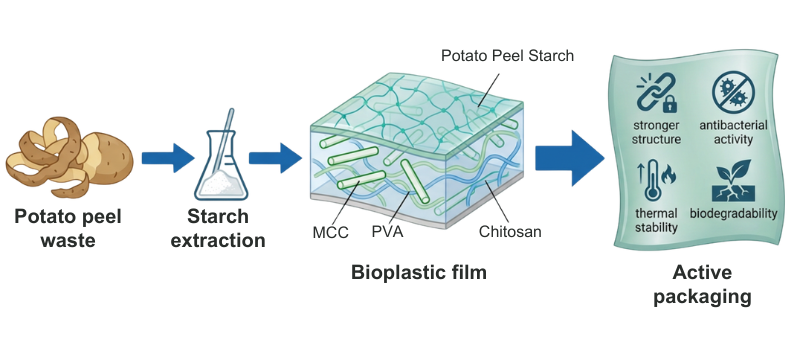
The increasing accumulation of petroleum-based plastic waste has led to the development of biodegradable packaging materials from renewable agro-industrial resources. Therefore, this study aims to synthesize biodegradable potato peel starch/polyvinyl alcohol (PPS/PVA) blend bioplastic films reinforced with microcrystalline cellulose (MCC) and functionalized with chitosan. Films were prepared through solution casting with varied MCC contents and characterized for density, tensile properties, crystallinity, thermal stability, morphology, antibacterial activity, and biodegradability. The results showed that an increase in MCC improved film compactness, tensile strength, crystallinity, and surface uniformity, showing stronger interfacial interactions within the polymer matrix. FTIR confirmed enhanced hydrogen bonding among starch, PVA, chitosan, and MCC, while thermal analysis showed improved resistance to degradation. The produced films also exhibited antibacterial activity against Staphylococcus aureus and Escherichia coli, with the highest performance observed at higher MCC loading. Despite reinforcement, the products remained biodegradable in soil. These results show the potential of PPS/PVA blend bioplastic films containing PPS waste as sustainable materials for active packaging applications.

References
[1] Dimassi, S. N., Hahladakis, J. N., Yahia, M. N. D., Ahmad, M. I., Sayadi, S., & Al-Ghouti, M. A. (2022). Degradation-fragmentation of marine plastic waste and their environmental implications: A critical review. Arabian Journal of Chemistry, 15(11), 104262. doi: 10.1016/j.arabjc.2022.104262
[2] Kumar, M., Bolan, S., Padhye, L. P., Konarova, M., Foong, S. Y., Lam, S. S., … Bolan, N. (2023). Retrieving back plastic wastes for conversion to value added petrochemicals: opportunities, challenges and outlooks. Applied Energy, 345, 121307. doi: 10.1016/j.apenergy.2023.121307
[3] Bishop, G., Styles, D., & Lens, P. N. L. (2021). Environmental performance comparison of bioplastics and petrochemical plastics: A review of life cycle assessment (LCA) methodological decisions. Resources, Conservation and Recycling, 168, 105451. doi: 10.1016/j.resconrec.2021.105451
[4] Ali, Z., Abdullah, M., Yasin, M. T., Amanat, K., Ahmad, K., Ahmed, I., … Khan, J. (2024). Organic waste-to-bioplastics: Conversion with eco-friendly technologies and approaches for sustainable environment. Environmental Research, 244, 117949. doi: 10.1016/j.envres.2023.117949
[5] Costa, A., Encarnação, T., Tavares, R., Todo Bom, T., & Mateus, A. (2023). Bioplastics: Innovation for Green Transition. Polymers, 15(3), 517. doi: 10.3390/polym15030517
[6] Nanda, S., Patra, B. R., Patel, R., Bakos, J., & Dalai, A. K. (2022). Innovations in applications and prospects of bioplastics and biopolymers: a review. Environmental Chemistry Letters, 20(1), 379–395. doi: 10.1007/s10311-021-01334-4
[7] Hamin, S. H., Sayid Abdullah, S. H. Y., Lananan, F., Abdul Hamid, S. H., Kasan, N. A., Mohamed, N. N., & Endut, A. (2023). Effect of chemical treatment on the structural, thermal, and mechanical properties of sugarcane bagasse as filler for starch‐based bioplastic. Journal of Chemical Technology & Biotechnology, 98(3), 625–632. doi: 10.1002/jctb.7218
[8] Kassim, N. I. A. C., Gunny, A. A. N., Saifuddin, M. N. A. A., Sam, S. T., Ali, F., Jamaluddin, J., … Che Kassim, F. N. (2025). Issues and Challenges of Starch-Based Bioplastics: A Review (pp. 197–207). doi: 10.1007/978-981-96-3785-0_16
[9] Ribba, L., Garcia, N. L., D’Accorso, N., & Goyanes, S. (2017). Disadvantages of Starch-Based Materials, Feasible Alternatives in Order to Overcome These Limitations. In Starch-Based Materials in Food Packaging (pp. 37–76). Elsevier. doi: 10.1016/B978-0-12-809439-6.00003-0
[10] Abdullah, A. H. D., Putri, O. D., Fikriyyah, A. K., Nissa, R. C., & Intadiana, S. (2020). Effect of microcrystalline cellulose on characteristics of cassava starch-based bioplastic. Polymer-Plastics Technology and Materials, 59(12), 1250–1258. doi: 10.1080/25740881.2020.1738465
[11] Syarifah, N. L., Masriatini, R., Wahyudi, A., Fatimura, M., & Laila Syarifah, N. (2025). Biofoam Cassava Starch and Sugarcane Bagasse Cellulose with the Addition of Polyvinyl Alcohol and Chitosan. CHEESA: Chemical Engineering Research Articles, 8(2), 93. doi: 10.25273/cheesa.v8i2.22973.93-102
[12] Arifin, U. F., Adetya, N. P., Pambudi, W., & Ratnaningsih, W. (2022). Quality Evaluation of Bioplastic from Glutinous Rice Starch Reinforced with Bamboo Leaf Powder. CHEESA: Chemical Engineering Research Articles, 5(2), 82. doi: 10.25273/cheesa.v5i2.14235.82-91
[13] Bello, T. K., Eze, E. C., Usman, M. S., & Isa, M. T. (2024). Characterization of bioplastics produced from yam and potato peels using hydrochloric and acetic acids. Biomass Conversion and Biorefinery, 14(15), 18019–18030. doi: 10.1007/s13399-023-04021-2
[14] Chaffa, T. Y., Meshesha, B. T., Mohammed, S. A., & Jabasingh, S. A. (2024). Production, characterization, and optimization of starch-based biodegradable bioplastic from waste potato (Solanum tuberosum) peel with the reinforcement of false banana (Ensete ventricosum) fiber. Biomass Conversion and Biorefinery, 14(21), 27365–27377. doi: 10.1007/s13399-022-03426-9
[15] Sultan, A., Sultan, H., Shahzad, W., Kareem, A., Liaqat, A., Ashraf, Z., … Acevedo, R. (2024). Comparative analysis of physical and mechanical properties of starch based bioplastic derived from the pulp and peel of potatoes. Journal of the Indian Chemical Society, 101(10), 101301. doi: 10.1016/j.jics.2024.101301
[16] Momtaz, F., Momtaz, E., Mehrgardi, M. A., Momtaz, M., Narimani, T., & Poursina, F. (2024). Enhanced antibacterial properties of polyvinyl alcohol/starch/chitosan films with NiO–CuO nanoparticles for food packaging. Scientific Reports, 14(1), 7356. doi: 10.1038/s41598-024-58210-8
[17] Deng, H., Su, J., Zhang, W., Khan, A., Sani, M. A., Goksen, G., … Rhim, J.-W. (2024). A review of starch/polyvinyl alcohol (PVA) blend film: A potential replacement for traditional plastic-based food packaging film. International Journal of Biological Macromolecules, 273, 132926. doi: 10.1016/j.ijbiomac.2024.132926
[18] Ma, N., Dong, W., Qin, D., Dang, C., Xie, S., Wang, Y., … Kumar, R. (2024). Green and renewable thermoplastic polyvinyl alcohol/starch blend film fabricated by melt processing. International Journal of Biological Macromolecules, 279, 134866. doi: 10.1016/j.ijbiomac.2024.134866
[19] Khui, P. L. N., Rahman, M. R., & Bakri, M. K. Bin. (2022). Cellulose reinforcement in bioplastic composites. In Fundamentals and Recent Advances in Nanocomposites Based on Polymers and Nanocellulose (pp. 143–158). Elsevier. doi: 10.1016/B978-0-323-85771-0.00016-6
[20] Divakaran, D., Sriariyanun, M., Jagadeesan, R., Suyambulingam, I., Sanjay, M. R., & Siengchin, S. (2024). Isolation and characterization of an agro-industrial waste-based novel cellulosic micro fillers from mustard (Brassica juncea) seed oil cake: A waste to wealth approach. Biomass Conversion and Biorefinery, 14(18), 22921–22937. doi: 10.1007/s13399-023-04346-y
[21] Sunesh, N. P., Indran, S., Divya, D., & Suchart, S. (2022). Isolation and characterization of novel agrowaste‐based cellulosic micro fillers from Borassus flabellifer flower for polymer composite reinforcement. Polymer Composites, 43(9), 6476–6488. doi: 10.1002/pc.26960
[22] Nasution, H., Asdita, M., Zoelva, A., Syabina Asraf, F., Atqia Tamanni, D., & Mufidah Lubis, N. (2024). The Effect of Microcrystal Cellulose Filling from Coconut Fiber and Betel Leaf Extract as Antimicrobials on Sago Starch Bioplastic Composite. E3S Web of Conferences, 519, 04003. doi: 10.1051/e3sconf/202451904003
[23] Lubis, M., Bangun Harahap, M., Hendra, M., Ginting, S., Sartika, M., & Azmi, H. (2018). Production Of Bioplastic from Avocado Seed Starch Reinforced with Microcrystalline Cellulose from Sugar Palm Fibers. Journal of Engineering Science and Technology, 13(2), 381–393.
[24] Shrestha, B., Chapain, K., Shah, S., & Pandit, R. (2023). Starch/ Polyvinyl Alcohol (PVA) Blend Bioplastics: Synthesis and Physicochemical Properties. Journal of Nepal Chemical Society, 43(2), 103–109. doi: 10.3126/jncs.v43i2.53349
[25] Faisal, M., Žmirić, M., Kim, N., Bruun, S., Mariniello, L., Famiglietti, M., … Blennow, A. (2023). A Comparison of Cellulose Nanocrystals and Nanofibers as Reinforcements to Amylose-Based Composite Bioplastics. Coatings, 13(9), 1573. doi: 10.3390/coatings13091573
[26] Shuprajhaa, T., Paramasivam, S. K., Pushpavalli, S., Anandakumar, Su., & Naik, R. (2025). Influence of additives on the development, mechanical, functional characteristics and biodegradability of banana starch-based bio plastic films. International Journal of Biological Macromolecules, 295, 139544. doi: 10.1016/j.ijbiomac.2025.139544
[27] Area, M. R., Montero, B., Rico, M., Barral, L., Bouza, R., & López, J. (2020). Properties and behavior under environmental factors of isosorbide-plasticized starch reinforced with microcrystalline cellulose biocomposites. International Journal of Biological Macromolecules, 164, 2028–2037. doi: 10.1016/j.ijbiomac.2020.08.075
[28] Julinová, M., Vaňharová, L., Jurča, M., Minařík, A., Duchek, P., Kavečková, J., … Skácelík, P. (2020). Effect of Different Fillers on the Biodegradation Rate of Thermoplastic Starch in Water and Soil Environments. Journal of Polymers and the Environment, 28(2), 566–583. doi: 10.1007/s10924-019-01624-7
[29] Nurhamiyah, Y., Marlina, R., & Syamani, F. A. (2022). Dynamic Mechanical Properties of Acetylated Cassava Starch-Chitosan Based Film, With Addition of Sorghum Micro-Fibrillated Cellulose (pp. 159–169). doi: 10.1007/978-981-19-0308-3_12
[30] Bangar, S. P., Whiteside, W. S., Dunno, K. D., Cavender, G. A., & Dawson, P. (2022). Pearl millet starch-based nanocomposite films reinforced with Kudzu cellulose nanocrystals and essential oil: Effect on functionality and biodegradability. Food Research International, 157, 111384. doi: 10.1016/j.foodres.2022.111384
[31] Rumi, S. S., Liyanage, S., & Abidi, N. (2024). Soil burial-induced degradation of cellulose films in a moisture-controlled environment. Scientific Reports, 14(1), 6921. doi: 10.1038/s41598-024-57436-w
[32] Olusanya, J. O., Turup Pandurangan, M., & Kanny, K. (2023). Influence of alkali treated cellulose nanoparticles filled starch-based bioplastic films and their effect on thermal and mechanical properties. Journal of Industrial Textiles, 53. doi: 10.1177/15280837231198016
[33] Wang, W., Han, L., Zhai, X., Li, Z., Wang, A., Wu, T., & Hou, H. (2021). Etherification of Microcrystalline Cellulose for Application in Starch Films. Shipin Kexue/Food Science, 42, 65–71. doi: 10.7506/spkx1002-6630-20200128-283
[34] Żołek-Tryznowska, Z., Bednarczyk, E., Tryznowski, M., & Kobiela, T. (2023). A Comparative Investigation of the Surface Properties of Corn-Starch-Microfibrillated Cellulose Composite Films. Materials, 16(9), 3320. doi: 10.3390/ma16093320
[35] Hsiao, K.-Y., Chung, R.-J., Chang, P.-P., & Tsai, T.-H. (2025). Identification of Hydroxyl and Polysiloxane Compounds via Infrared Absorption Spectroscopy with Targeted Noise Analysis. Polymers, 17(11), 1533. doi: 10.3390/polym17111533
[36] Khatun, M. A., Sultana, S., Islam, Z., Kabir, M. S., Hossain, M. S., Nur, H. P., & Chowdhury, A. M. S. (2023). Extraction of crystalline nanocellulose (CNC) from date palm mat fibers and its application in the production of nanocomposites with polyvinyl alcohol and polyvinylpyrrolidone blended films. Results in Engineering, 17, 101031. doi: 10.1016/j.rineng.2023.101031
[37] Rao, L. S., Naidu, C. D., & Tiwari, S. (2022). Investigation on synthesis, structure and degradability of starch based bioplastics. Materials Today: Proceedings, 49, 257–261. doi: 10.1016/j.matpr.2021.01.917
[38] Andoko, A., Prasetya, R., Cakra, B. D., Syah, M. Z., & Santoso, A. (2025). Autoclave-assisted multi-objective optimization of the deacetylation process in chitosan production from shrimp shell waste via response surface methodology. Results in Engineering, 27, 106353. doi: 10.1016/j.rineng.2025.106353
Downloads
Published
How to Cite
Issue
Section
License
Copyright (c) 2026 Mochamad Viky Afandy, Andoko, Riduwan Prasetya, Muhammad Faizullah Pasha, Mohammad Sukri bin Mustapa

This work is licensed under a Creative Commons Attribution 4.0 International License.
- Previous License: Creative Commons Attribution-NonCommercial-ShareAlike (CC BY-NC-SA)
- New License: Creative Commons Attribution (CC BY 4.0)
Previous copyright: With the receipt of the article by CHEESA Editorial Board and the decision to be published, the copyright regarding the article will be transferred to CHEESA Journal. CHEESA has the right to multiply and distribute the article and every author is not allowed to publish the same article that was published in this journal.
New Copyright: Authors who publish with this journal agree to the following terms:
Authors retain copyright and grant the journal right of first publication with the work simultaneously licensed under a Creative Commons Attribution License (CC BY 4.0) that allows others to share the work with an acknowledgement of the work's authorship and initial publication in this journal.