Green Synthesis of CuO-Doped Fe₃O₄ for Degradation of Crystal Violet Dye: RSM-Based Optimization
DOI:
https://doi.org/10.25273/cheesa.v9i1.24394.1-14Keywords:
Crystal violet dye, CuO/Fe3O4 composite, quadratic model, Rhodomyrtus tomentosa leaf extract, RSMAbstract
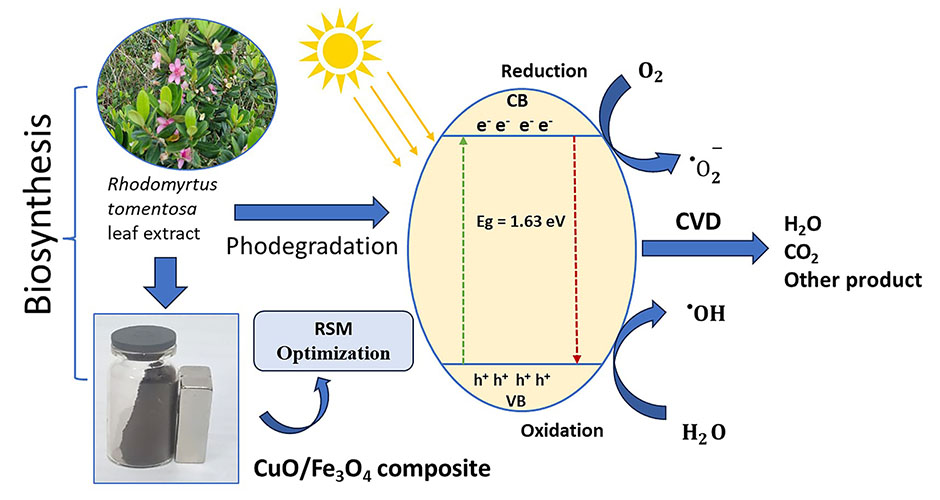
The limitations of CuO photocatalyst include high electron–hole recombination and low charge-transfer efficiency. In this context, doping with Fe3O4 is used to form a heterojunction, which enhances charge separation, increases electron transfer, and imparts magnetic properties for easy separation and reuse of the catalyst. Therefore, this study aimed to synthesize a biphasic CuO/Fe₃O₄ composite using Rhodomyrtus tomentosa leaf extract as a green reducing agent, and evaluate the performance as a photocatalyst for the degradation of Crystal Violet Dye (CVD). Structural, morphological, optical, and magnetic properties were characterized using X-ray diffraction (XRD), scanning electron microscopy with energy-dispersive X-ray spectroscopy (SEM–EDX), UV–Vis diffuse reflectance spectroscopy (DRS), and vibrating sample magnetometer (VSM). XRD patterns confirmed the coexistence of CuO and Fe₃O₄ phases, indicating successful composite formation. VSM analysis reported that the composite had magnetic properties with a saturation magnetization and band gap values of 46.92 emu/g and 1.63 eV, respectively. Process optimization was conducted using Response Surface Methodology (RSM) based on Central Composite Design (CCD). The results showed that the quadratic model was the most appropriate and statistically significant model, indicated by a p-value < 0.05 with a coefficient of determination (R2) of 0.9953. In addition, optimization of the degradation process led to CVD degradation efficiency of 98.73% under optimal conditions of initial concentration of 25.4 mg/L, pH 9.5, and irradiation time of 39.4 min with a visible-light radiation source. The composite also reported good reusability, retaining 92.11% of degradation efficiency after five cycles, confirming the potential as a magnetically recoverable, environmentally sustainable photocatalyst for wastewater treatment applications.

References
[1] Ravi, A., Annamalai, P., Sankar, V., Achutharaman, K. R., Valdes, H., SaravanaVadivu, A., … Alharbi, S. A. (2024). Sustainable synthesis, superior performance: Nanoflower-like α-Bi2O3 from solvent-free solid state for photocatalytic Crystal violet degradation. Journal of the Taiwan Institute of Chemical Engineers, 157, 105413. doi: 10.1016/j.jtice.2024.105413
[2] Khan, S., Zeeshan, M., Jan, F. A., & Ullah, N. (2025). Photocatalytic degradation of Crystal violet and Eosin yellow dyes using ZnS-Co3O4 composite: Synthesis, characterization, and process optimization under UV light. Inorganic Chemistry Communications, 177, 114354. doi: 10.1016/j.inoche.2025.114354
[3] Tian, F., Wang, Y., Guo, G., Ding, K., Yang, F., Wang, H., … Liu, C. (2021). Enhanced azo dye biodegradation at high salinity by a halophilic bacterial consortium. Bioresource Technology, 326, 124749. doi: 10.1016/j.biortech.2021.124749
[4] Alwabsi, H. A. (2026). Cationic cellulose aerogel immobilized with horseradish peroxidase for visible light-assisted degradation and detoxification of Crystal violet dye. Journal of the Taiwan Institute of Chemical Engineers, 181, 106526. doi: 10.1016/j.jtice.2025.106526
[5] Neda, G., Taddesse, A. M., Diaz, I., Mohammed, A. M., Mayoral, Á., & Yassin, J. M. (2025). Nitrogen and phosphorus co-doped ZnO-CdO nanocomposite with boosted photocatalytic degradation of Crystal violet. Scientific Reports, 15(1). doi: 10.1038/s41598-025-01403-6
[6] Rathi, V. H., Jeice, A. R., & Jayakumar, K. (2023). Green synthesis of Ag/CuO and Ag/ TiO2 nanoparticles for enhanced photocatalytic dye degradation, antibacterial, and antifungal properties. Applied Surface Science Advances, 18, 100476. doi: 10.1016/j.apsadv.2023.100476
[7] Raizada, P., Sudhaik, A., Patial, S., Hasija, V., Parwaz Khan, A. A., Singh, P., … Nguyen, V. H. (2020). Engineering nanostructures of CuO-based photocatalysts for water treatment: Current progress and future challenges. Arabian Journal of Chemistry, 13(11), 8424–8457. doi: 10.1016/j.arabjc.2020.06.031
[8] Liu, Q., Sun, J., Han, D., Liu, X., Gao, X., Jiang, Y., & Xie, K. (2020). Highly efficient photocatalytic removal of methylene blue by lamellar structured nanocrystalline and amorphous CuO. Materials Letters, 276, 128217. doi: 10.1016/j.matlet.2020.128217
[9] Gomaa, H., Zhai, Y., Wang, T., An, C., Lee, A., Deng, Q., & Hu, N. (2025). Morphology-performance relationship in hollow-sphere cobalt sulfide photocatalysts for solar-light-driven dye degradation: Integration of RSM, DFT, and machine learning. Journal of Environmental Chemical Engineering, 13(6), 119235. doi: 10.1016/j.jece.2025.119235
[10] Ma, Q., Zhang, H., Zhang, X., Li, B., Guo, R., Cheng, Q., & Cheng, X. (2019). Synthesis of magnetic CuO/MnFe2O4 nanocomposite and its high activity for degradation of Levofloxacin by activation of persulfate. Chemical Engineering Journal, 360, 848–860. doi: 10.1016/j.cej.2018.12.036
[11] Uma, H. B., Kumar, M. S. V., & Ananda, S. (2022). Semiconductor-assisted photodegradation of textile dye, photo-voltaic, and antibacterial property of electrochemically synthesized Sr-doped CuO nano photocatalysts. Journal of Molecular Structure, 1264, 133110. doi: 10.1016/j.molstruc.2022.133110
[12] Raees, A., Jamal, M. A., Ahmed, I., Silanpaa, M., & Algarni, T. S. (2021). Synthesis and characterization of CeO2/CuO nanocomposites for photocatalytic degradation of Methylene blue in visible light. Coatings, 11(3), 11030305. doi: 10.3390/coatings11030305
[13] Mengting, Z., Kurniawan, T. A., Yanping, Y., Dzarfan Othman, M. H., Avtar, R., Fu, D., & Hwang, G. H. (2020). Fabrication, characterization, and application of ternary magnetic recyclable Bi2WO6/BiOI@Fe3O4 composite for photodegradation of Tetracycline in aqueous solutions. Journal of Environmental Management, 270, 126988. doi: 10.1016/j.jenvman.2020.110839
[14] Kumar, P., Deng, Z. Y., Tsai, P. Y., Chiu, C. Y., Lin, C. W., Chaudhary, P., … Chen, K. L. (2024). Enhanced visible-light photocatalytic activity of Fe3O4@MoS2@Au nanocomposites for methylene blue degradation through Plasmon-Induced charge transfer. Separation and Purification Technology, 342, 126988. doi: 10.1016/j.seppur.2024.126988
[15] El-Sherbiny, G. M., Shehata, M. E., & Kalaba, M. H. (2025). Biogenic copper and copper oxide nanoparticles to combat multidrug-resistant Staphylococcus aureus: Green synthesis, mechanisms, resistance, and future perspectives. Biotechnology Reports, 46, e00896. doi: 10.1016/j.btre.2025.e00896
[16] Yizengaw, M. B., Kitaw, S. L., & Bekele, E. T. (2025). Green synthesis of CuO nanoparticles using Rhamnus prinoides leaf extracts, and mechanistic insights into antibacterial efficacy. Journal of Agriculture and Food Research, 24, 102481 doi: 10.1016/j.jafr.2025.102481
[17] Kandasamy, M., Husain, A., Pandian, S. A., Selvaraj, M., Suresh, S., Gunnasegaran, P., … Balaji, D. (2025). Greener and facile synthesis of binary zinc oxide/nickel oxide heterojunction nanocomposite for potential solar energy conversion, environmental remediation, and energy storage applications. Results in Engineering, 25, 103842. doi: 10.1016/j.rineng.2024.103842
[18] Zhao, Z., Wu, L., Xie, J., Feng, Y., Tian, J., He, X., … Zheng, X. (2020). Rhodomyrtus tomentosa (Aiton.): A review of phytochemistry, pharmacology, and industrial applications research progress. Food Chemistry. 309, 125715. doi: 10.1016/j.foodchem.2019.125715
[19] Puspito, S., Purwanto, P., Muhlisin, M., Kurniawati, A., Anggraeny, Y. N., Setiasih, S., … Krishna, N. H. (2024). Phytochemical diversity, rhodomyrtone content, nutrient content, and antioxidant efficacy in keramunting leaves from Belitung Island, Indonesia: A comparative study of different solvent extraction methods. Case Studies in Chemical and Environmental Engineering, 10, 100874. doi: 10.1016/j.cscee.2024.100874
[20] Kuntorini, E. M., Sari, S. G., & Fariani, R. (2023). The morphoanatomy, histochemistry, and phytochemistry of the leaves and fruits of Rhodomyrtus tomentosa. Biodiversitas, 24(1), 98–105. doi: 10.13057/biodiv/d240113
[21] Khoshsang, H., Abbasi, K., & Ghaffarinejad, A. (2023). Biosynthesis of ZnO and CuO nanoparticles using sunflower petal extract. Inorganic Chemistry Communications, 155, 111083. doi: 10.1016/j.inoche.2023.111083
[22] Denada, L., Aprianti, N., Philo, D., & Hariani, P. L. (2025). Eco-friendly synthesis of chitosan-PVA/Ag-CeO2 composite for Crystal violet dye degradation and antibacterial performance. Chimica Techno Acta, 12(4), 9153. doi: 10.15826/chimtech.9153
[23] Fouad, S. S., Nabil, M., Horia, F., Easawi, K., & Negm, S. (2024). Synthesis of CuO/Fe3O4 Nanocomposite for enhanced solar thermal desalination. Ceramics International, 50(24), 54707–54715. doi: 10.1016/j.ceramint.2024.10.329
[24] Atri, A., Echabaane, M., Bouzidi, A., Harabi, I., Soucase, B. M., & Ben Chaâbane, R. (2023). Green synthesis of copper oxide nanoparticles using Ephedra Alata plant extract and a study of their antifungal, antibacterial activity and photocatalytic performance under sunlight. Heliyon, 9(2), 13484. doi: 10.1016/j.heliyon.2023.e13484
[25] Naika, H. R., Lingaraju, K., Manjunath, K., Kumar, D., Nagaraju, G., Suresh, D., & Nagabhushana, H. (2015). Green synthesis of CuO nanoparticles using Gloriosa superba L. extract and their antibacterial activity. Journal of Taibah University for Science, 9(1), 7–12. doi: 10.1016/j.jtusci.2014.04.006
[26] Abrar, M. M., Kabir, A., & Nishat, S. S. (2022). A DFT+U study on the structural, electronic, magnetic, and optical properties of Fe and Co co-doped CuO. Materials Today Communications, 32. doi: 10.1016/j.mtcomm.2022.103923
[27] Yew, Y. P., Shameli, K., Miyake, M., Ahmad Khairudin, N. B. B., Mohamad, S. E. B., Naiki, T., & Lee, K. X. (2020). Green biosynthesis of superparamagnetic magnetite Fe3O4 nanoparticles and biomedical applications in targeted anticancer drug delivery system: A review. Arabian Journal of Chemistry. 12(4), 1–13. doi: 10.1016/j.arabjc.2018.04.013
[28] Mohanty, L., Sundar Pattanayak, D., Singhal, R., Pradhan, D., & Kumar Dash, S. (2022). Enhanced photocatalytic degradation of rhodamine B and malachite green employing BiFeO3/g-C3N4 nanocomposites: An efficient visible-light photocatalyst. Inorganic Chemistry Communications, 138, 109286. doi: 10.1016/j.inoche.2022.109286
[29] Raina, I., Kumar, P., Kumar, A., Singh, K., Somvanshi, A., Sawini, … Kumar, D. (2025). Visible-light-activated La-doped ZnO photocatalysts for enhanced degradation of Crystal violet dye. Ceramics International. 51, 54185–54199. doi: 10.1016/j.ceramint.2025.09.158
[30] Riyanti, F., Hariani, P. L., Hasanudin, H., Rachmat, A., & Purwaningrum, W. (2024). Optimization Photodegradation of Methylene Blue Dye using Bentonite/PDA/Fe3O4@CuO Composite by Response Surface Methodology. Bulletin of Chemical Reaction Engineering and Catalysis, 19(2), 252–264. doi: 10.9767/bcrec.20132
[31] Saravan, R. S., Muthukumaran, M., Mubashera, S. M., Abinaya, M., Prasath, P. V., Parthiban, R., … Sagadevan, S. (2020). Evaluation of the photocatalytic efficiency of cobalt oxide nanoparticles towards the degradation of Crystal violet and Methylene violet dyes. Optik, 207, 164428. doi: 10.1016/j.ijleo.2020.164428
[32] Pandey, B., Tewatia, H., Meel, D., & Singh, P. (2023). Phyto-fabrication of zinc oxide nanoparticles using Ficus religiosa and its potential application in the degradation of crystal violet dye. Applied Chemical Engineering, 6(3), 1–11. doi: 10.24294/ace.v6i3.2024
[33] Pakzad, K., Alinezhad, H., & Nasrollahzadeh, M. (2019). Green synthesis of Ni@Fe3O4 and CuO nanoparticles using Euphorbia maculata extract as photocatalysts for the degradation of organic pollutants under UV-irradiation. Ceramics International, 45(14), 17173–17182. doi: 10.1016/j.ceramint.2019.05.272
[34] Niaz, R., Sabir, M., Abid, M. Z., Mahar, J., Younas, U., Khan, M. A., … Hussain, E. (2025). Insight into the synthesis and proceeding of Ni-Al@Si‒TiO2 catalyst: A state-of-the-art approach for crystal violet dye degradation. Surfaces and Interfaces, 74, 107658. doi: 10.1016/j.surfin.2025.107658
[35] Kaur, K., Yamini, S., J V, R., G, L., Kumar, P., Rao K C, V., & Senapati, S. (2025). Green synthesis of saponin-capped copper (II) oxide (CuO) nanoparticles and their efficacy in photocatalytic dye degradation. Sustainable Chemistry One World, 6, 100054. doi: 10.1016/j.scowo.2025.100054
[36] Eddy, N. O., Jibrin, J. I., Ukpe, R. A., Odiongenyi, A., Iqbal, A., Kasiemobi, A. M., … Runde, M. (2024). Experimental and theoretical investigations of photolytic and photocatalysed degradations of crystal violet dye (CVD) in water by oyster shells-derived CaO nanoparticles (CaONP). Journal of Hazardous Materials Advances, 13, 100413. doi: 10.1016/j.hazadv.2024.100413
[37] Boucherdoud, A., Kherroub, D. E., Dahmani, K., Douinat, O., Seghier, A., Bestani, B., & Benderdouche, N. (2024). Polyaniline/cupric oxide organometallic nanocomposites as a sonocatalyst for the degradation of Methylene blue: Experimental study, RSM optimization, and DFT analysis. Journal of Organometallic Chemistry, 1022, 123386. doi: 10.1016/j.jorganchem.2024.123386
[38] Lee, Y. S., Lee, K. M., & Ong, B. H. (2025). Magnetic recoverable cobalt ferrite nanophotocatalyst for Crystal violet dye degradation. Ceramics International, 51, 39630–39638. doi: 10.1016/j.ceramint.2025.06.198
Downloads
Published
How to Cite
Issue
Section
License
Copyright (c) 2026 Ady Mara, Fahma Riyanti, Desnelli, Poedji Loekitowati Hariani

This work is licensed under a Creative Commons Attribution 4.0 International License.
- Previous License: Creative Commons Attribution-NonCommercial-ShareAlike (CC BY-NC-SA)
- New License: Creative Commons Attribution (CC BY 4.0)
Previous copyright: With the receipt of the article by CHEESA Editorial Board and the decision to be published, the copyright regarding the article will be transferred to CHEESA Journal. CHEESA has the right to multiply and distribute the article and every author is not allowed to publish the same article that was published in this journal.
New Copyright: Authors who publish with this journal agree to the following terms:
Authors retain copyright and grant the journal right of first publication with the work simultaneously licensed under a Creative Commons Attribution License (CC BY 4.0) that allows others to share the work with an acknowledgement of the work's authorship and initial publication in this journal.


