Hybrid Paper Membrane Based on Abaca (Musa textilis) Fibers and Rice Husk Ash Silica Using Citric Acid as a Cross-Linking Agent for the Removal of Dyes and Heavy Metals
DOI:
https://doi.org/10.25273/cheesa.v9i1.24288.41-52Keywords:
citric acid, cross-linking, hybrid membrane, rice husk ash silica, wastewater separationAbstract
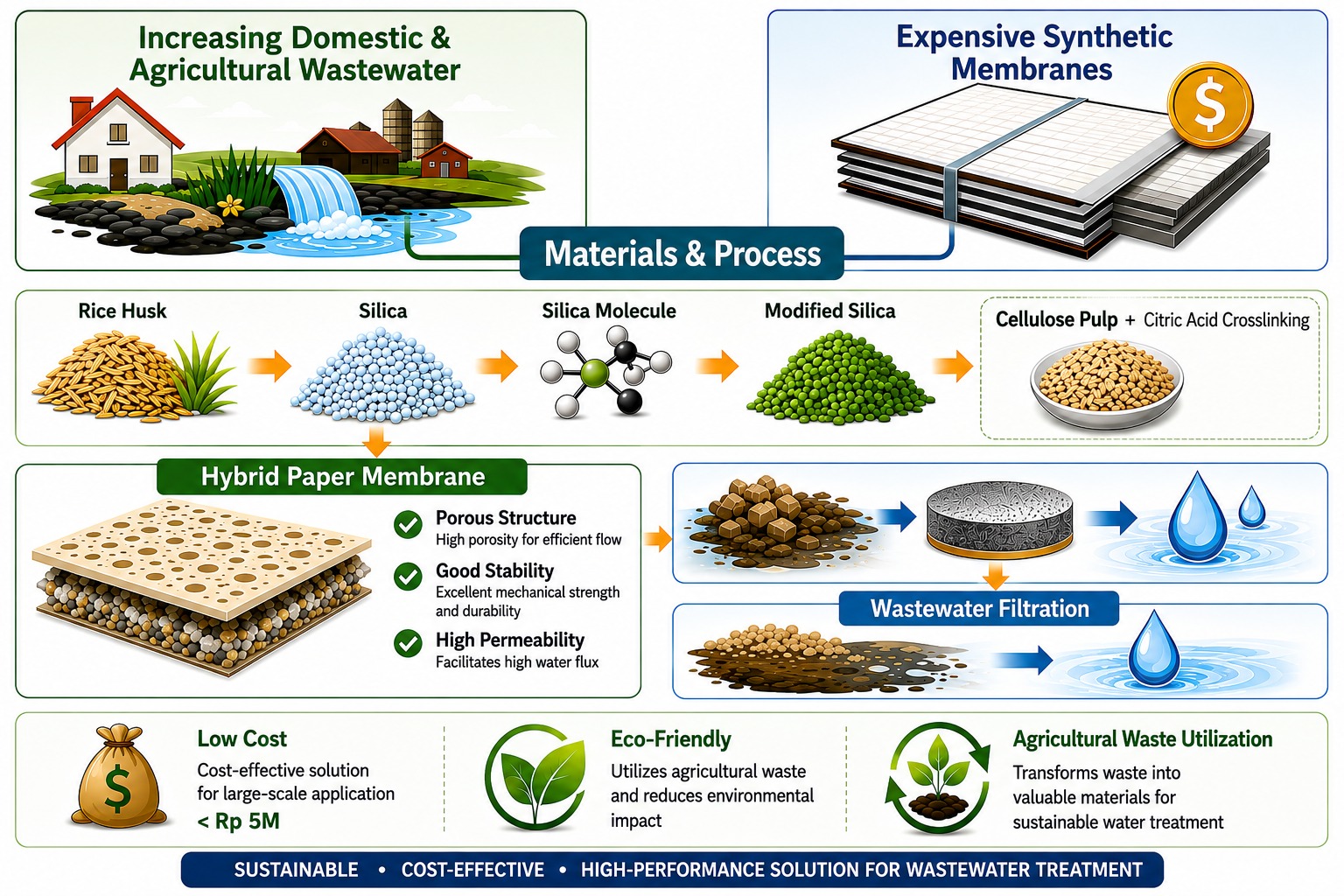
The pollution from wastewater containing synthetic dyes and heavy metals is a serious environmental issue in Indonesia. The situation is associated with the lack of locally sourced membranes to simultaneously integrate physical filtration and chemical adsorption mechanisms (filtro-adsorption). Therefore, this research aims to develop a hybrid paper membrane based on abaca (Musa textilis) fiber pulp and rice husk ash silica using citric acid as a cross-linking agent for the removal of methylene blue (MB) dye and heavy metal ions (Cu²⁺ and Pb²⁺) from synthetic wastewater. The methodology required silica extraction from rice husk ash through an alkaline method and modification of the product with 3-aminopropyltriethoxysilane (APTES)s. There was also membrane fabrication with different variations of silica (0–20% of dry fiber weight) and citric acid (0–15%) contents, as well as characterization through X-ray Diffraction (XRD), Fourier Transform Infrared Spectroscopy (FTIR), and Scanning Electron Microscopy with Energy Dispersive X-ray Spectroscopy (SEM-EDS). The results showed that the optimal membrane with 15% silica and 10% citric acid achieved a water flux of 285 L/m²·h·bar and removal efficiencies of >95% for MB (C₀ = 50 mg/L), 78.5 ± 3.2% for Cu²⁺, and 82.3 ± 2.8% for Pb²⁺ (C₀ = 10 mg/L). The two-way analysis of variance (ANOVA) also confirmed that the variations in silica and citric acid content significantly affected the separation performance (p < 0.05). The results showed that the hybrid membrane derived from abundant local agricultural waste had potential as an environmentally friendly wastewater treatment technology.

References
[1] Astuti, W., & Susilowati, N. (2014). Sintesis adsorben berbasis Lignoselulosa dari kayu randu (Ceiba pentandral.) Untuk menjerap Pb (II) dalam Limbah cair artifisial. Jurnal Bahan Alam Terbarukan, 3(2), 50-54.
[2] Stamina, N., Hashim, N. A., Ong, L. De, Rabuni, M. F., & Abdul Manaf, N. (2024). Unlocking the potentialities of biomass-based cellulose acetate membrane from waste rice husk for water treatment. Chemical Papers, 78(10), 5793-5804.
[3] Quellmalz, A., & Mihranyan, A. (2015). Citric acid cross-linked nanocellulose-based paper for size-exclusion nanofiltration. ACS Biomaterials Science & Engineering, 1(4), 271-276.
[4] Chik, N. S. I., & Shaari, N. Z. K. (2023). Integral Membrane Properties of Polysulfone/Chitosan/Polyvinyl Alcohol Blend Incorporated with Rice Husk Ash Silica Gel. Indonesian Journal of Chemistry, 23(3).
[5] Environesia Global Saraya. (2025, juliol 9). Limbah Industri dan Ancaman Pencemaran Air di Indonesia. Environesia.
[6] Kurniawan, I., Rahman, D. Y., Hanafi, F., Rahman, M. I., Suryana, A. T., Lestari, A., … Huda, A. (2026). High stability and performance of organic pollutant removal using PVDF-TiO. Journal of Ecological Engineering, 27(5), 430-443.
[7] Liu, H., Pan, Y., Jin, S., Sun, X., Jiang, Y., Wang, Y., … Cui, Q. (2021). Associations between six common per-and polyfluoroalkyl substances and estrogens in neonates of China. Journal of Hazardous Materials, 407, 124378.
[8] Sapei, L., Padmawijaya, K. S., Sutejo, A., & Theresia, L. (2015). Karakterisasi silika sekam padi dengan variasi temperatur leaching menggunakan asam asetat. Jurnal Teknik Kimia, 9(2), 38-43.
[9] Gastaldon, F., Junca, E., Grillo, F. F., Sobieranski, A. C., Gomes, S. Q., Rafique, J., … Frizon, T. E. A. (2025). CELLULOSIC MEMBRANES SUPPORTED WITH SILICA FROM RICE HUSK AND RICE HUSK ASH FOR SLOW RELEASE. Química Nova, 48(4), e-20250095.
[10] Mohd Zainuddin, N. A. F., Kassim Shaari, N. Z., Chik, N. S. I., & Hamzah, F. (2023). Evaluation of crosslinking degree on the integral membrane by using Rice Husk Ash (RHA). Journal of Mechanical Engineering (JMechE), 20(2), 57-71.
[11] Malafatti, J. O. D., Tavares, F. A., Neves, T. R., Mascarenhas, B. C., Quaranta, S., & Paris, E. C. (2023). Modified silica nanoparticles from rice husk supported on polylactic acid as adsorptive membranes for dye removal. Materials, 16(6), 2429.
[12] Hubadillah, S. K., Othman, M. H. D., Tai, Z. S., Jamalludin, M. R., Yusuf, N. K., Ahmad, A., … Harun, Z. (2020). Novel hydroxyapatite-based bio-ceramic hollow fiber membrane derived from waste cow bone for textile wastewater treatment. Chemical Engineering Journal, 379, 122396.
[13] Natarajan, E., Markandan, K., Hassan, C. S. B., & Koppad, P. G. (2017). Sustainable Structural Materials.
[14] Bindir, H. S., Ahmed, R. A., Bello, A., Sanni, S. E., Ngene, P., Fashedemi, O. O., … Onwualu, A. P. (2025). Experimental determination of the mechanical and hydrolytic properties of chitosan/rice husk ash composite membranes. International Journal of Biological Macromolecules, 286, 138390.
[15] Mautner, A., & Bismarck, A. (2021). Bacterial nanocellulose papers with high porosity for optimized permeance and rejection of nm-sized pollutants. Carbohydrate polymers, 251, 117130.
[16] Hawthorne, F. C., & Gagné, O. C. (2024). New ion radii for oxides and oxysalts, fluorides, chlorides and nitrides. Structural Science, 80(4), 326-339.
[17] Abánades Lázaro, I., Chen, X., Ding, M., Eskandari, A., Fairen-Jimenez, D., Giménez-Marqués, M., … Forgan, R. S. (2024). Metal–organic frameworks for biological applications. Nature Reviews Methods Primers, 4(1), 42.
[18] Raja, P. M., Rangkuti, I. U. P., Hendra Ginting, M., Giyanto, & Siregar, W. F. (2021). Preparation and characterization of cellulose microcrystalline made from palm oil midrib. En IOP Conference Series: Earth and Environmental Science (Vol. 819, p. 012002). IOP Publishing.
[19] Phanthong, P., Reubroycharoen, P., Hao, X., Xu, G., Abudula, A., & Guan, G. (2018). Nanocellulose: Extraction and application. Carbon Resources Conversion, 1(1), 32-43.
[20] Qi, F., Qi, B., Cui, Z., Chen, X., Wan, Y., & Luo, J. (2025). Cellulose-based separation membranes: A sustainable evolution or fleeting trend? Advanced Membranes, 5, 100153. doi: https://doi.org/10.1016/j.advmem.2025.100153
[21] Huong, T. T., & Trang, T. Y. D. (2023). Removal of lead ions from aqueous media using rice husk modified with manganese oxide. Environ. Ecol. Res, 11(2), 340-361.
[22] Tran, N.-A., Hien, N. T., Hoang, N. M., Dang, H.-L. T., Huy, D. Q., Van Quy, T., … Dao, V.-D. (2023). Carbon dots in environmental treatment and protection applications. Desalination, 548, 116285.
Downloads
Published
How to Cite
Issue
Section
License
Copyright (c) 2026 Ian Kurniawan, Adri Huda, Reisya Ichwani, Dina Nasution, Nasrul Rofiah Hidayati, Noor Haida Mohd Kaus

This work is licensed under a Creative Commons Attribution 4.0 International License.
- Previous License: Creative Commons Attribution-NonCommercial-ShareAlike (CC BY-NC-SA)
- New License: Creative Commons Attribution (CC BY 4.0)
Previous copyright: With the receipt of the article by CHEESA Editorial Board and the decision to be published, the copyright regarding the article will be transferred to CHEESA Journal. CHEESA has the right to multiply and distribute the article and every author is not allowed to publish the same article that was published in this journal.
New Copyright: Authors who publish with this journal agree to the following terms:
Authors retain copyright and grant the journal right of first publication with the work simultaneously licensed under a Creative Commons Attribution License (CC BY 4.0) that allows others to share the work with an acknowledgement of the work's authorship and initial publication in this journal.


