Thermoplastic Elastomers of Polystyrene-Based Reinforced with Natural Rubber and Carbon Filler from Oil Palm Empty Fruit Bunches
DOI:
https://doi.org/10.25273/cheesa.v9i1.23348.15-25Keywords:
filler, natural rubber, oil palm empty fruit bunches, polystyrene, thermoplastic elastomerAbstract
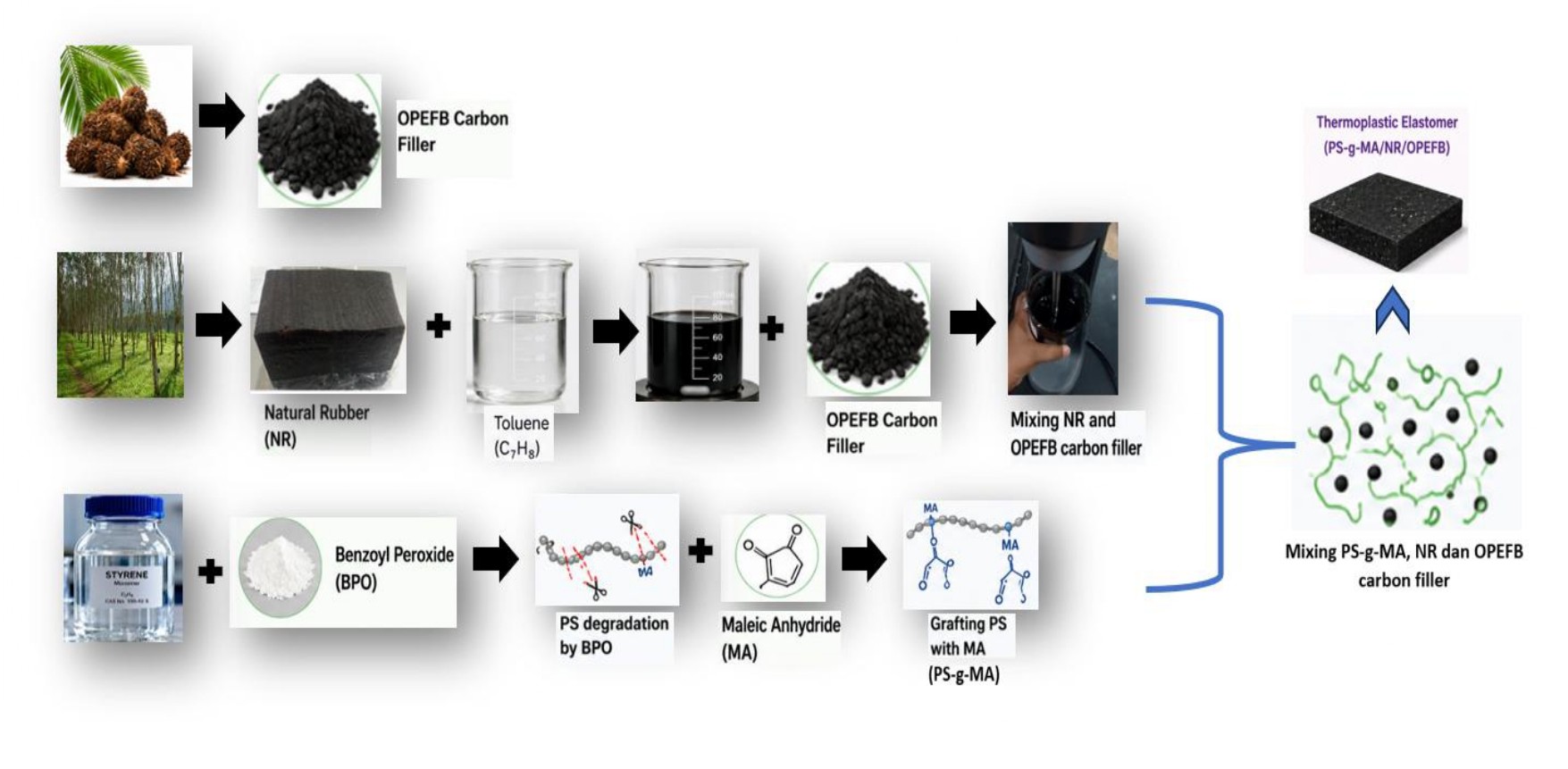
Polystyrene (PS) has limited resistance to extreme temperatures, often becoming soft, brittle, and losing its elasticity. To address these limitations, the material was modified by adding Natural Rubber (NR) and oil palm empty fruit bunch (OPEFB) carbon filler. Therefore, this research aimed to modify the surface of PS by adding NR and OPEFB carbon filler, followed by analysis of the resulting morphology, thermal stability, and enthalpy change (ΔH) of the composites. The polystyrene grafting with maleic anhydride (PS-g-MA) was carried out at 75 °C for 10 minutes. The composition variations of PS-g-MA/NR/OPEFB carbon filler were (30:65:5) wt%, (30:60:10) wt%, (30:55:15) wt%, (30:50:20) wt%, and (30:45:25) wt%. The highest thermal stability (T5%) was achieved with 10% filler at 363°C. However, morphological analysis showed that increasing the filler content to 20% provides an optimal point in balancing interfacial interaction (maximum adhesion) and phase dispersion, with a ΔH value of -27.86 J/g.

References
[1] Tajeddin, B., & Arabkhedri, M. (2020). Polymers and food packaging. Polymer Science and Innovative Applications: Materials, Techniques, and Future Developments. INC. doi: 10.1016/B978-0-12-816808-0.00016-0
[2] Hatami Dehnou, K., & Hadianfard, M. J. (2024). Enhancing Thermal, Viscoelastic, and Mechanical Properties of Silicone Rubber Matrix through Reinforcements for Use as a Medical Implant. Recent Progress in Materials, 06(02), 1–30. doi: 10.21926/rpm.2402011
[3] Petrény, R., Tóth, C., Horváth, A., & Mészáros, L. (2022). Development of electrically conductive hybrid composites with a poly(lactic acid) matrix, with enhanced toughness for injection molding, and material extrusion-based additive manufacturing. Heliyon, 8(8). doi: 10.1016/j.heliyon.2022.e10287
[4] Akmar Rejab, N., Olabode Akindoyo, J., & Jaafar, M. (2022). Flexural properties of recycled polystyrene composite laminates reinforced with MWCNT filled kenaf fiber. Materials Today: Proceedings, 66, 2900–2903. doi: https://doi.org/10.1016/j.matpr.2022.06.554
[5] Li, H., Wang, G., Wu, Y., Jiang, N., & Niu, K. (2024). Functionalization of Carbon Nanotubes in Polystyrene and Properties of Their Composites: A Review. Polymers, 16(6). doi: 10.3390/polym16060770
[6] Tutek, K., Kosmalska-olańska, A., Masek, A., Tutek, K., Kosmalska-olańska, A., & Masek, A. (2025). Thermoplastic Elastomer ( TPE ) Composites with Modified Fibers and Hemp Shives – an Ecological Approach to Modern Polymer Materials Thermoplastic Elastomer ( TPE ) Composites with Modified Fibers and Hemp Shives – an Ecological Approach to Modern Polymer M. Journal of Natural Fibers, 22(1). doi: 10.1080/15440478.2025.2473466
[7] Nuriskasari, I., Syahrial, A. Z., Ivandini, T. A., Sumboja, A., Priyono, B., Yan, Q., … Priyono, S. (2024). Synthesis of graphitic carbon from empty palm oil fruit bunches through single-step graphitization process using K2FeO4-KOH catalyst as lithium ion battery anode. Results in Engineering, 24(October), 103273. doi: 10.1016/j.rineng.2024.103273
[8] Sakamoto, T., Ahmad Zaini, M. A., Amano, Y., & Machida, M. (2021). Preparation and characterization of activated carbons produced from oil palm empty fruit bunches. Carbon, 175, 611. doi: https://doi.org/10.1016/j.carbon.2021.01.072
[9] Tayouri, M. I., Estaji, S., Mousavi, S. R., Yazdanbakhsh, A., Nouranian, S., Ruckdäschel, H., & Khonakdar, H. A. (2023). Polystyrene/Polyolefin Elastomer Blends Loaded with Halloysite Nanotubes: Morphological, Mechanical, and Gas Barrier Properties. Macromolecular Materials and Engineering, 308(9), 1–17. doi: 10.1002/mame.202300080
[10] Karunanayake, L., Etampawala, T., de Silva, D. J., Bandara, J., Rajapaksha, A. U., & Vithanage, M. (2025). Role and potential of biochar as a sustainable alternative reinforcing filler to carbon black in rubber composites. Biochar, 7(1). doi: 10.1007/s42773-025-00429-3
[11] Goodarzi, M., Pircheraghi, G., Khonakdar, H. A., & Altstadt, V. (2022). Flexible high dielectric polystyrene/ethylene-α-octene copolymer/graphene nanocomposites: Tuning the morphology and dielectric properties by graphene’s surface polarity. Polymers for Advanced Technologies, 33(3), 937–951. doi: https://doi.org/10.1002/pat.5569
[12] Entezam, M., Poormadadkar, H., Khonakdar, H. A., & Jafari, S. H. (2020). Melt rheology and interfacial properties of binary and ternary blends of PS, EOC, and SEBS. Journal of Applied Polymer Science, 137(23), 48791. doi: https://doi.org/10.1002/app.48791
[13] Kiani, F., Entezam, M., Khonakdar, H. A., Jafari, S. H., Callsen, C., & Altstädt, V. (2020). Assessment of compatibilization role of nanoclay in immiscible polystyrene/ethylene–octene copolymer blends via wide-angle X-ray scattering, microstructure, rheological analyses, and mechanical properties. Journal of Applied Polymer Science, 137(22), 48748. doi: https://doi.org/10.1002/app.48748
[14] Sharma, T., & Garg, M. (2023). Effect of ZnO nanoparticles and temperature on dielectric constant/loss properties of polystyrene nanocomposite films. The European Physical Journal Plus, 138(7), 611. doi: 10.1140/epjp/s13360-023-04250-4
[15] Zhang, Z., Cao, H., Quan, Y., Ma, R., Pentzer, E. B., Green, M. J., & Wang, Q. (2022). Thermal Stability and Flammability Studies of MXene–Organic Hybrid Polystyrene Nanocomposites. Polymers, 14(6), 1–10. doi: 10.3390/polym14061213
[16] Liu, X., Qin, Y., Zhao, S., & Dong, J.-Y. (2021). Nanocomposites-Turned-Nanoalloys Polypropylene/Multiwalled Carbon Nanotubes-graft-Polystyrene: Synthesis and Polymer Nanoreinforcement. Industrial & Engineering Chemistry Research, 60(28), 10167–10179. doi: 10.1021/acs.iecr.1c01362
[17] Hidayani, T. R., Wirjosentono, B., Nasution, D. Y., & Tamrin. (2023). Preparation and Characterization of Sound-Absorbent Based on Polystyrene Reinforced Primary Sludge and Fly Ash from Pulp Mill. International Journal of Technology, 14(3), 649–658. doi: 10.14716/ijtech.v14i3.5131
[18] Atmakuri, A., Palevicius, A., Vilkauskas, A., & Janusas, G. (2022). Numerical and Experimental Analysis of Mechanical Properties of Natural-Fiber-Reinforced Hybrid Polymer Composites and the Effect on Matrix Material. Polymers, 14(13). doi: 10.3390/polym14132612
[19] Mechanics, A., Nanda, S., Andrianto, K., Maulana, J., Eden, O., Riyanto, S., … Fahrozy, M. (2026). Jurnal Mekanik Terapan Analisis Sifat Mekanik dan Penyerapan Air Komposit Polyester Berbasis Serat Alami, 06(03), 172–180. doi: 10.32722/jmt.v6i3.7978
[20] Peña‐Alcántara, A., Nikzad, S., Michalek, L., Prine, N., Wang, Y., Gong, H., … Bao, Z. (2023). Effect of Molecular Weight on the Morphology of a Polymer Semiconductor–Thermoplastic Elastomer Blend. Advanced Electronic Materials, 9(9). doi: 10.1002/aelm.202201055
[21] Tian, A., Zhang, J., & Wang, Y. (2025). Miscibility, Thermal, and Mechanical Properties of Recycled Waste Tire Rubber-Modified Polystyrene Sustainable Composites. BioResources . doi: 10.15376/biores.20.1.1273-1285
[22] Hashim, F., Surya, I., Rusli, A., & Ismail, H. (2022). Microstructure-properties of dynamically vulcanized mengkuang leaf fibre/ethylene vinyl acetate/natural rubber thermoplastic elastomer composites. BioResources, 17(4), 6036–6055. doi: 10.15376/biores.17.4.6036-6055
[23] Ma, Y., Yang, K., Zhang, Y., Wang, J., Zeng, S., & Huang, X. (2024). Mechanical properties and thermal stability of high-temperature (cooking temperature)-resistant PP/HDPE/POE composites. E-Polymers, 24(1). doi: 10.1515/epoly-2023-0164
[24] Seier, M., Stanic, S., Koch, T., & Archodoulaki, V. M. (2020). Effect of different compatibilization systems on the rheological, mechanical and morphological properties of polypropylene/polystyrene blends. Polymers, 12(10), 1–20. doi: 10.3390/polym12102335
[25] Fitriana, I., Ratnasari, D., Ismoyojati, R., & Febriansyah, I. (2024). Journal of Sustainable Agriculture and Biosystems Engineering Chemical Characteristics of Palm Frond and Empty Fruit Bunch Biochar in Pyrolysis Method, 02(01), 28–33.
[26] Marhani, Sahur, A., Laban, S., & Musa, Y. (2022). Characterization of Biochar Empty Fruit Bunches OPEFB at Various Temperatures and Burning Time. Journal of Experimental Biology and Agricultural Sciences, 10(3), 599–606. doi: 10.18006/2022.10(3).599.606
[27] Bolanakis, N., Maravelakis, E., Papadakis, V., Kalderis, D., Michailidis, N., Argyros, A., … Vidakis, N. (2025). Valorization of Biochar as a Reinforcement Agent in Polyethylene Terephthalate Glycol for Additive Manufacturing: A Comprehensive Content Optimization Course. Journal of Manufacturing and Materials Processing, 9(2). doi: 10.3390/jmmp9020068
[28] Paula, R., Carvalho, J., Júnior, A., Fagundes, F., de Lima, R., Lima, E., … Machado, A. (2025). Analysis of Biochar–Cement Composites by SEM/EDS: Interfacial Interactions and Effects on Mechanical Strength. C-Journal of Carbon Research, 11(3), 1–14. doi: 10.3390/c11030045
[29] Mahardika, M., Zakiyah, A., Ulfa, S. M., Ilyas, R. A., Hassan, M. Z., Amelia, D., … Norrrahim, M. N. F. (n.d.). No TitleRecent Developments in Oil Palm Empty Fruit Bunch (OPEFB) Fiber Composite. Journal of Natural Fibers. doi: https://doi.org/10.1080/15440478.2024.2309915
[30] Md Noh, N. H., & Wusko, I. (2020). Characterization and Analysis of Oil Palm Empty Fruit Bunch (OPEFB) Waste of PT Kharisma Alam Persada South Borneo. Majalah Obat Tradisional, 25. doi: 10.22146/mot.52715
[31] Haile, L. (2021). Study of Recycling of Waste High Impact Polystyrene (PS-HI) and Polystyrene with Flame Retardant Additives (PS-FR) Co-Polymers. Journal of Textile Science & Fashion Technology, 7(4), 1–11. doi: 10.33552/jtsft.2021.07.000666
[32] Phoncharoen, V., & Pianthong, K. (2025). Investigation on Yield of Natural Rubber to Bio-Crude Oil from Hydrothermal Liquefaction Process. Journal of Research and Applications in Mechanical Engineering, 13(1), 1–10. doi: 10.14456/jrame.2025.5
[33] Setiorini, I. A. (2020). K Karakteristik Termoplastik Elastomer Dari Karet Alam Dan Polipropilena Dengan Penambahan Carbon Black Filler. Jurnal Teknik Patra Akademika, 10(02), 41–44. doi: 10.52506/jtpa.v10i02.93
[34] Saleh, T. A. (2022). Chapter 8 - Properties of nanoadsorbents and adsorption mechanisms. In T. A. Saleh (Ed.), Surface Science of Adsorbents and Nanoadsorbents (Vol. 34, pp. 233–263). Elsevier. doi: https://doi.org/10.1016/B978-0-12-849876-7.00010-5
[35] Oktaviani, Z., Wahyuni, D., & Nurhanisa, M. (2024). Sintesis Karbon Aktif dari Tandan Kosong Kelapa Sawit dengan Aktivator Gelombang Mikro dan Pengujian Kualitas Berdasarkan SNI 06-3730-1995. Newton-Maxwell Journal of Physics, 5(1). doi: 10.33369/nmj.v5i1.33499
[36] Tanasă, F., Zănoagă, M., Teacă, C.-A., Nechifor, M., & Shahzad, A. (2020). Modified hemp fibers intended for fiber-reinforced polymer composites used in structural applications—A review. I. Methods of modification. Polymer Composites, 41(1), 5–31. doi: https://doi.org/10.1002/pc.25354
[37] Das, C., Tamrakar, S., Kiziltas, A., & Xie, X. (2021). Incorporation of biochar to improve mechanical, thermal and electrical properties of polymer composites. Polymers, 13(16), 1–32. doi: 10.3390/polym13162663
[38] Fan, Y., Fowler, G. D., & Zhao, M. (2020). The past, present and future of carbon black as a rubber reinforcing filler – A review. Journal of Cleaner Production, 247, 119115. doi: https://doi.org/10.1016/j.jclepro.2019.119115
[39] Okoye, C. O., Jones, I., Zhu, M., Zhang, Z., & Zhang, D. (2021). Manufacturing of carbon black from spent tyre pyrolysis oil – A literature review. Journal of Cleaner Production, 279, 123336. doi: https://doi.org/10.1016/j.jclepro.2020.123336
[40] Chang, B. P., Gupta, A., Muthuraj, R., & Mekonnen, T. H. (2021). Bioresourced fillers for rubber composite sustainability: current development and future opportunities. Green Chem., 23(15), 5337–5378. doi: 10.1039/D1GC01115D
[41] Kalogeras, I. M. (2016). Glass-Transition Phenomena in Polymer Blends. Encyclopedia of Polymer Blends: Volume 3: Structure (Vol. 3). doi: 10.1002/9783527653966.ch1
[42] Ucpinar, B., Sivrikaya, T., & Aytac, A. (2025). Sustainable hemp fiber reinforced polylactic acid/poly(butylene succinate) biocomposites: Assessing the effectiveness of MAH-g-PLA as a compatibilizer. Polymer Composites, 46(10), 9438–9453. doi: 10.1002/pc.29569
[43] Guo, Y., Ruan, K., Shi, X., Yang, X., & Gu, J. (2020). Factors affecting thermal conductivities of the polymers and polymer composites: A review. Composites Science and Technology, 193, 108134. doi: https://doi.org/10.1016/j.compscitech.2020.108134
[44] Ruan, K., Shi, X., Guo, Y., & Gu, J. (2020). Interfacial thermal resistance in thermally conductive polymer composites: A review. Composites Communications, 22, 100518. doi: https://doi.org/10.1016/j.coco.2020.100518
Downloads
Published
How to Cite
Issue
Section
License
Copyright (c) 2026 Indah Agus Setiorini, Achmad Faisal Faputri, Rahma Nuryanti, Amiliza Miarti, Muhammad Rasyad Hilmi, Hasrinah Hasbullah

This work is licensed under a Creative Commons Attribution 4.0 International License.
- Previous License: Creative Commons Attribution-NonCommercial-ShareAlike (CC BY-NC-SA)
- New License: Creative Commons Attribution (CC BY 4.0)
Previous copyright: With the receipt of the article by CHEESA Editorial Board and the decision to be published, the copyright regarding the article will be transferred to CHEESA Journal. CHEESA has the right to multiply and distribute the article and every author is not allowed to publish the same article that was published in this journal.
New Copyright: Authors who publish with this journal agree to the following terms:
Authors retain copyright and grant the journal right of first publication with the work simultaneously licensed under a Creative Commons Attribution License (CC BY 4.0) that allows others to share the work with an acknowledgement of the work's authorship and initial publication in this journal.


