Extraction of Gold Through Leaching Using NaOCN Leaching Reagent from the Tailings Leach Process of Refractory Gold Ore
DOI:
https://doi.org/10.25273/cheesa.v9i1.22851.77-82Keywords:
Extraction, gold-refractories, leaching reagent, re-processing, tailingAbstract
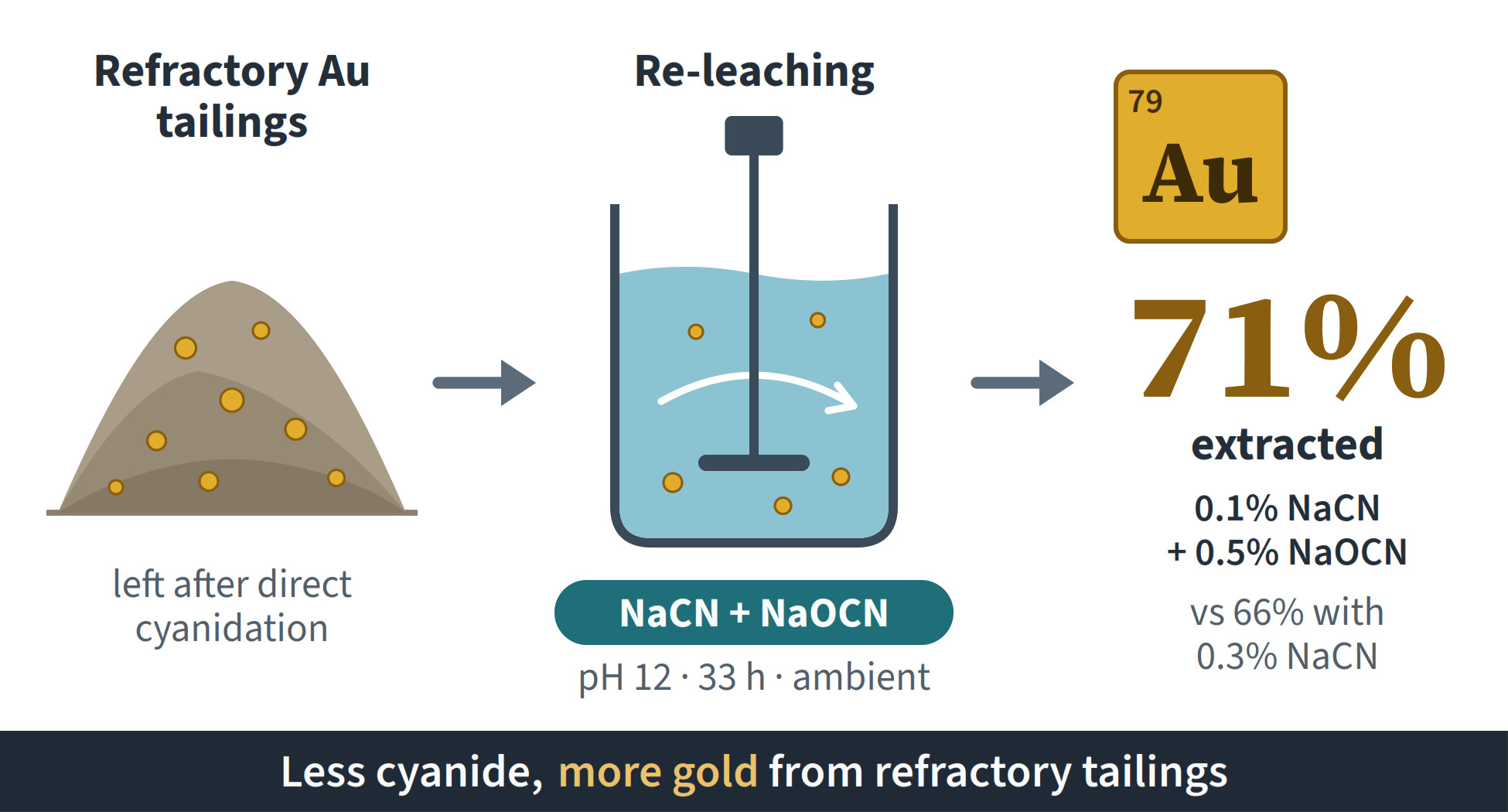
Gold is increasingly extracted from low-grade and complex ores, commonly referred to as refractory gold ores, as high-grade reserves become progressively depleted. These ores are difficult to process through conventional methods, as direct cyanidation consumes a substantial amount of cyanide but typically achieves gold extraction rates of only 50–80%. The limitation is especially significant for small- and medium-scale mining operations that are not aware of developments in refractory gold ore processing. Several mines in Indonesia continue to apply direct cyanidation, leaving substantial quantities of gold in the resulting tailings. Re-leaching these tailings offers an opportunity to recover residual gold and reduce the need for new mining. Therefore, this study aimed to re-leach the tailings from a direct cyanidation process of refractory gold ore using NaCN for 33 hours at ambient temperature and pH 12. The extraction efficiency was compared with alternative reagents based on NaOCN and a mixture of NaOCN + NaCN. To evaluate the efficiency of gold extraction through leaching, analyses were performed using Atomic Absorption Spectrophotometry (AAS). The results showed that the best experiments extracted up to 71% gold using 0.1% NaCN + 0.5% NaOCN reagent. This mixture can be used as a reference in the search and development of other leaching reagents that are cheaper and environmentally friendly.

References
[1] Peluso, N. L. (2018). Entangled Territories in Small-Scale Gold Mining Frontiers: Labor Practices, Property, and Secrets in Indonesian Gold Country. World Development, 101, 400–416. doi: 10.1016/j.worlddev.2016.11.003
[2] Spiegel, S. J., Agrawal, S., Mikha, D., Vitamerry, K., Le Billon, P., Veiga, M., … Paul, B. (2018). Phasing Out Mercury? Ecological Economics and Indonesia’s Small-Scale Gold Mining Sector. Ecological Economics, 144, 1–11. doi: 10.1016/j.ecolecon.2017.07.025
[3] Meutia, A. A., Lumowa, R., & Sakakibara, M. (2022, April 1). Indonesian Artisanal and Small-Scale Gold Mining—A Narrative Literature Review. International Journal of Environmental Research and Public Health. MDPI. doi: 10.3390/ijerph19073955
[4] Asamoah, R. K. (2021). Specific Refractory Gold Flotation and Bio-Oxidation Products: Research Overview. Minerals, 11(1), 93. doi: 10.3390/min1101
[5] Cho, K., Kim, H., Myung, E., Purev, O., Choi, N., & Park, C. (2020). Recovery of gold from the refractory gold concentrate using microwave assisted leaching. Metals, 10(5). doi: 10.3390/met10050571
[6] Qin, H., Guo, X., Tian, Q., Yu, D., & Zhang, L. (2021). Recovery of gold from sulfide refractory gold ore: Oxidation roasting pretreatment and gold extraction. Minerals Engineering, 164. doi: 10.1016/j.mineng.2021.106822
[7] Komnitsas, C., & Pooley, F. D. (1989). Mineralogical Characteristics And Treatment of Refractory Gold Ores. Minerals Engineering, 2(4), 449-457 doi: 10.1016/0892-6875(89)90080-0.
[8] Nazari, A. M., Ghahreman, A., & Bell, S. (2017). A comparative study of gold refractoriness by the application of QEMSCAN and diagnostic leach process. International Journal of Mineral Processing, 169, 35–46. doi: 10.1016/j.minpro.2017.10.007
[9] Zhao, H. fei, Yang, H. ying, Tong, L. lin, Zhang, Q., & Kong, Y. (2020). Biooxidation-thiosulfate leaching of refractory gold concentrate. International Journal of Minerals, Metallurgy and Materials, 27(8), 1075–1082. doi: 10.1007/s12613-020-1964-9
[10] Hilson, G., & Monhemius, A. J. (2006). Alternatives to cyanide in the gold mining industry: what prospects for the future?. Journal of Cleaner Production. doi: 10.1016/j.jclepro.2004.09.005
[11] Jorjani, E. (2021). Likely scenarios in the microbial leaching of gold from refractory and non-refractory ores. Minerals Engineering, 170. doi: 10.1016/j.mineng.2021.107048
[12] Wang, J., Faraji, F., Ramsay, J., & Ghahreman, A. (2021, May 10). A review of biocyanidation as a sustainable route for gold recovery from primary and secondary low-grade resources. Journal of Cleaner Production. Elsevier Ltd. doi: 10.1016/j.jclepro.2021.126457
[13] Yu, S., Yu, T., Song, W., Yu, X., Qiao, J., Wang, W., … Li, T. (2020). Ultrasound-assisted cyanide extraction of gold from gold concentrate at low temperature. Ultrasonics Sonochemistry, 64. doi: 10.1016/j.ultsonch.2020.105039
[14] Kantarcı, S., & Alp, İ. (2019). Removal of mercury from cyanide solution. Karadeniz Chem. Sci. Tech, 4. Retrieved from: https://dergipark.org.tr/en/download/article-file/913887
[15] Manzila, A. N., Moyo, T., & Petersen, J. (2022). A Study on the Applicability of Agitated Cyanide Leaching and Thiosulphate Leaching for Gold Extraction in Artisanal and Small-Scale Gold Mining. Minerals, 12(10). doi: 10.3390/min12101291
[16] Torkaman, P., Veiga, M. M., de Andrade Lima, L. R. P., Oliveira, L. A., Motta, J. S., Jesus, J. L., & Lavkulich, L. M. (2021). Leaching gold with cassava: An option to eliminate mercury use in artisanal gold mining. Journal of Cleaner Production, 311. doi: 10.1016/j.jclepro.2021.127531
[17] CELEP, O., ALP, I., DEVECI, H., & VICIL, M. (2009). Characterization of refractory behaviour of complex gold/silver ore by diagnostic leaching. Transactions of Nonferrous Metals Society of China (English Edition), 19(3), 707–713. doi: 10.1016/S1003-6326(08)60337-4
[18] Kursunoglu, S. (2025, September 1). A Review on the Recovery of Critical Metals from Mine and Mineral Processing Tailings: Recent Advances. J. Sustain. Metall. 11, 2023–2050. doi: 10.1007/s40831-025-01126-y
[19] Anderson, C. G. (2016). Alkaline sulfide gold leaching kinetics. Minerals Engineering, 92, 248–256. doi: 10.1016/j.mineng.2016.01.009
[20] Birich, A., Stopic, S., & Friedrich, B. (2019). Kinetic Investigation and Dissolution Behavior of Cyanide Alternative Gold Leaching Reagents. Scientific Reports, 9(1). doi: 10.1038/s41598-019-43383-4
[21] Muir, D. M. (2011). A review of the selective leaching of gold from oxidised copper-gold ores with ammonia-cyanide and new insights for plant control and operation. Minerals Engineering, 24(6), 576–582. doi: 10.1016/j.mineng.2010.08.022
[22] Fagan, P., Paull, B., Haddad A’, P. R., Dunne, R., & Kamar, H. (1997). Ion chromatographic analysis of cyanate in gold processing samples containing large concentrations of copper(I) and other metallo-cyanide complexes. Journal of Chromatography A, 770(1-2), 175-183. doi: 10.1016/S0021-9673(96)01027-8.
[23] Li, J., Sun, C., Kou, J., Wang, P., & Liu, X. (2025). Development of a gold leaching reagent as an alternative to cyanide: Synthesis and performance evaluation. International Journal of Minerals, Metallurgy and Materials, 32(4), 835–850. doi: 10.1007/s12613-024-2957-x
[24] Li, J., Kou, J., Sun, C., Zhang, N., & Zhang, H. (2023). A review of environmentally friendly gold lixiviants: Fundamentals, applications, and commonalities. Minerals Engineering, 197, 108074. doi: 10.1016/J.MINENG.2023.108074
[25] Wenqing, X., Kunming, X., Xinyan, Z., Jinwu, C. (2014). A kind of Sodium cyanate (NaOCN) gold-leaching technology. Google Patents. (CN104232922B). Retrieved from https://patents.google.com/patent/CN104232922B/en
[26] Jingkun, L. (2013). Gold and silver leaching agent prepared from cyanate and method for recovering gold and silver by using leaching agent. Google Patents. (CN103695644A). Retrieved from https://patents.google.com/patent/CN103695644A/en
[27] Razmakhnin, K. K., & Vasiljuk, P. A. (2022). Technological and environmental features of heap leaching of Delmachik gold-bearing ores deposit. In IOP Conference Series: Earth and Environmental Science (Vol. 991). IOP Publishing Ltd. doi: 10.1088/1755-1315/991/1/012044
[28] Khuduwe, M. J., Shemi, A., & Ndlovu, S. (2024). Extraction of Gold from Tailings Using Ethaline Deep Eutectic Solvent. Minerals 2024, Vol. 14, Page 1239, 14(12), 1239. doi: 10.3390/MIN14121239
Downloads
Published
How to Cite
Issue
Section
License
Copyright (c) 2026 Sitti Ratmi Nurhawaisyah, Nurliah Jafar, Mubdiana Arifin, Andi Artiningsih, La Ifa, Muhammad Ramli, Suriyanto Bakri

This work is licensed under a Creative Commons Attribution 4.0 International License.
- Previous License: Creative Commons Attribution-NonCommercial-ShareAlike (CC BY-NC-SA)
- New License: Creative Commons Attribution (CC BY 4.0)
Previous copyright: With the receipt of the article by CHEESA Editorial Board and the decision to be published, the copyright regarding the article will be transferred to CHEESA Journal. CHEESA has the right to multiply and distribute the article and every author is not allowed to publish the same article that was published in this journal.
New Copyright: Authors who publish with this journal agree to the following terms:
Authors retain copyright and grant the journal right of first publication with the work simultaneously licensed under a Creative Commons Attribution License (CC BY 4.0) that allows others to share the work with an acknowledgement of the work's authorship and initial publication in this journal.