Comparative Study of Maceration and Ultrasonic Techniques in Coffee Oil Extraction Based on Energy Evaluation and Mass Transfer Value
DOI:
https://doi.org/10.25273/cheesa.v7i1.19326.47-56Keywords:
coffee grounds, extraction, Gibbs energy, maceration, mass transfer, ultrasonicsAbstract
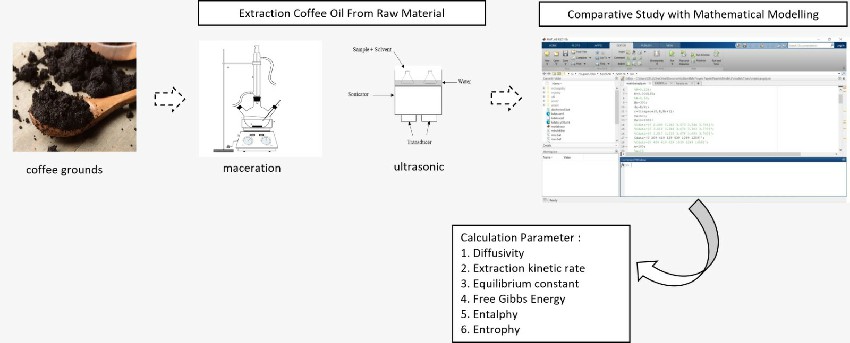
Coffee is a significant commodity trend, with numerous coffee shops rapidly established in Indonesia. The development of this industry has led to an increased discharge of coffee grounds into the environment. The discarded grounds contain oil which can be optimized using various methods and serve as a raw material for biodiesel. Therefore, this study aimed to compare the maceration and ultrasonic methods of extracting coffee grounds. The comparison focused on yield, mass transfer value (diffusivity), and extraction speed constant based on the proposed mathematical model. The results showed a yield of 12.1% and 16%, for the maceration and ultrasonic methods, respectively. Diffusivity value was registered at 9.99 x 10⁻¹¹ m2/min and 9.8 x 10⁻¹⁰ m2/min, while extraction speed constant values were discovered to be 0.2 m/min and 1.798 m/min, respectively. Additionally, the energy evaluation of ultrasonic extraction produced a Gibbs energy value of -3765.72 Joules.

References
[1] BPS. (2022). Statistik Kopi Indonesia. Badan Pusat Statistik, Jakarta
[2] Usman, I and Nanda, A.P.V. (2017). Green business opportunity of coffee ground waste through reverse logistics. Journal Global Business Advancement, 10(6), 727-737
[3] Luz, F.C., Volpe, M., Fiori, L., Manni, A., Cordiner, S., Mulone, V., and V. Rocco. (2018). Spent coffee enhanced biomethane potential via an integrated hydrothermal carbonization-anaerobic digestion process. Bioresources Technology, 256, 102-109, doi: 10.1016/j.biortech.2018.02.021
[4] Jenkins R.W., Stageman, N.E., Fortune, C.M., and Chuck, C.J. (2014). Effect of the Type of Bean, Processing, and Geographical Location on the Biodiesel Produced from Waste Coffee Grounds. Energy & Fuels, 28(2), 1166−1174, doi: 10.1021/ef4022976
[5] Mussatto, S.1., Machado, E.M.S., Martins, S, and Teixeira, J.A. (2011). Production, Composition, and Application of Coffee and Its Industrial Residues. Food and Bioprocess Technology, 4(5), 661-672, doi: 10.1007/s11947-011-0565-z
[6] Somnuk, K., Eawlex, P., and Prateepchaikul, G. (2017). Optimization of coffee oil extraction from spent coffee grounds using four solvents and prototype-scale extraction using circulation process. Agriculture and Natural Resources, 51(3), 181-189, doi: 10.1016/j.anres.2017.01.003
[7] Al-Hamamre, Z., Foerster, S., Hartmann, F., Kröger, M., and Kaltschmitt, M. (2012). Oil extracted from spent coffee grounds as a renewable source for fatty acid methyl ester manufacturing. Fuel,96(1), 70-60, doi: 10.1016/j.fuel.2012.01.023
[8] Campos-Vega, R., Loarca-Piña, G., Vergara-Castañeda, H.A., and Oomah, B.D. (2015). Spent coffee grounds: A review on current research and prospects. Trends in Food Science & Technology, 45(1), 24-36, doi: 10.1016/j.tifs.2015.04.012
[9] Fitriaa, M., Mulyawan, R., Sulhatun, A., Muarif, A., and Bahri, S. (2023). Effect of Solvent and Extraction Time Variation on The Coffee Oil Extraction Results. Journal of Chemistry & Chemistry Education, 11(1), 26-30, doi: 10.24815/kcd.v11i1.32550
[10] Romadhon, M., and Prasetyo, D. (2021). The Effectiveness of South Sumatra Coffee (Coffea arabica L.) Extract Cream in Burn Wound Recovery od Male White Mice (Mus musculus). Jurnal Farmasi Sains dan Komunitas, 18(1), 49-55, doi: 10.24071/jpsc.003018
[11] Gligor, O., Clichici, S., Moldovan, R., Muntean, D., Vlase, A.M., Nadăș, G.C., Matei, I.A., Filip, G.A., Vlase, L., and Crișan, G. (2023). The Effect of Extraction Methods on Phytochemicals and Biological Activities of Green Coffee Beans Extracts. Plants, 12(4), 712, doi: 10.3390.plants12040712
[12] Tinoco-Caicedoa, D.L., Mero-Benavides, M., CórdovaMolin, K., and Blanco-Marigorta, A.M. (2013). Oil Extraction from Spent Coffee Grounds: Experimental Studies and Exergoeconomic Analysis. Chemical Engineering Transactions, 102, 295-300, doi: 10.3303/CET23102050
[13] Adriyanti, H., Rizkia, G., Syamsuddin, Y., Satriana, S., and Supardan, M.D. (2023). Effect of microwave drying pretreatment before soxhlet extraction of coffee oil. in The 4th International Conference on Agriculture and Bio-industry, doi: 10.1088/1755/1183/1/012066
[14] Pattaraprachyakul, W., Sawangkeaw, R., Ngamprasertsith, S., and Suppavorasatit, I. (2023). Optimization of Coffee Oil Extraction from Defective Beans Using a Supercritical Carbon Dioxide Technique: Its Effect on Volatile Aroma Components. Foods, 12(13), 2515, doi: 10.3390/foods12132515
[15] Hibbert, S., Welham, K., and Zein, S.H. (2019). An innovative method of extraction of coffee oil using an advanced microwave system: in comparison with conventional Soxhlet extraction method. SN Applied Science, 1, 1467, doi: 10.1007/s42452-019-1457-5
[16] Tsukui, A., Júnior, H.S., Oigman, S., Souza, R.d., Bizzo, H., and., Rezende, C. (2014). Microwave-assisted extraction of green coffee oil and quantification of diterpenes by HPLC. Food Chemistry, 1(164), 266-271, doi: 10.106/j.foodchem.2014.05.039
[17] Miladi, M., Martins, A.A., Mata, T.M., Vergara, M., Pérez-Infantes, M., Remmani, R., Ruiz-Canales, A., and Núñez-Gómez, D. (2021). Optimization of Ultrasound-Assisted Extraction of Spent Coffee Grounds Oil Using Response Surface Methodology. Processes, 9(11), 2085, doi : 10.3390/pr9112085
[18] Goh, B.H.H., Ong, H.C., Chong, C,T., Chen, W.H., Leong, K.Y., Tan, S.X., and Lee, X.J. (2020). Ultrasonic-assisted oil extraction and biodiesel synthesis of Spent Coffee Ground. Fuel, 261, 116121, doi: 10.1016/j.fuel.2019.116121
[19] Mustikaningrum, M., and Johar, N. (2023). Penentuan Difusivitas Beta Karoten dalam Berbagai Pelarut pada Ekstraksi Maserasi Labu Kuning. Jurnal Integrasi Proses, 22 - 27
[20] M. Mustikaningrum and P. D. Anjarsari, "Analisis Pengaruh Perbedaan Volume Pelarut Heksana pada Parameter Konstanta Kecepatan Ekstraksi Minyak Kopi Robusta. Jurnal Surya Teknika, pp. 896-899, 2023.
[21] Muqorrobin M., and Mustikaningrum, M. (2023). Pengaruh Perbedaan Suhu dan Waktu Terhadap Kinetika Ekstraksi Minyak dengan Metode Ultrasonik pada Ampas Kopi. Jurnal Integrasi dan Lingkungan, 1(1), 24-29, doi: 10.30587/jipl.v1i1.6416
[22] Beverly, D., Lopez-Quiroga, E., Farr, Melrose, R.J., Henson, S., Bakalis, S., and Fryer, P.J. (2020). Modeling Mass and Heat Transfer in Multiphase Coffee Aroma Extraction. Industrial & Engineering Chemistry Research, 59(24), 11099-11112, doi: 10.1021.acs.iecr.0c01153
[23] Mustikaningrum,M., Arista, D., Nyamiati, R.D., and Nanda, D.E. (2023). Evaluasi Nilai Difusifitas Pelarut dan Konstanta Kecepatan Ekstraksi pada Isolasi Piperin Lada Hitam. Eksergi, 47-51,
[24] Zhang, Q.W., Lin L.G., and Ye, Y.C. (2018). Techniques for extraction and isolation of natural products: a comprehensive review. Chinese Medicine, 13(20), doi: 10.1186/s13020-018-0177-x
[25] Ningsih, A.W., Sukardiman., Syahrani, A, Charisma A.M., and Wahyuni, K.I. (2022). Study of Drying Methods and Extraction Methods on Phenolic Content. in The 2nd International Conference on Government Education Management and Tourism, 1(1)
[26] Kumar, K., Srivastav, S., and Sharanagat, V.S. (2020). Ultrasound-assisted extraction (UAE) of bioactive compounds from fruit and vegetable processing by-products: A review. Ultrasonic Sonochemistry,105325, doi: 10.1016/j.ultsonch.2020.105325
[27] Ashokkumar, M. (2015). Applications of ultrasound in food and bioprocessing. Ultrasonics Sonochemistry, 25, 17-23, doi: 10.1016/j.ultsonch.2014.08.012
[28] Petigny, L., Périno-Issartier, S., Wajsman, J., and Chemat, F. (2013). Batch and Continuous Ultrasound-Assisted Extraction of Boldo Leaves (Peumus boldus Mol.). International Journal of Molecular Sciences, 14(3), 5750-5764,doi:10.3390/ijms14035750
[29] Kulkarni, S.J. (2016). Diffusivity: A Review on Research and Studies with Insight into Affecting Parameters. International Journal of Science and Healthcare Research, 1(4), 9-14
[30] Lenart, I., and Ausländer, D. (1980). The effect of ultrasound on diffusion through membranes. Ultrasonics, 18(5), 216-218, doi:10.1016/0041-624X(80)90123-7
[31] Chemat, F., Rombaut, N., Meullemiestre, A., Turk, M., Perino, S., Fabiano-Tixier, A.S., and Abert-Vian, M. (2017). Review of Green Food Processing techniques. Preservation, transformation, and extraction. Innovative Food Science & Emerging Technologies, 41, 357-377, doi: 10.1016/j.ifset.2017.04.016
[32] Roselló-Soto, E., Koubaa, M., Moubarik, A., Lopes, R.P., Saraiva, J.A., Boussetta, N., Grimm, N., and Barba, F.J. (2015). Emerging opportunities for the effective valorization of wastes and by-products generated during olive oil production process: Non-conventional methods for the recovery of high-added value compounds. Trends in Food Science & Technology, 296-310
[33] Mustikaningrum, M., Cahyono, R.B., and Yuliansyah, A.T. (2021). Adsorption of Methylene Blue on Nano-Crystal Cellulose of Oil Palm Trunk: Kinetic and Thermodynamic Studies. Indonesian Journal of Chemistry, 22(4), 953 - 964, doi: 10.22146/ijc.72156
[34] Mataa, T.M., Martins A.A., and Caetano, N.S. (2017). Bio-refinery approach for spent coffee grounds valorization. Bioresource Technology, 1077-1084, doi: 10.1016/j.biotech.2017.09.106
[35] Stylianou, M., Agapiou, A., Omirou,M., Vyrides, I., Ioannides, I.M., Maratheftis, G., and Fasoula, D. (2018). Converting environmental risks to benefits by using spent coffee grounds (SCG) as a valuable resource. Environmental Science and Pollution Research, 25(36), 35776-35790, doi: 10.1007/s11356-01802359-6
[36] Mustikaningrum, M., and Anjarsari, P.D. (2023). Analisis Pengaruh Perbedaan Volume Pelarut Heksana pada Parameter Konstanta Kecepatan Ekstraksi Minyak Kopi Robusta. Jurnal Surya Teknika, 24-29
[37] Kumar, K., Srivastav, S., and Sharanagat, V.S. (2021). Ultrasound assisted extraction (UAE) of bioactive compounds from fruit and vegetable processing by-products: A review. Ultrasonics Sonochemistry, 70, doi:10.1016/j.ultsonch.2020.105325
Downloads
Published
How to Cite
Issue
Section
License
Copyright (c) 2024 CHEESA: Chemical Engineering Research Articles

This work is licensed under a Creative Commons Attribution-NonCommercial-ShareAlike 4.0 International License.
- Previous License: Creative Commons Attribution-NonCommercial-ShareAlike (CC BY-NC-SA)
- New License: Creative Commons Attribution (CC BY 4.0)
Previous copyright: With the receipt of the article by CHEESA Editorial Board and the decision to be published, the copyright regarding the article will be transferred to CHEESA Journal. CHEESA has the right to multiply and distribute the article and every author is not allowed to publish the same article that was published in this journal.
New Copyright: Authors who publish with this journal agree to the following terms:
Authors retain copyright and grant the journal right of first publication with the work simultaneously licensed under a Creative Commons Attribution License (CC BY 4.0) that allows others to share the work with an acknowledgement of the work's authorship and initial publication in this journal.


