Pengaruh Fenantren terhadap Aktivitas Enzim Katabolik Pseudomonas Putida TI (8)
DOI:
https://doi.org/10.25273/cheesa.v3i2.7735.99-105Keywords:
bakteri hidrokarbonoklastik, enzim katabolik, fenantren, Pseudomonas putida T1 (8)Abstract
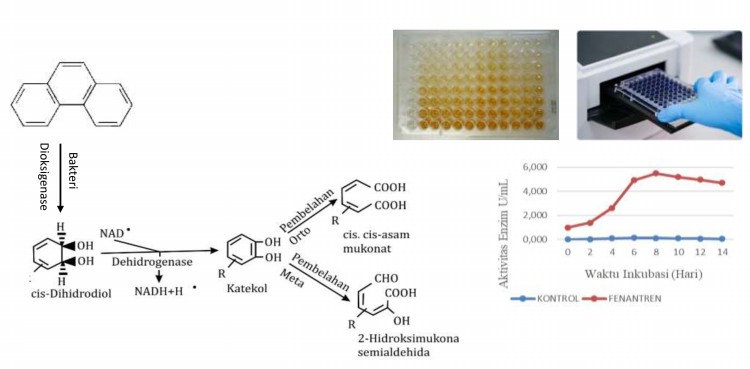
Penelitian ini bertujuan untuk menguji pengaruh fenantren terhadap aktivitas enzim katabolik pada Pseudomonas putida TI (8). Isolat ditumbuhkan pada media Air Mineral Sintetis (AMS) dengan penambahan 1% fenantren. Enzim katabolik diuji aktivitasnya terhadap fenantren. Uji aktivitas enzim ditentukan berdasarkan penurunan absorbansi NADH pada panjang gelombang 340 nm. Satu unit aktivitas enzim dinyatakan sebagai jumlah enzim yang membutuhkan 1 µmol NADH untuk mengoksidasi substrat. Hasil penelitian menunjukkan bahwa isolat dapat tumbuh menggunakan fenantren hingga 10 hari inkubasi. Aktivitas enzim katabolik tertinggi terhadap fenantren pada inkubasi hari ke 8 sebesar 5,391 U/mL. Penambahan 1% hidrokarbon poliaromatik dapat meningkatkan aktivitas enzim sebesar 10 kali, hal ini menunjukkan bahwa enzim katabolik pada Pseudomonas putida TI (8) merupakan enzim induktif.

References
Abbasian, F., Lockington, R., Mallavarapu, M., & Naidu, R. (2015). A Comprehensive Review of Aliphatic Hydrocarbon Biodegradation by Bacteria. Journal of Biochemistry and Biotechnology, 176(3), 670-699, DOI: 10.1007/s12010-015-1603-5 DOI: https://doi.org/10.1007/s12010-015-1603-5
Alami, N. H. (2010). Efektivitas Biosurfaktan Pseudomonas Putida T1(8) Dalam Bioremediasi Tanah Tercemar Minyak Mentah. Tesis: Universitas Airlangga. http://repository.unair.ac.id/38351/
Alrumman, S. A., Standing, D. B., & Paton, G. I. (2015). Effect of Hydrocarbon Contamination on Soil Microbial Community and Enzyme Activity. Journal of King Saud University-Science, 27(1), 31-41, DOI: 10.1016/j.jksus.2014.10.001 DOI: https://doi.org/10.1016/j.jksus.2014.10.001
Bharali, P., Singh, S. P, Bashir, Y., Dutta, N., Konwar, B. K, & Singh, C. B. (2018). Characterization and Assessment of Biosurfactant Producing Indigenous Hydrocarbonoclastic Bacteria: Potential Application in Bioremediation. Nova Biotechnologica et Chimica, 17(2), 103-114, DOI: 10.2478/nbec-2018-0011 DOI: https://doi.org/10.2478/nbec-2018-0011
Chelyadyn, V. L., Bogoslavets, M. M., Chelyadyn, L. I., Poznyak, O. R., & Novosad, P. V. (2020). Sludge of Oil Refining Units and Their Processing. Journal of Ecological Engineering, 21(7), 169-177, DOI: 10.12911/22998993/125556 DOI: https://doi.org/10.12911/22998993/125556
Crawford, R. L., & Crawford, D. L. (1996). Bioremediation: Principls and Applications. Cambridge, UK: Cambridge University Press. DOI: https://doi.org/10.1017/CBO9780511608414
Demaneche, S., Meyer C., Micoud, J., Louwagie, M., Willison, J. C., & Jouanneau, Y. (2004). Identification and Functional Analysis of Two Aromatic-Ring-Hydroxylating Dioxygenases from a Sphingomonas Strain that Degrades Various Polycyclic Aromatic Hydrocarbons. Applied and Environmental Microbiology, 70(11), 6714-6725, DOI: 10.1128/AEM.70.11.6714-6725.2004 DOI: https://doi.org/10.1128/AEM.70.11.6714-6725.2004
Devi, S. P & Jha, D. K. (2020). Screening of Bacteria Isolated from Refinery Sludge of Assam for Hydrocarbonoclastic Activities. Journal of Pure and Applied Microbiology, 14(2), 1453-1465, DOI: 10.22207/JPAM.14.2.43 DOI: https://doi.org/10.22207/JPAM.14.2.43
Grimm, A. C., & Harwood, C. S. (1997). Chemotaxis of Pseudomonas spp to the Polyaromatic Hydrocarbon Naphthalene, Applied and Environmental Microbiology, 63(10), 4111-4115, DOI: 10.1128/AEM.63.10.4111-4115.1997 DOI: https://doi.org/10.1128/aem.63.10.4111-4115.1997
Hamzah, A., Tavakoli, A., & Rabu, A. (2011). Detection of Toluene Degradation in Bacteria Isolated from Oil Contaminated Soil. Sains Malaysiana, 40(11), 1231-1235, http://journalarticle.ukm.my/2932/
Jauhari, N., Mishra, S., Kumari, B., & Singh, S. N. (2014). Bacteria Mediated Aerobic Degradation of Hexacosane in vitro Conditions. Bioresource Technology, 170, 62-68, DOI: 10.1016/j.biortech.2014.07.091 DOI: https://doi.org/10.1016/j.biortech.2014.07.091
Kanaly, R. A, & Harayama, S. (2000). Bioderadation of High-Molecular-Weight Polycyclic Aromatic Hydrocarbons by Bacteria. Journal of Bacteriology, 182(8), 2059-2067, DOI: 10.1128/JB.182.8.2059-2067.2000 DOI: https://doi.org/10.1128/JB.182.8.2059-2067.2000
Lawal, A. T. (2017). Polycyclic Aromatic Hydrocarbon. A review, Cogent Environmental Science, 3, 1-89, DOI: 10.1080/23311843.2017.1339841 DOI: https://doi.org/10.1080/23311843.2017.1339841
Mishra, S. & Singh, S. N. (2012). Microbial Degradation of n-Hexadecane in Mineral Salt Medium as Mediated by Degradative Enzymes. Bioresource Technology 111, 148-154, DOI: 10.1016/j.biortech.2012.02.049 DOI: https://doi.org/10.1016/j.biortech.2012.02.049
Mishra, S., Singh, S. N., & Pande, V. (2014). Bacteria Induced Degradation of Fluoranthene in Minimal Salt Medium Mediated by Catabolic Enzymes in vitro Condition. Bioresource Technology, 164, 299-308, DOI: 10.1016/j.biortech.2014.04.076 DOI: https://doi.org/10.1016/j.biortech.2014.04.076
Nzila, A. (2013). Update on the Cometabolism of Organic Pollutants by Bacteria. Environmental Pollution, 178, 474-482, DOI: 10.1016/j.envpol.2013.03.042 DOI: https://doi.org/10.1016/j.envpol.2013.03.042
Olivera, E. R, & Luengo, J. M. (2019). Steroids as environmental compounds recalcitrant to degradation: Genetic mechanisms of bacterial biodegradation pathways. Genes, 10(7), 512, DOI: 10.3390/genes10070512 DOI: https://doi.org/10.3390/genes10070512
Pelczar, J. M. (1986). Dasar-Dasar Mikrobiologi. Jakarta: Universitas Indonesia.
Seo, J-S., Keum, Y-S., & Li, Q. X. (2009). Bacterial Degradation of Aromatic Compounds. Environmental Research and Public Health, 6(1), 278-309, DOI: 10.3390/ijerph6010278 DOI: https://doi.org/10.3390/ijerph6010278
Singh, S. N., Kumari, B., Upadhyay, S. K., Mishra, S., & Kumar, D. (2013). Bacterial Degradation of Pyrene in Minimal Salt Medium Mediated by Catechol Dioxygenases: Enzyme Purification and Molecular Size Determination. Bioresource Technology 133, 293-300, DOI: 10.1016/j.biortech.2013.01.068 DOI: https://doi.org/10.1016/j.biortech.2013.01.068
Sudarmadji, S. (1996). Teknik Analisa Biokimiawi. Yogyakarta: Liberty.
Tuleva, B., Christova, N., Jordanov, B., Nikolova-Damyanova, B., & Petrov, P. (2005). Naphthalene Degradation and Biosurfactant Activity by Bacillus Cereus 28BN. Zeitschrift fur Naturforschung C, 60(7), 577-582, DOI: 10.1515/znc-2005-7-811 DOI: https://doi.org/10.1515/znc-2005-7-811
Wulandari, Y. T., Susanti, R., & Bintari, S. H. (2019). Analisis Perkembangan Ti-ter Antibodi Hasil Vaksinasi Infec-tious Bronchitis pada Ayam Petelur Strain Hisex Brown. Life Science, 8(1), 25-33, DOI: 10.15294/lifesci.v8i1.29987 DOI: https://doi.org/10.15294/lifesci.v8i1.29987
Yani, M., Charlena,C., Mas'ud Z, A., Anas, I., Setiadi, Y., Syakti, A. D. (2020). Isolation, Selection and Identification of Polyaromatic Hydrocarbons (PAHs) Degrading Bacteria from Heavy Oil Waste (HOW)-Contaminated Soil. HAYATI Journal of Biosciences, 27(2), 142-153, [SOURCES] DOI: https://doi.org/10.4308/hjb.27.2.142
Zam, S. I. (2011). Bioremediasi Tanah yang Tercemar Limbah Pengilangan Minyak Bumi secara In Vitro pada Konsentrasi pH Berbeda. Jurnal Agroteknologi, 1(2), 1-8, http://ejournal.uin-suska.ac.id/index.php/agroteknologi/article/view/50 DOI: https://doi.org/10.18860/elha.v1i2.1691
Downloads
Published
How to Cite
Issue
Section
License
Copyright (c) 2020 CHEESA: Chemical Engineering Research Articles

This work is licensed under a Creative Commons Attribution-NonCommercial-ShareAlike 4.0 International License.
- Previous License: Creative Commons Attribution-NonCommercial-ShareAlike (CC BY-NC-SA)
- New License: Creative Commons Attribution (CC BY 4.0)
Previous copyright: With the receipt of the article by CHEESA Editorial Board and the decision to be published, the copyright regarding the article will be transferred to CHEESA Journal. CHEESA has the right to multiply and distribute the article and every author is not allowed to publish the same article that was published in this journal.
New Copyright: Authors who publish with this journal agree to the following terms:
Authors retain copyright and grant the journal right of first publication with the work simultaneously licensed under a Creative Commons Attribution License (CC BY 4.0) that allows others to share the work with an acknowledgement of the work's authorship and initial publication in this journal.