Pengaruh Suhu dan Jenis Perekat Terhadap Kualitas Biobriket dari Ampas Kopi dengan Metode Torefaksi
DOI:
https://doi.org/10.25273/cheesa.v4i1.7697.39-50Keywords:
ampas kopi, biobriket, bioenergi, getah pinus, torefaksiAbstract
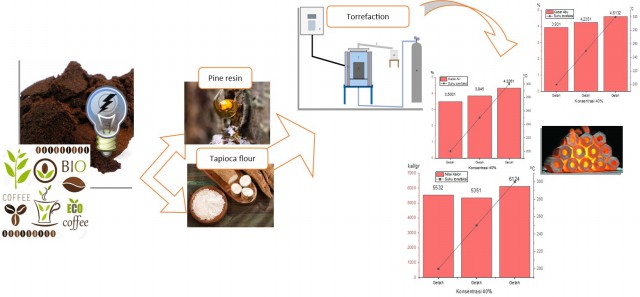
Penggunaan energi biomassa sebagai sumber energi alternatif terbarukan diupayakan untuk mengurangi emisi CO2. Ampas kopi merupakan limbah biomassa yang dihasilkan dari proses produksi yang digunakan sebagai raw material dalam pembuatan biobriket. Limbah biomassa mempunyai calorific value yang relatif tinggi jika diolah menjadi biobriket dengan perekat. Jenis perekat yang digunakan adalah tepung tapioka dan getah pinus dengan komposisi tepung tapioka yang digunakan 0%, 10% dan 20% sedangkan jumlah perekat getah pinus 0%, 10%, 20%, dan 40%. Dengan mengetahui pengaruh jenis dan jumlah perekat dalam pembuatan biobriket menggunakan metode torefaksi, diharapkan limbah ampas kopi dapat menjadi biomassa sebagai energi alternatif. Penelitian dilakukan pada suhu torefaksi yaitu 200 oC, 250 oC dan 300 oC. Suhu torefaksi yang optimal untuk pembuatan biobriket dari ampas kopi adalah 300 oC dengan perekat getah pinus 40% yang menghasilkan biobriket lebih padat dan tidak mudah hancur dengan nilai kalori sebesar 6124 kal/gr.

References
Alamsyah, R., Siregar, N. C., & Hasanah, F. (2018). Peningkatan Nilai Kalor Pellet Biomassa Cocopeat sebagai Bahan Bakar Terbarukan dengan Aplikasi Torefaksi. Warta Industri Hasil Pertanian, 33(01), 17-23. [Sources]
Ali, N. J., Anas, M., & Erniwati. (2020). Pengaruh Variasi Bahan Perekat terhadap Nilai Kalor dan Waktu Nyala Briket Arang Ban Bekas. Jurnal Penelitian Pendidikan Fisika, 5(4), 334-338. [Sources]
Aprita, I. R. (2016). Produksi Biopelet Dan Biobriket Ampas Seduhan Dan Cangkang Biji Kopi Dengan Dan Tanpa Pra Perlakuan Bahan Pada Berbagai Komposisi Perekat. Bogor Agricultural University. [Sources]
Baryatik, P., Pujiati, R. S., & Ellyke. (2016). Pemanfaatan Arang Aktif Ampas Kopi sebagai Adsorben Logam Kromium (Cr) pada Limbah Cair Batik (Studi Kasus Industri Batik UD. Pakem Sari Desa Sumberpakem Kecamatan Sumberjambe Kabupaten Jember). Artikel Ilmiah Hasil Penelitian Mahasiswa 2016, 1(1), 1-6. [Sources]
Basu, P. (2010). Biomass Gasification and Pyrolysis - 1st Edition. elsevier (1st ed.). united states: Academic Press. [Sources]
Batoro, J. (2015). Pengelolaan Lingkungan Dengan Pendekatan Etnobiologi-Etnobotani (1st ed.). Malang: University of Brawijaya Press.
Bergman, P. C. A., Boersma, A. R., Zwart, R. W. R., & Kiel, J. H. A. (2005). Torrefaction for biomass co-firing in existing coal-fired power stations. BIOCOAL. [Sources]
Bezanson, A. 2009. Pyrolysis and Torrefaction of Biomass. Canada: Dalhousie University.
Chu, Y. (2013). Coffee: Emerging Health Effects and Disease Prevention. Wiley. [Sources]
Fitri, N. (2017). Pembuatan Briket dari Campuran Kulit Kopi (coffea arabica) dan Serbuk Gergaji dengan Menggunakan Getah Pinus Sebagai Perekat. (Skripsi, Universitas Islam Negeri Alauddin Makassar). [Sources]
Hachicha, R., Rekik, O., Hachicha, S., Ferchichi, M., Woodward, S., Moncef, N., ... Mechichi, T. (2012). Co-composting of spent coffee ground with olive mill wastewater sludge and poultry manure and effect of Trametes versicolor inoculation on the compost maturity. Chemosphere, 88(6), 677-682. DOI: 10.1016/j.chemosphere.2012.03.053 DOI: https://doi.org/10.1016/j.chemosphere.2012.03.053
Khusna, D., & Susanto, J. (2015). Pemanfaatan Limbah Padat Kopi Sebagai Bahan Bakar Alternatif Dalam Bentuk Briket Berbasis Biomass (Studi Kasus di PT. Santos Jaya Abadi Instan Coffee). Seminar Nasional Sains dan Teknologi Terapan III 2015, Institut Teknologi Adhi Tama Surabaya, 247-260. [Sources]
Lubis, H. A. (2011). Uji Variasi Komposisi Bahan Pembuat Briket Kotoran Sapi dan Limbah Pertanian. [Sources]
Maharsa, L., & Muhammad, M. (2012). Pengaruh Variasi Komposisi Campuran Pada Biobriket Kulit Mete Dan Sekam Padi Terhadap Laju Pembakaran. ROTASI, 14(4), 15-22. DOI: 10.14710/rotasi.14.4.15-22
Pane, J. P., Junary, E., & Herlina, N. (2015). Pengaruh Konsentrasi Perekat Tepung Tapioka Dan Penambahan Kapur Dalam Pembuatan Briket Arang Berbahan Baku Pelepah Aren (Arenga Pinnata). Jurnal Teknik Kimia USU, 4(2), 32-38. DOI: 10.32734/jtk.v4i2.1468 DOI: https://doi.org/10.32734/jtk.v4i2.1468
Parinduri, L., & Parinduri, T. (2020). Konversi Biomassa Sebagai Sumber Energi Terbarukan. JET (Journal of Electrical Technology), 5(2), 88-92. LINK<
Pratiwi, V. D. (2020). Effect of Burning Temperature on The Quality of Alternatife Bio-energy from Coffee Waste. ELKOMIKA: Jurnal Teknik Energi Elektrik, Teknik Telekomunikasi, & Teknik Elektronika, 8(3), 615. DOI: 10.26760/elkomika.v8i3.615 DOI: https://doi.org/10.26760/elkomika.v8i3.615
Pratiwi, V. D., Isnaeni, I., Pratiwi, D. (2020). Variasi Perekat Dan Waktu Pemanasan Pada Biobriket Dari Ampas Kopi. (Laporan Penelitian Dosen, Institut Teknologi Nasional Bandung).
Purnomo, R. H., Hower, H., & Rizki Padya, I. (2015). Pemanfaatan limbah biomassa untuk briket sebagai energi alternatif. Prosiding Seminar Agroindustri dan Lokakarya Nasional FKPT-TPI, (September), 54-67. [Sources]<
Romeiro, G. A., Salgado, E. C., Silva, R. V. S., Figueiredo, M. K. K., Pinto, P. A., & Damasceno, R. N. (2012). A study of pyrolysis oil from soluble coffee ground using low temperature conversion (LTC) process. Journal of Analytical and Applied Pyrolysis, 93, 47-51. DOI: 10.1016/j.jaap.2011.09.006 DOI: https://doi.org/10.1016/j.jaap.2011.09.006
Ryu, C., Yang, Y. Bin, Khor, A., Yates, N. E., Sharifi, V. N., & Swithenbank, J. (2006). Effect of fuel properties on biomass combustion: Part I. Experiments - Fuel type, equivalence ratio and particle size. Fuel, 85(7-8), 1039-1046. DOI: 10.1016/j.fuel.2005.09.019 DOI: https://doi.org/10.1016/j.fuel.2005.09.019
Suhartini, S., Hidayat, N., & Wijaya, S. (2011). Physical properties characterization of fuel briquette made from spent bleaching earth. Biomass and Bioenergy, 35(10), 4209-4214. DOI: 10.1016/j.biombioe.2011.07.002 DOI: https://doi.org/10.1016/j.biombioe.2011.07.002
Suranto, Y. (2018). Karakter Dan Kualitas Gondorukem Kuna Hasil Penemuan Di Pemukiman Pecinan Kutoarjo Kabupaten Purworejo. Jurnal Konservasi Cagar Budaya, 12(2), 47-60. DOI: 10.33374/jurnalkonservasicagarbudaya.v12i2.188 DOI: https://doi.org/10.33374/jurnalkonservasicagarbudaya.v12i2.188
Tsai, W. T., Liu, S. C., & Hsieh, C. H. (2012). Preparation and fuel properties of biochars from the pyrolysis of exhausted coffee residue. Journal of Analytical and Applied Pyrolysis, 93, 63-67. DOI: 10.1016/j.jaap.2011.09.010 DOI: https://doi.org/10.1016/j.jaap.2011.09.010
Downloads
Published
How to Cite
Issue
Section
License
Copyright (c) 2021 CHEESA: Chemical Engineering Research Articles

This work is licensed under a Creative Commons Attribution-NonCommercial-ShareAlike 4.0 International License.
- Previous License: Creative Commons Attribution-NonCommercial-ShareAlike (CC BY-NC-SA)
- New License: Creative Commons Attribution (CC BY 4.0)
Previous copyright: With the receipt of the article by CHEESA Editorial Board and the decision to be published, the copyright regarding the article will be transferred to CHEESA Journal. CHEESA has the right to multiply and distribute the article and every author is not allowed to publish the same article that was published in this journal.
New Copyright: Authors who publish with this journal agree to the following terms:
Authors retain copyright and grant the journal right of first publication with the work simultaneously licensed under a Creative Commons Attribution License (CC BY 4.0) that allows others to share the work with an acknowledgement of the work's authorship and initial publication in this journal.


