Photocatalytic Activity and Kinetic Study of Methylene Blue Degradation using N-Doped TiO2 with Zeolite-NaY
DOI:
https://doi.org/10.25273/cheesa.v4i2.7646.75-81Keywords:
kinetic, methylene blue, photocatalytic, TiO2/Zeolite-NaY, TiO2-N/Zeolite-NaYAbstract
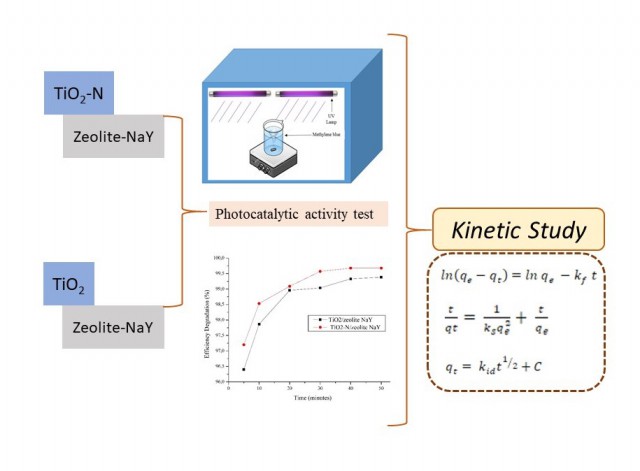
Methylene blue is the most widely used dye in the industry and it is difficult to be degraded by the microorganism. This research aims to investigate the photocatalytic activity and effects of contact time on the photocatalytic degradation rate of methylene blue by TiO2/Zeolite-NaY and TiO2-N/Zeolite-NaY material based on the kinetic study. The Advanced Oxidative Process (AOP) method was used to degrade methylene blue. Furthermore, the AOP is a degradation process that uses semiconductor material such as TiO2 or modification catalyst of TiO2 to be TiO2/Zeolite-NaY and TiO2-N/Zeolite-NaY. The degradation of methylene blue with catalyst TiO2/Zeolite-NaY and TiO2-N/Zeolite-NaY were tested under UV light for 5, 20, 30, 40, and 50 minutes. The result showed that TiO2/Zeolite-NaY and TiO2-N/Zeolite-NaY had an excellent activity for degrading the dye, which reached up to 99% after 20 and 30 minutes reaction, respectively. Also, a kinetic study of methylene blue degradation on TiO2/Zeolite-NaY and TiO2-N/Zeolite-NaY showed the kinetic models were according to pseudo-second-order.

References
Andarini, N. E., Wardhani, S. (2014). Fotokatalis TiO2-zeolit untuk degradasi metilen biru. Chemistry Progress, 7(1), 9-14. DOI: 10.35799/cp.7.1.2014.4848
Ansari, S. A., Khan, M. M., Ansari, M. O., & Cho, M. H. (2016). Nitrogen-doped titanium dioxide (N-doped TiO2) for visible light photocatalysis. New Journal of Chemistry, 40(4), 3000-3009. DOI: 10.1039/c5nj03478g DOI: https://doi.org/10.1039/C5NJ03478G
Behnajady, M. A., Modirshahla, N., & Hamzavi, R. (2006). Kinetic study on photocatalytic degradation of C.I. Acid Yellow 23 by ZnO photocatalyst. Journal of Hazardous Materials, 133(1-3), 226-232. DOI: 10.1016/j.jhazmat.2005.10.022 DOI: https://doi.org/10.1016/j.jhazmat.2005.10.022
Che Othman, F. E., Yusof, N., Hasbullah, H., Jaafar, J., Ismail, A. F., Abdullah, N.,Wan Salleh, W. N. (2017). Polyacrylonitrile/magnesium oxide-based activated carbon nanofibers with well-developed microporous structure and their adsorption performance for methane. Journal of Industrial and Engineering Chemistry, 51(2016), 281-287. DOI: 10.1016/j.jiec.2017.03.014 DOI: https://doi.org/10.1016/j.jiec.2017.03.014
Delavar, M., Asghar Ghoreyshi, A., Jahanshahi, M., Khalili, S., & Nabian, N. (2012). Equilibria and kinetics of natural gas adsorption on multi-walled carbon nanotube material. RSC Advances, 2(10), 4490-4497. DOI: 10.1039/c2ra01095j DOI: https://doi.org/10.1039/c2ra01095j
Endang, P. S., Rahadian, A. R., Ulva, T. I. M., Alvin, R. W., Rendy, M. I., & Nurul, W. (2019). The mno2/zeolite nay catalyzed oxidation of co emission in catalytic converter system. Materials Science Forum, 964 MSF, 199-208. DOI: 10.4028/www.scientific.net/MSF.964.199 DOI: https://doi.org/10.4028/www.scientific.net/MSF.964.199
Hidayat, A. R. P., Andina, V. R., Widiastuti, N., & Iqbal, R. M. (2019). Synthesis, Characterization, and Performance of TiO2-N as Filler in Polyethersulfone Membranes for Laundry Waste Treatment. Jurnal Sains dan Seni ITS, 8(2). [Sources] DOI: https://doi.org/10.12962/j23373520.v8i2.49806
Jia, P., Tan, H., Liu, K., & Gao, W. (2018). Removal of methylene blue from aqueous solution by bone char. Applied Sciences (Switzerland), 8(10). DOI: 10.3390/app8101903 DOI: https://doi.org/10.3390/app8101903
Kalantari, K., Kalbasi, M., Sohrabi, M., & Royaee, S. J. (2016). Synthesis and characterization of N-doped TiO2 nanoparticles and their application in photocatalytic oxidation of dibenzothiophene under visible light. Ceramics International, 42(13), 14834-14842. DOI: 10.1016/j.ceramint.2016.06.117 DOI: https://doi.org/10.1016/j.ceramint.2016.06.117
Khalil, M., Iqbal, R. M., Kadja, G. T. M., & Djuhana, D. (2020). Recent Advances on Plasmon-enhanced Titania Nanocatalysts for Photocatalytic Degradation of Organic Dyes. Journal of the Indonesian Chemical Society, 3(3), 117. DOI: 10.34311/jics.2020.03.3.117 DOI: https://doi.org/10.34311/jics.2020.03.3.117
Kurajica, S., Minga, I., Blazic R., Muzina, K., Tominac, P. (2018). Adsorption and Degradation Kinetics of Methylenen Blue on As-prepared and Calcined Titanate Nanotubes. Athens Journal of Sciences, 5(1), 7-22. DOI: 10.30958/ajs.5-1-1 DOI: https://doi.org/10.30958/ajs.5-1-1
Rashidi, N. A., Yusup, S., & Hameed, B. H. (2013). Kinetic studies on carbon dioxide capture using lignocellulosic based activated carbon. Energy, 61, 440-446. DOI: 10.1016/j.energy.2013.08.050 DOI: https://doi.org/10.1016/j.energy.2013.08.050
Susanti, I. (2019). Polysulfone Membrane With Zeolite Filler for CO2/CH4 Gas Separation: a Review. Science Education and Application Journal, 1(1), 10. DOI: 10.30736/seaj.v1i1.93 DOI: https://doi.org/10.30736/seaj.v1i1.93
Susanti, I., & Santoso, A. (2020). Efektivitas Lempung Alam Dan Kulit Pisang Sebagai Bahan Komposit Untuk Adsorpsi Metilen Biru. Barometer, 5(2), 258-260. DOI: 10.35261/barometer.v5i2.3803 DOI: https://doi.org/10.35261/barometer.v5i2.3803
Wibowo, E. A. P. (2017). Sintesis Komposit N-TiO2/Bentonit dan Karakterisasi Menggunakan FTIR. JTT (Jurnal Teknologi Terpadu), 5(1), 96. DOI: 10.32487/jtt.v5i1.218 DOI: https://doi.org/10.32487/jtt.v5i1.218
Yasui, K., Sasaki, K., Ikeda, N., & Kinoshita, H. (2019). Dye adsorbent materials based on porous ceramics from glass fiber-reinforced plastic and clay. Applied Sciences (Switzerland), 9(8). DOI: 10.3390/app9081574 DOI: https://doi.org/10.3390/app9081574
Downloads
Published
How to Cite
Issue
Section
License
Copyright (c) 2021 CHEESA: Chemical Engineering Research Articles

This work is licensed under a Creative Commons Attribution-NonCommercial-ShareAlike 4.0 International License.
- Previous License: Creative Commons Attribution-NonCommercial-ShareAlike (CC BY-NC-SA)
- New License: Creative Commons Attribution (CC BY 4.0)
Previous copyright: With the receipt of the article by CHEESA Editorial Board and the decision to be published, the copyright regarding the article will be transferred to CHEESA Journal. CHEESA has the right to multiply and distribute the article and every author is not allowed to publish the same article that was published in this journal.
New Copyright: Authors who publish with this journal agree to the following terms:
Authors retain copyright and grant the journal right of first publication with the work simultaneously licensed under a Creative Commons Attribution License (CC BY 4.0) that allows others to share the work with an acknowledgement of the work's authorship and initial publication in this journal.