Penentuan pH dan Suhu Optimum Isomerisasi Pembuatan Sirup Fruktosa dari Hidrolisat Onggok Menggunakan Katalis Mg/Al
DOI:
https://doi.org/10.25273/cheesa.v5i1.10243.1-12Keywords:
hidrotalsit Mg/Al, isomerisasi, metode permukaan respon, onggok, sirup fruktosaAbstract
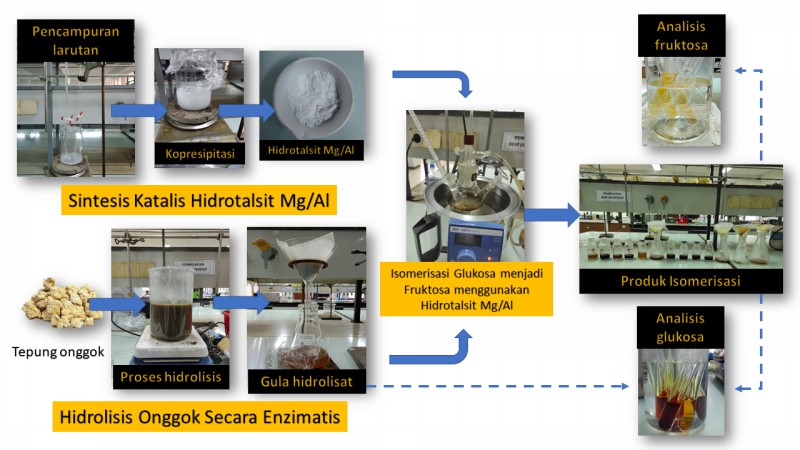
Onggok merupakan limbah padat yang dihasilkan dari industri tepung tapioka yang masih mengandung karbohidrat dalam bentuk pati sebesar 70,37%, amilosa 17,22% dan amilopektin 53,15%. Onggok berpotensi untuk diolah menjadi sirup fruktosa melalui proses hidrolisis pati yang dilanjutkan dengan isomerisasi gula hidrolisat. Penelitian ini bertujuan untuk menentukan pH dan suhu optimum isomerisasi pembuatan sirup fruktosa dari hidrolisat onggok melalui eksperimen dan analisis Response Surface Methodology (RSM). Proses hidrolisis untuk memecah pati menjadi glukosa dilakukan secara enzimatis, sedangkan isomerisasi untuk mengubah glukosa menjadi fruktosa dilakukan menggunakan katalis hidrotalsit Mg/Al yang disintesis sendiri. Variasi pH dan suhu isomerisasi ditentukan menggunakan desain eksperimen RSM. Dari percobaan didapatkan bahwa kondisi optimum isomerisasi yaitu pada pH 7 dan suhu 120 oC dengan yield sebesar 36,19% dan selektivitas sebesar 25,88%. Selanjutnya, melalui contour plot dan surface plot dari analisis RSM dapat diprediksi bahwa yield dan selektivitas fruktosa dapat mencapai masing-masing sebesar 17,87% dan 35,07% pada pH 6,58 dan suhu 126,2 °C.

References
Asngad, A. (2005). Perubahan Kadar Protein pada Fermentasi Jerami Padi dengan Penambahan Onggok untuk Makanan Ternak. Jurnal Penelitian Sains & Teknologi, 6(1), 65-74.
Basahel, S. N., Al-Thabaiti, S. A., Narasimharao, K., Ahmed, N. S., & Mokhtar, M. (2014). Nanostructured mg-al hydrotalcite as catalyst for fine chemical synthesis. Journal of Nanoscience and Nanotechnology, 14(2), 1931-1946. DOI: 10.1166/jnn.2014.9193 DOI: https://doi.org/10.1166/jnn.2014.9193
Delidovich, I., & Palkovits, R. (2014). Catalytic activity and stability of hydrophobic Mg-Al hydrotalcites in the continuous aqueous-phase isomerization of glucose into fructose. Catalysis Science and Technology, 4(12), 4322-4329. DOI: 10.1039/c4cy00776j DOI: https://doi.org/10.1039/C4CY00776J
Dwi, D., & Sugiarti, S. (2019). Modifikasi Zeolit Alam Ende dengan Garam Logam serta Potensinya Sebagai Katalis Transformasi Glukosa Menjadi 5-Hidroksimetilfurfural. Alchemy Jurnal Penelitian Kimia, 15(2), 203-218. DOI: 10.20961/alchemy.15.2.28180.203-218 DOI: https://doi.org/10.20961/alchemy.15.2.28180.203-218
Fajrin, A. E., Hartono, S., & Waluyati, L. R. (2016). Permintaan Gula Rafinasi Pada Industri Makanan Minuman Dan Farmasi Di Indonesia. Agro Ekonomi, 26(2), 150. DOI: 10.22146/agroekonomi.17267 DOI: https://doi.org/10.22146/agroekonomi.17267
Foster, J., Barkus, E., & Yavorsky, C. (2006). Understanding and Using Advanced Statistics, London: Sage Publications Ltd DOI: https://doi.org/10.4135/9780857020154
Harlan, J. (2018). Analisis Regresi Linear. Depok: Gunadarma
Hasanah, N., Saskiawan, I. (2015). Aktivitas selulase isolat jamur dari limbah media tanam jamur merang. In Prosiding Seminar Nasional Masyarakat Biodiversitas Indonesia, 1(5), 1110-1115. Semarang. [Sources] DOI: https://doi.org/10.13057/psnmbi/m010524
Kusbandari, A. (2015). Analisisis kualitataif kandungan sakarida dalam tepung dan pati umbi ganyong (Canna edulis Ker.). Pharmaciana, 5(1), 35-42. DOI: 10.12928/pharmaciana.v5i1.2284 DOI: https://doi.org/10.12928/pharmaciana.v5i1.2284
Leardi, R. (2009). Experimental design in chemistry: A tutorial. Analytica Chimica Acta, 652(1-2), 161-172. DOI: 10.1016/j.aca.2009.06.015 DOI: https://doi.org/10.1016/j.aca.2009.06.015
Li, C., Wang, Y., Zhang, Y., Wang, M., Sun, X., & Cui, H. (2020). Isomerization Kinetics of Glucose to Fructose in Aqueous Solution with Magnesium-Aluminum Hydrotalcites. Chemistry Select, 5, 270-279. DOI: 10.1002/slct.201903959 DOI: https://doi.org/10.1002/slct.201903959
Mahreni, & Sulistyowati, E. (2004). Pembuatan "High Fructose Syrup" Dari Tepung Maizena Secara Enzimatis ( The Making Of High Fructose Syrup From Cornmeal Flour Through Enzymization ). In Prosiding SNTPK VI 2004 (pp. 7-15).
Miftahudin, H. (2021). Siaran Pers: Kemenperin Jaga Ketersediaan Bahan Baku Gula untuk Industri Mamin. Kemenperin. Retrieved February 10, 2021, [Sources]
Mun, D., Thanh, N., & Huynh, T. (2017). Facile isomerization of glucose into fructose using anion-exchange resins in organic solvents and application to direct conversion of glucose into furan compounds. Research on Chemical Intermediates, 43(10), 5495-5506. DOI: 10.1007/s11164-017-2942-3 DOI: https://doi.org/10.1007/s11164-017-2942-3
Musita, N. (2018). Kajian Sifat Fisikokimia Tepung Onggok Industri Besar Dan Industri Kecil. Majalah Tknologi Agro Industri (Tegi), 10(1), 19-24. DOI: 10.46559/tegi.v10i1.3990 DOI: https://doi.org/10.46559/tegi.v10i1.3990
Permanasari, A. R., Fauzan, A., Rachmalia, N. L., Elfanti, R., & Wibisono, W. (2020). Fructose syrup production from Onggok with isomerization process by Mg/Al hydrotalcite catalyst and glucose isomerase enzyme. Journal of Physics: Conference Series, 1450(1), 1-9. DOI: 10.1088/1742-6596/1450/1/012002 DOI: https://doi.org/10.1088/1742-6596/1450/1/012002
Permanasari, A. R., & Yulistiani, F. (2015). Pembuatan Gula Cair Dari Pati Singkong dengan Menggunakan Hidrolisis Enzimatis. Fluida, 11(2), 9-14. DOI: https://doi.org/10.35313/fluida.v11i2.81
Downloads
Published
How to Cite
Issue
Section
License
Copyright (c) 2022 CHEESA: Chemical Engineering Research Articles

This work is licensed under a Creative Commons Attribution-NonCommercial-ShareAlike 4.0 International License.
- Previous License: Creative Commons Attribution-NonCommercial-ShareAlike (CC BY-NC-SA)
- New License: Creative Commons Attribution (CC BY 4.0)
Previous copyright: With the receipt of the article by CHEESA Editorial Board and the decision to be published, the copyright regarding the article will be transferred to CHEESA Journal. CHEESA has the right to multiply and distribute the article and every author is not allowed to publish the same article that was published in this journal.
New Copyright: Authors who publish with this journal agree to the following terms:
Authors retain copyright and grant the journal right of first publication with the work simultaneously licensed under a Creative Commons Attribution License (CC BY 4.0) that allows others to share the work with an acknowledgement of the work's authorship and initial publication in this journal.


