Risk Analysis Related to the Possibility of Using CNG in Trans Jogja Buses
DOI:
https://doi.org/10.25273/cheesa.v5i1.10824.28-39Keywords:
CNG, ETA, FTA, risk matrix, Trans JogjaAbstract
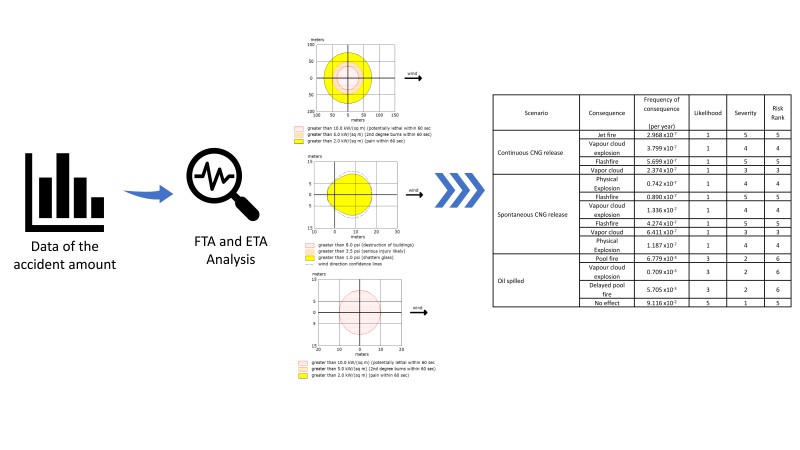
One of the issues in urban areas such as DI Yogyakarta province is air pollution. The pollution level is high, as shown by the quality index value of about 85.25 in 2019. Vehicle emissions are the most significant source of this pollution in urban areas and can be decreased by using fuel with minimum carbon emission. Compressed Natural Gas (CNG) is an environmentally friendly fuel. However, a safety study is required because CNG is stored under high pressure. Therefore, this research aims to analyze the risk of using CNG in the Trans Jogja bus. The research method collects secondary data and then processes them using FTA, ETA, ALOHA software, and a risk matrix. The result shows that the risk value for CNG usage in the Trans Jogja bus is low to a moderate level or acceptable.

References
Anonim. (2009). Reference Manual Bevi Risk Assessments Version 3.2. Bilthoven: National Institute of Public Health and the Environment (RIVM) Centre for External Safety. Retrieved from [Sources]
Anonim. (2012). Failure Rate and Event Data for use within Risk Assessments. Health & Safety Executive Offshore Safety Division. HSE - U.K. Health and Safety Executive.
Anonim. (2021). Jumlah Penduduk menurut Kabupaten/Kota di D.I. Yogyakarta (Jiwa), 2018-2020. Badan Pusat Statistik Provinsi D.I. Yogyakarta. Retrieved October 31, 2021, from [Sources]
Anonim. (2021). Turbocharger damage. Retrieved July 11, 2021, from [Sources]
Aslam, M. U., Masjuki, H. H., Kalam, M. A., Abdesselam, H., Mahlia, T. M. I., & Amalina, M. A. (2006). An experimental investigation of CNG as an alternative fuel for a retrofitted gasoline vehicle. Fuel, 85(2), 717-724. DOI: 10.1016/j.fuel.2005.09.004 DOI: https://doi.org/10.1016/j.fuel.2005.09.004
Aulady, M. F. N., Nuciferani, F. T., & Wicaksono, S. B. (2018). Application of Failure Mode Effects Analysis (FMEA ) Method and Fault Tree Analysis (FTA ) Towards Health and Occupational Safety on Jetty Project, Gresik, Indonesia. Journal of Advanced Civil and Environmental Engineering, 1(2), 100-108. DOI: 10.30659/jacee.1.2.100-108 DOI: https://doi.org/10.30659/jacee.1.2.100-108
Berghmans, J., & Vanierschot, M. (2014). Safety aspects of CNG cars. Procedia Engineering, 84(2), 33-46. DOI: 10.1016/j.proeng.2014.10.407 DOI: https://doi.org/10.1016/j.proeng.2014.10.407
Budisatriyo, C. A., Agustiawan, H., & Aritonang, S. (2018). Meningkatkan penggunaan compressed natural gas sebagai bahan bakar angkutan umum jakarta increasing the use of compressed natural gas as public transportation fuel in jakarta. Jurnal Ketahanan Energi, 4(1), 1-25.
Haag, P. A. M. U. de, & Ale, B. J. M. (2005). Guidelines for Quantitative Risk Assessment, The Purple Book (First.). The National Institute of Public Health and the Environment (RIVM ). DOI: 10.26634/jfet.6.1.1292 DOI: https://doi.org/10.26634/jfet.6.1.1292
Hendershot, D. C., Dunbobbin, B. R., Silowka, W., Mundt, A. G., Tilton, W., Freiheiter, F., ... Crowl, D. A. (2000). Guidelines for chemical process quantitative risk analysis (second.). New York: Center for Chemical Process Safety (CCPS) of the American Institute of Chemicat Engineers.
Holton, M. M., Gokulakrishnan, P., Klassen, M. S., Roby, R. J., & Jackson, G. S. (2010). Autoignition Delay Time Measurements of Methane , Ethane , and Propane Pure Fuels and Methane-Based Fuel Blends. Journal of Engineering for Gas Turbines and Power, 132(2), 1-9. DOI: 10.1115/1.4000590 DOI: https://doi.org/10.1115/1.4000590
Fauzi, F. R. (2016). Penilaian Risiko Sosial Unloading Muatan Pada Terminal Penerima CNG Studi Kasus: Terminal Penerima CNG di Pembangkit Lombok Peaker. Institut Teknologi Sepuluh Nopember.
Khan, M. I., Yasmeen, T., Khan, M. I., Farooq, M., & Wakeel, M. (2016). Research progress in the development of natural gas as fuel for road vehicles: A bibliographic review ( 1991 - 2016 ). Renewable and Sustainable Energy Reviews, 66, 702-741. DOI: 10.1016/j.rser.2016.08.041 DOI: https://doi.org/10.1016/j.rser.2016.08.041
Khan, M. I., Yasmin, T., & Khan, N. B. (2015). Safety issues associated with the use and operation of natural gas vehicles: learning from accidents in Pakistan. Journal of the Brazilian Society of Mechanical Sciences and Engineering, 1-17. DOI: 10.1007/s40430-015-0410-9 DOI: https://doi.org/10.1007/s40430-015-0410-9
Khan, M. I., Yasmin, T., & Shakoor, A. (2015). Technical overview of compressed natural gas (CNG) as a transportation fuel. Renewable and Sustainable Energy Reviews, 51, 785-797. DOI: 10.1016/j.rser.2015.06.053 DOI: https://doi.org/10.1016/j.rser.2015.06.053
Ko, J.-S., & Kim, H. (2004). The Fire Risk Assessment in Compressed Natural Gas Buses and Gas Station. T. of Korean Institute of Fire Sci. & Eng., 18(2), 57-67.
Mannan, S. (2014). Lees' Process Safety Essentials: Hazard Identification, Assessment and Control (First.). Oxford: Elsevier Inc. DOI: 10.1016/C2009-0-20231-5 DOI: https://doi.org/10.1016/C2009-0-20231-5
Milojevic, S., & Pesic, R. (2012). Theoretical and experimental analysis of a CNG cylinder rack connection to a bus roof. International Journal of Automotive Technology, 13(3), 497-503. DOI: 10.1007/s12239 DOI: https://doi.org/10.1007/s12239-012-0047-y
Downloads
Published
How to Cite
Issue
Section
License
Copyright (c) 2022 CHEESA: Chemical Engineering Research Articles

This work is licensed under a Creative Commons Attribution-NonCommercial-ShareAlike 4.0 International License.
- Previous License: Creative Commons Attribution-NonCommercial-ShareAlike (CC BY-NC-SA)
- New License: Creative Commons Attribution (CC BY 4.0)
Previous copyright: With the receipt of the article by CHEESA Editorial Board and the decision to be published, the copyright regarding the article will be transferred to CHEESA Journal. CHEESA has the right to multiply and distribute the article and every author is not allowed to publish the same article that was published in this journal.
New Copyright: Authors who publish with this journal agree to the following terms:
Authors retain copyright and grant the journal right of first publication with the work simultaneously licensed under a Creative Commons Attribution License (CC BY 4.0) that allows others to share the work with an acknowledgement of the work's authorship and initial publication in this journal.