Optimization Production and Characterization of Bacterial Cellulose from Cornhusk
DOI:
https://doi.org/10.25273/cheesa.v6i1.11781.49-55Keywords:
cornhusk, fermentation, nata, optimizationAbstract
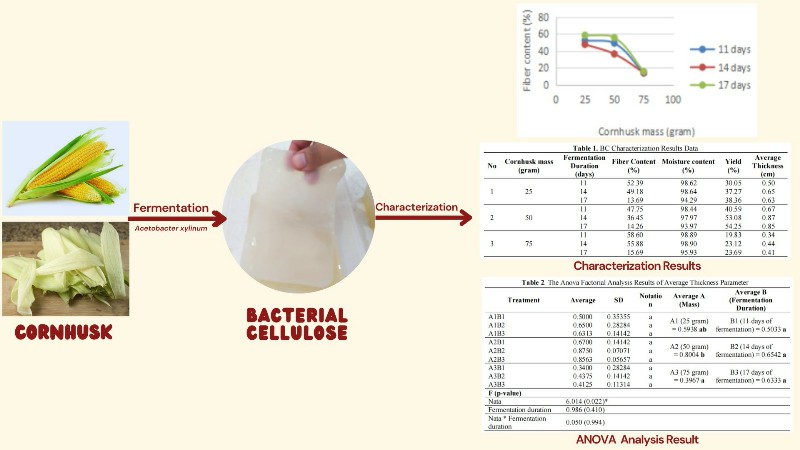
Cornhusks are agricultural wastes with low economic value that will cause environmental pollution if not appropriately handled. Cornhusk waste can be processed as raw material for bacterial cellulose (nata) since it contains 44% cellulose. This study aims to optimize bacterial cellulose production from cornhusks and determine the effect of cornhusk mass and fermentation duration on the characteristics of the nata produced. The primary process for producing bacterial cellulose from cornhusks was fermentation by Acetobacter xylinum. The nata characterization carried out in this study includes thickness, yield, crude fiber, and moisture content, as well as statistical analysis to determine whether there was significant effect of variations in cornhusk mass and fermentation duration on bacterial cellulose production. Based on the results of optimizing the production of nata from cornhusks, the optimal mass of cornhusks was of 25 grams with fermentation duration of 17 days. Based on the characterization and data analysis results, variation on the cornhusks mass and duration of the fermentation had a significant effect on fiber content, yield, and tensile strength of bacterial cellulose from cornhusks. On the other hand, the variations on cornhusks mass and the duration of fermentation did not significantly affect the moisture content and thickness of bacterial cellulose from cornhusks.

References
Abral, H., Chairani, M. K., Rizki, M. D., Mahardika, M., Handayani, D., Sugiarti, E., … Ilyas, R. A. (2021). Characterization of compressed bacterial cellulose nanopaper film after exposure to dry and humid conditions. Journal of Materials Research and Technology, 11, 896-904. DOI: 10.1016/J.JMRT.2021.01.057
Abral, H., Pratama, A. B., Handayani, D., Mahardika, M., Aminah, I., Sandrawati, N., … Ilyas, R. A. (2021). Antimicrobial Edible Film Prepared from Bacterial Cellulose Nanofibers/Starch/Chitosan for a Food Packaging Alternative. International Journal of Polymer Science, 2021, 6641284. DOI: 10.1155/2021/6641284
Barud, H. S., Regiani, T., Marques, R. F. C., Lustri, W. R., Messadeq, Y., & Ribeiro, S. J. L. (2011). Antomicrobial Bacterial Cellulose-Silver Nanoparticles Composite Membranes. Journal of Nanomaterials, 8(6), 1-8. DOI: 10.1155/2011/721631
Galdino, C. J. S., Maia, A. D., Meira, H. M., Souza, T. C., Amorim, J. D. P., Almeida, F. C. G., ... Sarubbo, L. A. (2020). Use of a bacterial cellulose filter for the removal of oil from wastewater. Process Biochemistry, 91, 288-296. DOI: 10.1016/J.PROCBIO.2019.12.020
Joshi, S., Goyal, S., & Reddy, M. S. (2018). Corn steep liquor as a nutritional source for biocementation and its impact on concrete structural properties. Journal of Industrial Microbiology and Biotechnology, 45(8), 657-667. DOI: 10.1007/s10295-018-2050-4
Jozala, A. F., de Lencastre-Novaes, L. C., Lopes, A. M., de Carvalho Santos-Ebinuma, V., Mazzola, P. G., Pessoa-Jr, A., ... Chaud, M. V. (2016). Bacterial nanocellulose production and application: a 10-year overview. Applied microbiology and biotechnology, 100, 2063-2072.
Downloads
Published
How to Cite
Issue
Section
License
Copyright (c) 2023 CHEESA: Chemical Engineering Research Articles

This work is licensed under a Creative Commons Attribution-NonCommercial-ShareAlike 4.0 International License.
- Previous License: Creative Commons Attribution-NonCommercial-ShareAlike (CC BY-NC-SA)
- New License: Creative Commons Attribution (CC BY 4.0)
Previous copyright: With the receipt of the article by CHEESA Editorial Board and the decision to be published, the copyright regarding the article will be transferred to CHEESA Journal. CHEESA has the right to multiply and distribute the article and every author is not allowed to publish the same article that was published in this journal.
New Copyright: Authors who publish with this journal agree to the following terms:
Authors retain copyright and grant the journal right of first publication with the work simultaneously licensed under a Creative Commons Attribution License (CC BY 4.0) that allows others to share the work with an acknowledgement of the work's authorship and initial publication in this journal.