Quality Evaluation of Bioplastic from Glutinous Rice Starch Reinforced with Bamboo Leaf Powder
DOI:
https://doi.org/10.25273/cheesa.v5i2.14235.82-91Keywords:
bioplastic, bamboo leaf powder, glutinous rice starch, psycho-mechanic propertiesAbstract
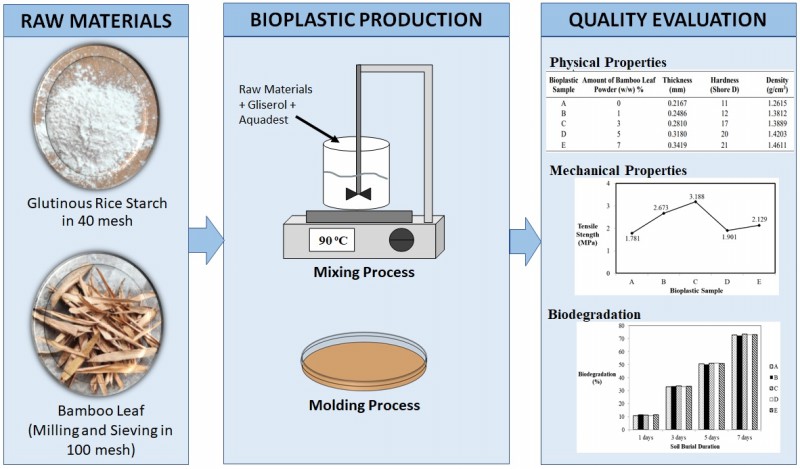
Plastics are widely used in various aspects of life due to their variety of superior properties. However, they contribute a negative impact on the environment, which leads to the search for an alternative solution such as the production of bioplastics as biodegradable plastics. Therefore, this study aims to evaluate the psycho-mechanic quality of bioplastic from glutinous rice starch reinforced with bamboo leaf powder. The bioplastic synthesis process was carried out using 0, 1, 3, 5, and 7% (w/w) variations of bamboo leaf powder on glutinous rice starch, respectively. The results showed that the best bioplastic composition was the addition of 3% (w/w) bamboo leaf powder to glutinous rice starch. This indicated that the addition of bamboo leaf powder in bioplastics can enhance the thickness, hardness, and tensile strength significantly. Meanwhile, the value of density, water vapor transmission rate, and elongation showed a slight increase, and the bioplastic also degraded more than 70% for 7 days.

References
Aminullah, Rohaeti, E., & Irzaman. (2015). Reduction of High Purity Silicon from Bamboo Leaf as Basic Material in Development of Sensors Manufacture in Satellite Technology. Procedia Environmental Sciences, 24, 308-316. DOI: 10.1016/j.proenv.2015.03.040
Bahtiar, A., Kurniati, M., Sari, Y. W., & Winarti, C. (2018). Surface morphology and water vapour transmission rate analysis of protein-based bioplastic. IOP Conference Series: Earth and Environmental Science, 187(1). DOI: 10.1088/1755-1315/187/1/012015
Haryanto, & Saputri, A. E. (2016). Pengembangan Bioplastik Dari Tepung Tapioka Dan Tepung Beras Ketan Putih. Techno, 17(2), 104-110.
Kavoosi, G., Dadfar, S. M. M., & Purfard, A. M. (2013). Mechanical, Physical, Antioxidant, and Antimicrobial Properties of Gelatin Films Incorporated with Thymol for Potential Use as Nano Wound Dressing. Journal of Food Science, 78(2). DOI: 10.1111/1750-3841.12015
Landi, T., & Arijanto, A. (2017). Perancangan Dan Uji Alat Pengolah Sampah Plastik Jenis Ldpe (Low Density Polyethylene) Menjadi Bahan Bakar Alternatif. Jurnal Teknik Mesin Undip, 5(1), 1-8.
Marichelvam, M. K., Jawaid, M., & Asim, M. (2019). Corn and rice starch-based bio-plastics as alternative packaging materials. Fibers, 7(4), 1-14. DOI: 10.3390/fib7040032
Ministry of Environment and Forestry. (2020). National Plastic Waste Reduction Strategic Actions for Indonesia. Republic of Indonesia. Retrieved from [Sources]
Nandiyanto, A. B. D., Fiandini, M., Ragadhita, R., Sukmafitri, A., Salam, H., & Triawan, F. (2020). Mechanical and biodegradation properties of cornstarch-based bioplastic material. Materials Physics and Mechanics, 44(3), 380-391. DOI: 10.18720/MPM.4432020_9
Nisah, K. (2017). Study Pengaruh Kandungan Amilosa dan Amilopektin Umbi-Umbian terhadap Karakteristik Fisik Plastik Biodegradable dengan Plastizicer Gliserol. BIOTIK: Jurnal Ilmiah Biologi Teknologi dan Kependidikan, 5(2), 106-113. DOI: 10.22373/biotik.v5i2.3018
Olawale, O. (2020). Bamboo leaves as an alternative source for silica in ceramics using Box Benhken design. Scientific African, 8, e00418. DOI: 10.1016/j.sciaf.2020.e00418
Oluwasina, O. O., Akinyele, B. P., Olusegun, S. J., Oluwasina, O. O., & Mohallem, N. D. S. (2021). Evaluation of the effects of additives on the properties of starch-based bioplastic film. SN Applied Sciences, 3(4). DOI: 10.1007/s42452-021-04433-7
Pillai, S. R., Venkatachalapathy, N., Kumar, K. S., & Pare, A. (2021). Effect of roasting and cooking on physiochemical properties of black rice soluble extract. International Journal of Chemical Studies, 9(1), 2848-2852. DOI: 10.22271/chemi.2021.v9.i1an.11655
Proshad, R., Kormoker, T., Islam, M. S., Haque, M. A., Rahman, M. M., & Mithu, M. M. R. (2018). Toxic effects of plastic on human health and environment: A consequences of health risk assessment in Bangladesh. International Journal of Health, 6(1), 1-5. DOI: 10.14419/ijh.v6i1.8655
Rahman, A. R., Syamsu, K. S., & Isroi, I. I. (2019). Biodegradability of Bioplastic in Natural Environment. Jurnal Pengelolaan Sumberdaya Alam dan Lingkungan (Journal of Natural Resources and Environmental Management), 9(2), 258-263. DOI: 10.29244/jpsl.9.2.258-263
Reddy, J. P., & Rhim, J. W. (2014). Characterization of bionanocomposite films prepared with agar and paper-mulberry pulp nanocellulose. Carbohydrate Polymers, 110, 480-488. DOI: 10.1016/j.carbpol.2014.04.056
Saputra, M. R. B., & Supriyo, E. (2020). Pembuatan Plastik Biodegradable Menggunakan Pati Dengan Penambahan Katalis ZnO dan Stabilizer Gliserol. Pentana, 1(1), 41-51.
Selvamurugan, M., & Sivakumar, P. (2019). Bioplastics - An Eco-friendly Alternative to Petrochemical Plastics. Current World Environment, 14(1), 49-59. DOI: 10.12944/cwe.14.1.07
Setiani, W., Sudiarti, T., & Rahmidar, L. (2013). Preparasi Dan Karakterisasi Edible Film Dari Poliblend Pati Sukun-Kitosan. Jurnal Kimia VALENSI, 3(2), 100-109. DOI: 10.15408/jkv.v3i2.506
Silviana, S., & Bayu, W. J. (2018). Silicon Conversion from Bamboo Leaf Silica by Magnesiothermic Reduction for Development of Li-ion Baterry Anode. MATEC Web of Conferences, 156, 0-3. DOI: 10.1051/matecconf/201815605021
Simarmata, E. O., Hartiati, A., & Harsojuwono, B. A. (2020). Karakteristik Komposit Bioplastik Dalam Variasi Rasio Pati Umbi Talas (Xanthosoma sagittifolium)-Kitosan. Jurnal Ilmiah Teknologi Pertanian Agrotechno, 5(2), 75. DOI: 10.24843/jitpa.2020.v05.i02.p05
Sorrentino, A., Tortora, M., & Vittoria, V. (2006). Diffusion behavior in polymer-clay nanocomposites. Journal of Polymer Science, Part B: Polymer Physics, 44(2), 265-274. DOI: 10.1002/polb.20684
Torabi, Z., & Nafchi, A. M. (2013). The Effects of SiO2 Nanoparticles on Mechanical and Physicochemical Properties of Potato Starch Films. The Journal of Chemical Health Risks, 3(1), 33-42. [Sources]
Wahyuningtiyas, N. E., & Suryanto, H. (2018). Properties of Cassava Starch based Bioplastic Reinforced by Nanoclay. Journal of Mechanical Engineering Science and Technology, 2(1), 20-26. DOI: 10.17977/um016v2i12018p020
Warsiki, E., Setiawan, I., & Hoerudin, H. (2020). Sintesa Komposit Bioplastik Pati Kulit Singkong-Partikel Nanosilika Dan Karakterisasinya. Jurnal Kimia dan Kemasan, 42(2), 37-45. DOI: 10.24817/jkk.v42i2.3535
Zhang, R., Wang, X., & Cheng, M. (2018). Preparation and characterization of potato starch film with various size of Nano-SiO2. Polymers, 10(10), 9-12. DOI: 10.3390/POLYM10101172
Zoungranan, Y., Lynda, E., Dobi-Brice, K. K., Tchirioua, E., Bakary, C., & Yannick, D. D. (2020). Influence of natural factors on the biodegradation of simple and composite bioplastics based on cassava starch and corn starch. Journal of Environmental Chemical Engineering, 8. DOI: 10.1016/j.jece.2020.104396
Downloads
Published
How to Cite
Issue
Section
License
Copyright (c) 2022 CHEESA: Chemical Engineering Research Articles

This work is licensed under a Creative Commons Attribution-NonCommercial-ShareAlike 4.0 International License.
- Previous License: Creative Commons Attribution-NonCommercial-ShareAlike (CC BY-NC-SA)
- New License: Creative Commons Attribution (CC BY 4.0)
Previous copyright: With the receipt of the article by CHEESA Editorial Board and the decision to be published, the copyright regarding the article will be transferred to CHEESA Journal. CHEESA has the right to multiply and distribute the article and every author is not allowed to publish the same article that was published in this journal.
New Copyright: Authors who publish with this journal agree to the following terms:
Authors retain copyright and grant the journal right of first publication with the work simultaneously licensed under a Creative Commons Attribution License (CC BY 4.0) that allows others to share the work with an acknowledgement of the work's authorship and initial publication in this journal.


