Isotherm and Kinetics Adsorption of Ammonium using Cocopeat Biochar Activated
DOI:
https://doi.org/10.25273/cheesa.v8i1.22466.43-54Keywords:
adsorption kinetics, ammonium removal, cocopeat biochar, potassium hydroxideAbstract
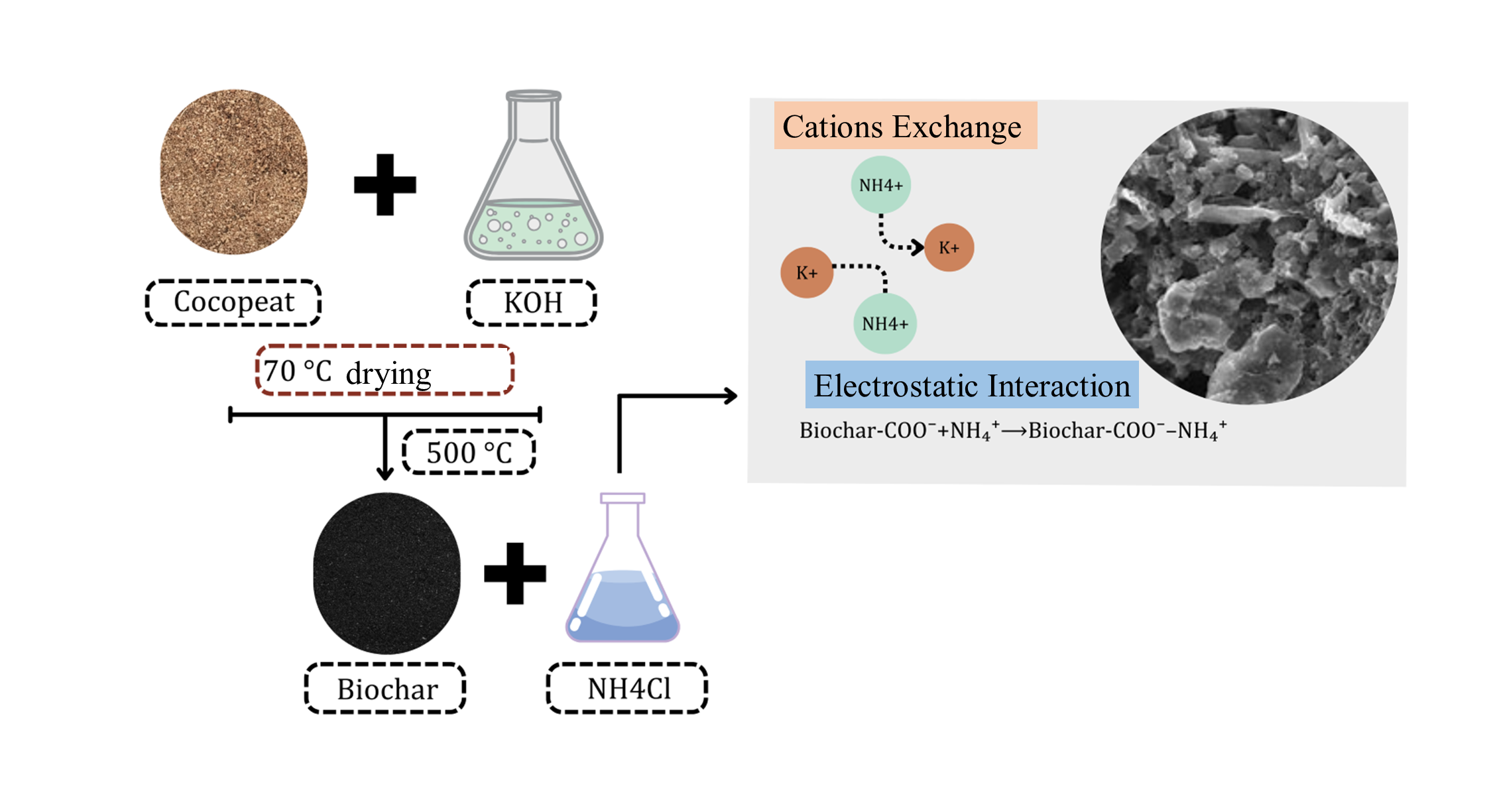
Nitrogen recovery from wastewater is capable of preventing eutrophication, offering economic benefits, and reducing carbon footprint from synthetic fertilizer production. Biochar has been explored as adsorbent for ammonium (NH??) removal. Therefore, this study aimed to investigate the potential of biochar derived from cocopeat as adsorbent for NH?? removal. Cocopeat was modified by potassium hydroxide (KOH) and pyrolyzed at 500°C for 2 h to produce activated biochar. Kinetics and isotherm studies were conducted to examine adsorption mechanisms. Fourier Transform Infrared (FTIR) data showed that the resulting biochar after activation and adsorption contained hydroxyl OH and CO groups, while a new NH band confirmed the interaction with NH?? ions. Biochar adsorbed NH?? ions with a maximum capacity of 0.3078?mg/g. FTIR spectra showed shifts and changes in the intensity of functional group bands, confirming the interaction between NH?? ion and the active sites on biochar surface. Adsorption followed Langmuir isotherm and pseudo-first-order kinetics model, with an optimal contact time of 5 h. These results suggested that cocopeat-based biochar had potential as an effective NH?? adsorbent.

References
[1] Nguyen, V. T., Vo, T. D. H., Tran, T., Nguyen, T. N., Le, T. N. C., Bui, X. T., & Bach, L. G. (2021). Biochar derived from the spent coffee ground for ammonium adsorption from aqueous solution. Case Studies in Chemical and Environmental Engineering, 4, 100141. doi: 10.1016/j.cscee.2021.100141
[3] Vamvuka, D., Loupasis, E., Chamilaki, E., & Sdoukou, E. (2024). Adsorption of ammonium from wastewaters by an almond kernel derived biochar modified by potassium hydroxide or dolomite and activated by steam. Environmental Advances, 15(November 2023), 100465. doi: 10.1016/j.envadv.2023.100465
[4] Zhang, X., & Liu, Y. (2021). Circular economy-driven ammonium recovery from municipal wastewater: State of the art, challenges and solutions forward. Bioresource Technology, 334(February), 125231. doi: 10.1016/j.biortech.2021.125231
[5] Lee, J. I., Jadamba, C., Lee, C. G., Hong, S. C., Kim, J. H., Yoo, S. C., & Park, S. J. (2024). Feasibility study of Aesculus turbinata fruit shell-derived biochar for ammonia removal in wastewater and its subsequent use as nitrogen fertilizer. Chemosphere, 357(April). doi: 10.1016/j.chemosphere.2024.142049
[6] Bilal, M., Ihsanullah, I., Younas, M., & Ul Hassan Shah, M. (2022). Recent advances in applications of low-cost adsorbents for the removal of heavy metals from water: A critical review. Separation and Purification Technology, 278(July 2021), 119510. doi: 10.1016/j.seppur.2021.119510
[8] Anisuzzaman, S. M., Zahrim, A. Y., Rajin, M., Saalah, S., Ismail, N. M., Duraim, R., & Krishnaiah, D. (2020). Adsorption of Ammonium Ions Using Activated Carbon Derived from Artocarpus odoratissimus Skin. IOP Conference Series: Materials Science and Engineering, 778(1). doi: 10.1088/1757-899X/778/1/012148
[16] An, Q., Li, Z., Zhou, Y., Meng, F., Zhao, B., Miao, Y., & Deng, S. (2021). Ammonium removal from groundwater using peanut shell based modified biochar: Mechanism analysis and column experiments. Journal of Water Process Engineering, 43(July), 102219. doi: 10.1016/j.jwpe.2021.102219
[18] Chandra, S., Medha, I., & Bhattacharya, J. (2020). Potassium-iron rice straw biochar composite for sorption of nitrate, phosphate, and ammonium ions in soil for timely and controlled release. Science of the Total Environment, 712, 136337. doi: 10.1016/j.scitotenv.2019.136337
[20] Oktavitri, N. I., Purnobasuki, H., Kuncoro, E. P., & Purnamasari, I. (2017). Ammonia Removal Using Coconut Shell Based Adsorbent: Effect of Carbonization Duration and Contact Time. IPTEK Journal of Proceedings Series, 0(4), 26. doi: 10.12962/j23546026.y2017i4.3072
[25] Armynah, B., Atika, Djafar, Z., Piarah, W. H., & Tahir, D. (2018). Analysis of Chemical and Physical Properties of Biochar from Rice Husk Biomass. Journal of Physics: Conference Series, 979(1). doi: 10.1088/1742-6596/979/1/012038
[26] Wang, T., Li, G., Yang, K., Zhang, X., Wang, K., Cai, J., & Zheng, J. (2021). Enhanced ammonium removal on biochar from a new forestry waste by ultrasonic activation: Characteristics, mechanisms and evaluation. Science of the Total Environment, 778, 146295. doi: 10.1016/j.scitotenv.2021.146295
[28] Sohaimi, K. S. A., Iberahim, N. I., Ghani, A. A., Zamrud, Z., & Heng, C. W. (2021). Ammonium adsorption - Desorption using rice husk biochar. IOP Conference Series: Earth and Environmental Science, 765(1). doi: 10.1088/1755-1315/765/1/012061
[29] Baig, U., Faizan, M., & Sajid, M. (2021). Effective removal of hazardous pollutants from water and deactivation of water-borne pathogens using multifunctional synthetic adsorbent materials: A review. Journal of Cleaner Production, 302, 126735. doi: 10.1016/j.jclepro.2021.126735
Downloads
Published
How to Cite
Issue
Section
License
Copyright (c) 2025 CHEESA: Chemical Engineering Research Articles

This work is licensed under a Creative Commons Attribution-NonCommercial-ShareAlike 4.0 International License.
- Previous License: Creative Commons Attribution-NonCommercial-ShareAlike (CC BY-NC-SA)
- New License: Creative Commons Attribution (CC BY 4.0)
Previous copyright: With the receipt of the article by CHEESA Editorial Board and the decision to be published, the copyright regarding the article will be transferred to CHEESA Journal. CHEESA has the right to multiply and distribute the article and every author is not allowed to publish the same article that was published in this journal.
New Copyright: Authors who publish with this journal agree to the following terms:
Authors retain copyright and grant the journal right of first publication with the work simultaneously licensed under a Creative Commons Attribution License (CC BY 4.0) that allows others to share the work with an acknowledgement of the work's authorship and initial publication in this journal.


