Studi Awal Pembuatan Membran Chitosan-Silica Based dari Berbagai Limbah
DOI:
https://doi.org/10.25273/cheesa.v3i1.5701Keywords:
kitosan, logam berat, membran, power plant waste, silikaAbstract
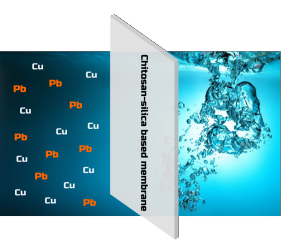
Jember memiliki potensi perikanan terutama udang sebagai sumber kitin yang merupakan dasar pembuatan kitosan. Kitosan berasal dari limbah kulit udang yang dicampur dengan limbah lain yaitu padatan silika dari Pembangkit Listrik Panas Bumi dan fly ash dari Pembangkit Listrik Tenaga Uap untuk menghasilkan membran yang dapat digunakan dalam filtrasi logam berat dalam air. Membran tanpa silika dibuat sebagai negative control dan dengan silika murni sebagai positive control. Membran kitosan dibuat dengan cara mencampurkan 1,0 gram kitosan dalam 100 mL larutan asam asetat 2% v/v dan 0,8 gram senyawa silika serta 0,5 gram polyethylene glycol. Membran yang telah dibuat diuji untuk menyaring larutan yang mengandung logam berat Cu dan Pb. Konsentratsi optimum dari Cu dan Pb dalam badan cairan dapat dikurangi sebesar 87% dan 80% menggunakan membran kitosan-silika.

References
Bokau, N. S. (2013). Sintesis Membran Kitosan Termodifikasi Silika Abu Sekam Padi untuk Proses Dekolorisasi. Universitas Negeri Semarang.
BPS. (2002). Jurnal Ekspor Perdagangan Luar Negeri Indonesia. Jakarta
Cui, L., Gao, S., Song, X., Huang, L., Dong, H., Liu, J., Chen, F., & Yu, S. (2018). Preparation and characterization of chitosan membranes. RSC Adv., 8(50), 28433-28439, https://doi.org/10.1039/C8RA05526B DOI: https://doi.org/10.1039/C8RA05526B
Fernandez-Kim, Sun-Ok. (2004). Physicochemical and functional properties of crawfish chitosan as affected by different processing protocols. Thesis: Louisiana State University, https://digitalcommons.lsu.edu/cgi/viewcontent.cgi?article=2337&context=gradschool_theses
Focher, B., Naggi, A., Torri, G., Cosani, A., & Terbojevich, M. (1992). Structural differences between chitin polymorphs and their precipitates from solutions-evidence from CP-MAS 13C-NMR, FT-IR and FT-Raman spectroscopy. Carbohydrate Polymers, 17(2), 97-102, https://doi.org/10.1016/0144-8617(92)90101-U DOI: https://doi.org/10.1016/0144-8617(92)90101-U
He, L.-h., Xue, R., Yang, D.-b., Liu, Y., & Song, R. (2009). Effects of blending chitosan with PEG on surface morphology, crystallization and thermal properties. Chinese Journal of Polymer Science, 27(04), 501-510, https://www.worldscientific.com/doi/pdf/10.1142/S0256767909004175 DOI: https://doi.org/10.1142/S0256767909004175
Kalapathy, U., Proctor, A., & Shultz, J. (2000). Production and properties of flexible sodium silicate films from rice hull ash silica. Bioresource technology, 72(2), 99-106, https://doi.org/10.1016/S0960-8524(99)00112-1 DOI: https://doi.org/10.1016/S0960-8524(99)00112-1
Li, C., Lou, T., Yan, X., Long, Y.-z., Cui, G., & Wang, X. (2018). Fabrication of pure chitosan nanofibrous membranes as effective absorbent for dye removal. International journal of biological macromolecules, 106, 768-774, https://doi.org/10.1016/j.ijbiomac.2017.08.072 DOI: https://doi.org/10.1016/j.ijbiomac.2017.08.072
Mahatmanti, F. W., Nuryono, N., & Narsito, N. (2016). Adsorption of Ca (II), Mg (II), Zn (II), and Cd (II) on Chitosan Membrane Blended with Rice Hull Ash Silica and Polyethylene Glycol. Indonesian Journal of Chemistry, 16(1), 45-52, https://jurnal.ugm.ac.id/ijc/article/view/21176 DOI: https://doi.org/10.22146/ijc.21176
Muljani, S., Kusuma, K. A., Nofitasari, L., Amalia, A. R., & Hapsari, N. (2018). Sintesis Membran Kitosan Silika Dari Geothermal Sludge. Jurnal Teknik Kimia, 13(1), https://doi.org/10.33005/tekkim.v13i1.1150 DOI: https://doi.org/10.33005/tekkim.v13i1.1150
Pemkab-Jember. (2016). Kelautan dan perikanan. Retrieved from http://www.jemberkab.go.id/kelautan-dan-perikanan/
Putnis, C. V. (2019). Editorial for Special Issue "Mineral Surface Reactions at the Nanoscale". Minerals, 9(3), 185, https://doi.org/10.3390/min9030185 DOI: https://doi.org/10.3390/min9030185
Sjamsiah, S., Ramadani, K., & Hermawan, H. (2017). Sintesis Membran Silika Kitosan Dari Abu Ampas Tebu (Bagasse). Al-Kimia, 5(1), 81-88, http://journal.uin-alauddin.ac.id/index.php/al-kimia/article/view/2857 DOI: https://doi.org/10.24252/al-kimia.v5i1.2857
Visa, M. (2016). Synthesis and characterization of new zeolite materials obtained from fly ash for heavy metals removal in advanced wastewater treatment. Powder Technology, 294, 338-347, https://doi.org/10.1016/j.powtec.2016.02.019 DOI: https://doi.org/10.1016/j.powtec.2016.02.019
Yang, D., Li, L., Chen, B., Shi, S., Nie, J., & Ma, G. (2019). Functionalized chitosan electrospun nanofiber membranes for heavy-metal removal. Polymer, 163, 74-85, https://doi.org/10.1016/j.polymer.2018.12.046 DOI: https://doi.org/10.1016/j.polymer.2018.12.046
Zeng, M., & Fang, Z. (2004). Preparation of sub-micrometer porous membrane from chitosan/polyethylene glycol semi-IPN. Journal of Membrane Science, 245(12), 95-102, https://doi.org/10.1016/j.memsci.2004.08.004 DOI: https://doi.org/10.1016/j.memsci.2004.08.004
Zhang, M., Li, X., Gong, Y., Zhao, N., & Zhang, X. (2002). Properties and biocompatibility of chitosan films modified by blending with PEG. Biomaterials, 23(13), 2641-2648, https://doi.org/10.1016/S0142-9612(01)00403-3 DOI: https://doi.org/10.1016/S0142-9612(01)00403-3
Zulti, F., Dahlan, K., & Sugita, P. (2013). Adsorption of Waste Metal Cr (VI) with Composite Membranes (Chitosan-Silica Rice Husks). Makara Journal of Science, 163-168, http://journal.ui.ac.id/index.php/science/article/view/1477 DOI: https://doi.org/10.7454/mss.v16i3.1477
Downloads
Published
How to Cite
Issue
Section
License
Copyright (c) 2020 CHEESA: Chemical Engineering Research Articles

This work is licensed under a Creative Commons Attribution-NonCommercial-ShareAlike 4.0 International License.
- Previous License: Creative Commons Attribution-NonCommercial-ShareAlike (CC BY-NC-SA)
- New License: Creative Commons Attribution (CC BY 4.0)
Previous copyright: With the receipt of the article by CHEESA Editorial Board and the decision to be published, the copyright regarding the article will be transferred to CHEESA Journal. CHEESA has the right to multiply and distribute the article and every author is not allowed to publish the same article that was published in this journal.
New Copyright: Authors who publish with this journal agree to the following terms:
Authors retain copyright and grant the journal right of first publication with the work simultaneously licensed under a Creative Commons Attribution License (CC BY 4.0) that allows others to share the work with an acknowledgement of the work's authorship and initial publication in this journal.


