Coffee Waste as a Potential Adsorbent for Peat Water Treatment
DOI:
https://doi.org/10.25273/cheesa.v8i1.22320.23-34Keywords:
adsorbent, adsorption isotherm, coffee waste, peat water treatmentAbstract
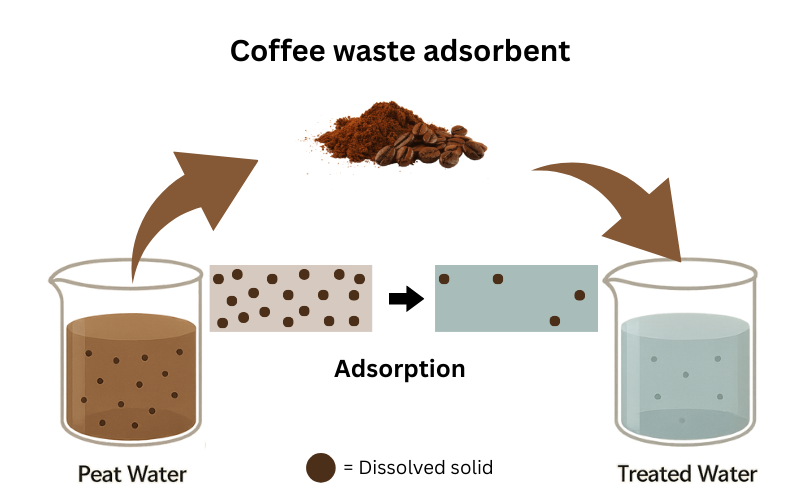
Peat water is characterized by high acidity, turbidity, and poor sensory qualities, which limit its usability. This study evaluated the effectiveness of thermally activated coffee waste adsorbent (CWA) for peat water treatment. CWA was prepared by heating coffee waste at 250°C, followed by washing and drying at 60°C. Batch adsorption experiments were conducted using 13 g of CWA in 200 mL of peat water at 30°C, stirred at 150 rpm for 30 minutes. The results revealed significant improvements in water quality: pH increased from 3.85 to 4.62; turbidity was reduced by 99.37% (from 75 to 0.47 NTU); conductivity decreased by 30.7% (from 424 to 294 ?S/cm); and total dissolved solids (TDS) dropped by 93.3% (from 208 to 14 ppm). The Langmuir isotherm model (R² = 0.7297) provided a better fit than the Freundlich model (R² = 0.5845), indicating monolayer adsorption behavior with a maximum capacity of 0.1634 mg/g and a favorable separation factor (RL = 0.0057). Sensory evaluation confirmed enhanced color and odor. These findings support the use of CWA as a sustainable and low-cost adsorbent for improving peat water quality.

References
[2] Kementerian Kesehatan Republik Indonesia. (2022). Profil Kesehatan Indonesia 2021. Jakarta.
Downloads
Published
How to Cite
Issue
Section
License
Copyright (c) 2025 CHEESA: Chemical Engineering Research Articles

This work is licensed under a Creative Commons Attribution-NonCommercial-ShareAlike 4.0 International License.
- Previous License: Creative Commons Attribution-NonCommercial-ShareAlike (CC BY-NC-SA)
- New License: Creative Commons Attribution (CC BY 4.0)
Previous copyright: With the receipt of the article by CHEESA Editorial Board and the decision to be published, the copyright regarding the article will be transferred to CHEESA Journal. CHEESA has the right to multiply and distribute the article and every author is not allowed to publish the same article that was published in this journal.
New Copyright: Authors who publish with this journal agree to the following terms:
Authors retain copyright and grant the journal right of first publication with the work simultaneously licensed under a Creative Commons Attribution License (CC BY 4.0) that allows others to share the work with an acknowledgement of the work's authorship and initial publication in this journal.