Characteristics and Thermal Stability of Biobriquettes Sub-Bituminous Coal and Coconut Shell (Cocos nucifera) Mixture
DOI:
https://doi.org/10.25273/cheesa.v9i1.24440.53-63Keywords:
Bio-briquettes, coconut shells, differential thermal analysis, sub-bituminous coalAbstract
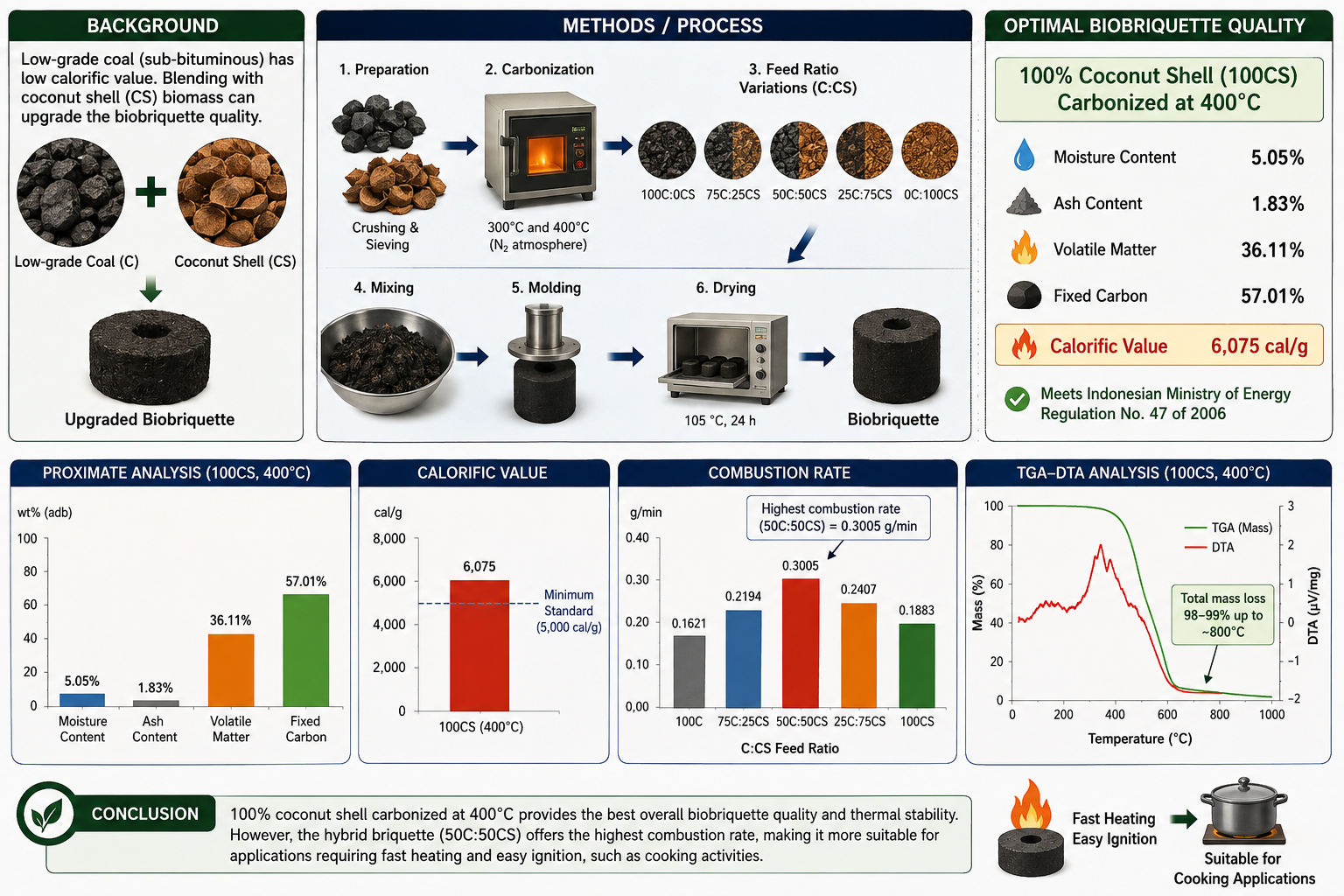
Low-grade coal, such as sub-bituminous, is characterized by low calorific value. In this context, combining coal (C) with coconut shell (CS) biomass can upgrade the quality. Therefore, this study aims to analyze the effect of feed ratio and carbonization temperature on improving the biobriquette quality. The processes included preparation, carbonization at 300°C and 400°C, variation in feed ratios, mixing, molding, and drying. Evaluation was conducted for proximate composition, calorific value, combustion rate, and thermal stability characteristics using Thermogravimetric Analysis (TGA) and Differential Thermal Analysis (DTA). The results showed that the biobriquette with 100CS contained 100% CS carbonized at 400°C. Furthermore, it had the best quality, with 5.05% moisture content, 1.83% ash content, 36.11% volatile matter, 57.01% fixed carbon, and a calorific value of 6,075 cal/g. These values met the Indonesian Ministry of Energy Regulation No. 47 of 2006. TGA–DTA analysis showed a total mass loss of 98–99% up to approximately 800°C, featuring the best thermal stability. Based on observation, 100% coconut shell (100CS) provided the best quality. This did not imply that hybrid composition was ineffective. For combustion performance tests, the highest combustion rate was recorded in a mixture of 50C: 50CS, namely 0.3005 g / min. The addition of coal to biomass briquettes aimed to improve combustion performance, specifically through increasing the combustion rate. This suggested that the briquettes are easier to ignite (easy ignition), and heat is generated more quickly. In conclusion, the mixture of coal and coconut shell is suitable for applications that require fast heating, such as cooking activities.

References
[1] IEA. (2022). World Energy Outlook 2022, IEA, Paris. International Energy Agency | World Energy Outlook 2024.
[2] Liu, X., Liang, B., Han, J., & Hu, S. (2025). Decoupling combustion of coal briquettes and coal-biomass blends in a pilot-scale test facility for novel grate boilers. Chinese Journal of Chemical Engineering, 87. doi: 10.1016/j.cjche.2025.05.040
[3] Patabang, D., Sam, A., & Basri. (2023). Thermochemical Characteristics of Briquettes of the Low-Rank Coal Mixed with Charcoal Sawdust of Meranti Wood. In IOP Conference Series: Earth and Environmental Science (Vol. 1157). doi: 10.1088/1755-1315/1157/1/012039
[4] BPS. (2022). Statistik Harga Produsen Pertanian Subsektor Tanaman Pangan, Hortikultura dan Tanaman Perkebunan Rakyat 2021. Badan Pusat Statistik (Vol. 11).
[5] Akolgo, G. A., Awafo, E. A., Essandoh, E. O., Owusu, P. A., Uba, F., & Adu-Poku, K. A. (2021). Assessment of the potential of charred briquettes of sawdust, rice and coconut husks: Using water boiling and user acceptability tests. Scientific African, 12. doi: 10.1016/j.sciaf.2021.e00789
[6] Jittabut, P. (2015). Physical and Thermal Properties of Briquette Fuels from Rice Straw and Sugarcane Leaves by Mixing Molasses. In Energy Procedia (Vol. 79). doi: 10.1016/j.egypro.2015.11.452
[7] Osei, B. B., Takase, M., Mantey, J. (2020). Preparation of charcoal briquette from palm kernel shells: case study in Ghana. Heliyon, 6(10). doi:10.1016/j.heliyon.2020.e05266
[8] Łaska, G., & Ige, A. R. (2023). A Review: Assessment of Domestic Solid Fuel Sources in Nigeria. Energies. doi: 10.3390/en16124722
[9] Yirijor, J., & Bere, A. A. T. (2024). Production and characterization of coconut shell charcoal-based bio-briquettes as an alternative energy source for rural communities. Heliyon, 10(16). doi: 10.1016/j.heliyon.2024.e35717
[10] Mustain, A., Sindhuwati, C., Wibowo, A. A., Estelita, A. S., & Rohmah, N. L. (2021). Pembuatan Briket Campuran Arang Ampas Tebu dan Tempurung Kelapa sebagai Bahan Bakar Alternatif. Jurnal Teknik Kimia dan Lingkungan, 5(2), 100–106. doi: 10.33795/jtkl.v5i2.183
[11] Rahman, D., & Raphael, F. (2025). Optimizing the utilization of coal in Indonesia through downstreaming: Economic benefits, challenges and solutions. Economic Military and Geographically Business Review, 2(2). doi: 10.61511/emagrap.v2i2.2025.1472
[12] Badan Standarisasi Nasional. (2014). Briket Arang Kayu SNI 01-6235-2000. Sni 01-6235-2000, 4(2).
[13] Radityaningrum, A., & Harnawan, B. (2022). Karakteristik Biobriket dari Kotoran Sapi dengan Kulit Durian. Jurnal Teknologi Lingkungan, 23(2). doi: 10.29122/jtl.v23i2.4730
[14] Kamdem, B. M., Lemaire, R., & Nikiema, J. (2025). Insight into the production factors influencing the physicochemical properties of densified briquettes comprising wood shavings and rice husk. Industrial Crops and Products, 223. doi: 10.1016/j.indcrop.2024.120134
[15] Wang, F., Tian, N., Ren, L., Zhang, K., Wang, J., & Zhang, Y. (2025). Quantitative investigation of moisture migration during microwave drying of coal slime dough through simulation and tracer analysis. Scientific Reports, 15(1). doi: 10.1038/s41598-025-95646-y
[16] Zhang, S., Zhang, Y., Zhang, X., Xing, D., Hu, J., Zhao, Z., & Yao, L. (2025). Physicochemical properties of torrefied biomass at different atmospheres: A review. Industrial Crops and Products. doi: 10.1016/j.indcrop.2025.121988
[17] Sihotang, M.S., Juwita, F. H., Lilik, W. (2025). Physical and Chemical Characterization of Briquettes Made from a Mixture of Butt Dust and Coconut Shell Charcoal Using Starch Binder. Journal Technomaterial Physics, 7(2). doi:10.32734/jotp.v7i2.21410
[18] Kabir, A, R., Anwar, S. S., Yusup, S., Sham, D. S., Inayat, M., & Aminu, U. H. (2022). Exploring the potential of coconut shell biomass for charcoal production. Ain Shams Engineering Journal, 13(1). doi: 10.1016/j.asej.2021.05.013
[19] Lichinga, K. N., Sikazwe, K., Elibariki, R., Masse, A. A., Kayumba, H. I., & Shija, H. (2025). Cleaner cooking solutions: Optimizing biomass briquettes to replace charcoal and mitigate climate change in Tanzania. Scientific African, 30. doi: 10.1016/j.sciaf.2025.e03056
[20] Suwankamnoed, S., Imsuwan, P., Tilokkarn, W., Meksiriporn, B., & Sutjaritvorakul, T. (2025). Characterization and proximate analysis of composite biochar briquette from oil palm frond and red clay. Journal of Ecological Engineering, 26(11). doi: 10.12911/22998993/207634
[21] Syarif, S., Cahyono, R. B., & Hidayat, M. (2019). Pemanfaatan Limbah Kulit Kakao Menjadi Briket Arang sebagai Bahan Bakar Alternatif dengan Penambahan Ampas Buah Merah. Jurnal Rekayasa Proses, 13(1). doi: 10.22146/jrekpros.41517
[22] Pari, G., Efiyanti, L., Darmawan, S., Saputra, N. A., Hendra, D., Adam, J., … Effendi, R. (2023). Initial Ignition Time and Calorific Value Enhancement of Briquette with Added Pine Resin. Journal of the Korean Wood Science and Technology, 51(3). doi: 10.5658/WOOD.2023.51.3.207
[23] Putri, R.W., Susanti, S., Aiko, H. M., Tasya, A. S., Wijayanti, M. (2024).Comparative Characterization of Rice Husk Raw Materials and Mixture of Rice Husk-Baggase on the Briquette Quality. Jurnal Teknologi Lingkungan, 25(2). doi:10.3303/CET23106047
[24] Amrullah, A., Irawansyah, H., Ardiyat, I. N., Cahyono, G. R., & Ansyah, P. R. (2023). Effect of carbonization temperature on the properties of Rubber Seed-Shell briquettes. In IOP Conference Series: Earth and Environmental Science (Vol. 1187). doi: 10.1088/1755-1315/1187/1/012022
[25] Hasibuan, R., Limbong, Y. W., Fazillah, R., & Pramananda, V. (2024). Effect of Pyrolysis Temperature and Time on Liquid Smoke Yield in Coconut (Cocos nucifera L.) Shells Pyrolysis Process. In E3S Web of Conferences (Vol. 560). doi: 10.1051/e3sconf/202456001008
[26] Mengesha, T. T., Ancha, V. R., Sundar, L. S., & Pollex, A. (2024). Review on the influence of pyrolysis process parameters for biochar production with minimized polycyclic aromatic hydrocarbon content. Journal of Analytical and Applied Pyrolysis. doi: 10.1016/j.jaap.2024.106699
[27] Afrianah, N., Ruslan, R., Suryadi, H. R., Amir, I., Irsyad, A., Jasruddin, & Nurhayati. (2023). Pengaruh Temperatur Karbonisasi Terhadap Karakteristik Briket Berbasis Arang Sekam Padi Dan Tempurung Kelapa. JFT: Jurnal Fisika dan Terapannya, 9(2). doi: 10.24252/jft.v9i2.25566
[28] Prista, T. F. Y., & Ashari, A. W. (2020). Effect of mixed additions in residual oil to improve the quality of sub-bituminous coal from Sangatta, East Kalimantan. In IOP Conference Series: Materials Science and Engineering (Vol. 885). doi: 10.1088/1757-899X/885/1/012012
[29] Wendlandt, W. W., & Hoiberg, J. A. (1963). A differential thermal analysis (DTA) and thermogravimetric analysis (TGA) study of some organic acids. Analytica Chimica Acta, 29, 539–544. doi: https://doi.org/10.1016/S0003-2670(00)88662-6
Downloads
Published
How to Cite
Issue
Section
License
Copyright (c) 2026 Rizka Wulandari Putri, Rahmatullah, Selpiana, Nyayu Gandasari, Salsabillah Nur Fazrin, Alek Al Hadi, Muhammad Haviz

This work is licensed under a Creative Commons Attribution 4.0 International License.
- Previous License: Creative Commons Attribution-NonCommercial-ShareAlike (CC BY-NC-SA)
- New License: Creative Commons Attribution (CC BY 4.0)
Previous copyright: With the receipt of the article by CHEESA Editorial Board and the decision to be published, the copyright regarding the article will be transferred to CHEESA Journal. CHEESA has the right to multiply and distribute the article and every author is not allowed to publish the same article that was published in this journal.
New Copyright: Authors who publish with this journal agree to the following terms:
Authors retain copyright and grant the journal right of first publication with the work simultaneously licensed under a Creative Commons Attribution License (CC BY 4.0) that allows others to share the work with an acknowledgement of the work's authorship and initial publication in this journal.


