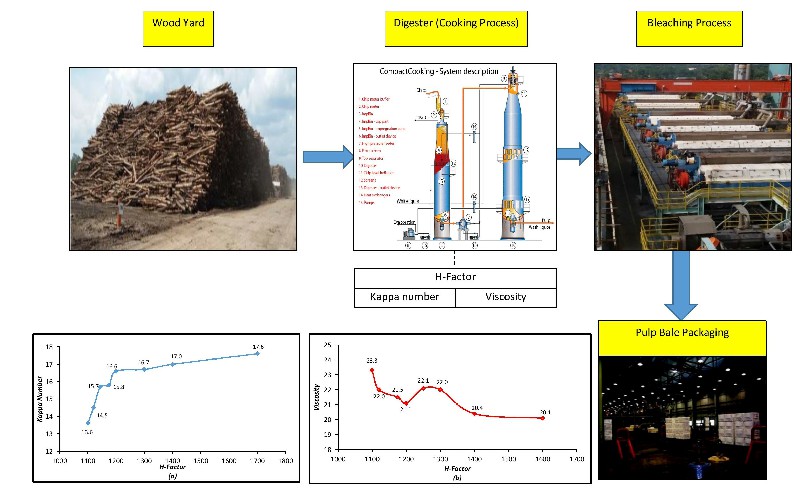
The Effect of H-Factor on Kappa Number and Viscosity in Continuous Digester
DOI:
https://doi.org/10.25273/cheesa.v6i1.15681.26-33Keywords:
active alkali, cooking process, H-Factor, kappa number, viscosityAbstract
One of the most important steps in pulping is the cooking process, which serves to separate the cellulose and hemicellulose from lignin and other by-products. During the cooking process in the digester, various factors must be considered to create high-quality pulp. Among these factors, the H-Factor plays a significant role due to its impact on the kappa number and viscosity in the pulping process. A high H-Factor can also damage the strength of the pulp. Therefore, this research aims to investigate the effect of the H-Factor and active alkali on pulp yield and quality. The active alkali used was in line with the desired production objectives, as insufficient levels of active alkali can lead to a low yield of pulp. Meanwhile, pulp quality standards in the Pulp and Paper Industry included kappa number of 12-18 in the digester process, an approximate viscosity of 23 mPa.s, and the selection of H-Factor based on the desired production target.

References
Ardina, V., Irawan, B., Prajitno, D. H., & Roesyadi, A. (2018). Active alkali charge effect on kraft pulping process of acacia mangium and eucalyptus pellita. In AIP Conference Proceedings, 1-6. DOI: 10.1063/1.5054440
Bahri, S. (2017). Pembuatan Pulp dari Batang Pisang. Jurnal Teknologi Kimia Unimal, 4(2), 36. DOI: 10.29103/jtku.v4i2.72
Li, J., Hu, H., & Chai, X. (2017). The kinetic modeling of carbonate formation during kraft pulping of eucalyptus wood. AIChE Journal, 63(5), 1489-1493. DOI: 10.1002/aic.15681
Luo, X., Liu, J., Zhan, H., Cao, S., Huang, L., & Chen, L. (2013). Prediction model and in-digester control of residual alkali content in black liquor during kraft pulping of eucalyptus. Journal of Biobased Materials and Bioenergy,7 (5), 559-565. DOI: 10.1166/jbmb.2013.1391
Downloads
Published
How to Cite
Issue
Section
License
Copyright (c) 2023 CHEESA: Chemical Engineering Research Articles

This work is licensed under a Creative Commons Attribution-NonCommercial-ShareAlike 4.0 International License.
- Previous License: Creative Commons Attribution-NonCommercial-ShareAlike (CC BY-NC-SA)
- New License: Creative Commons Attribution (CC BY 4.0)
Previous copyright: With the receipt of the article by CHEESA Editorial Board and the decision to be published, the copyright regarding the article will be transferred to CHEESA Journal. CHEESA has the right to multiply and distribute the article and every author is not allowed to publish the same article that was published in this journal.
New Copyright: Authors who publish with this journal agree to the following terms:
Authors retain copyright and grant the journal right of first publication with the work simultaneously licensed under a Creative Commons Attribution License (CC BY 4.0) that allows others to share the work with an acknowledgement of the work's authorship and initial publication in this journal.