Pressure Effect on Turbidity, pH, Lead Content, and Coliform during the Demineralization Process of Brackish Water
DOI:
https://doi.org/10.25273/cheesa.v8i2.17424.103-109Keywords:
brackish water, demineralized water, demineralization, membrane filter, ion exchangeAbstract
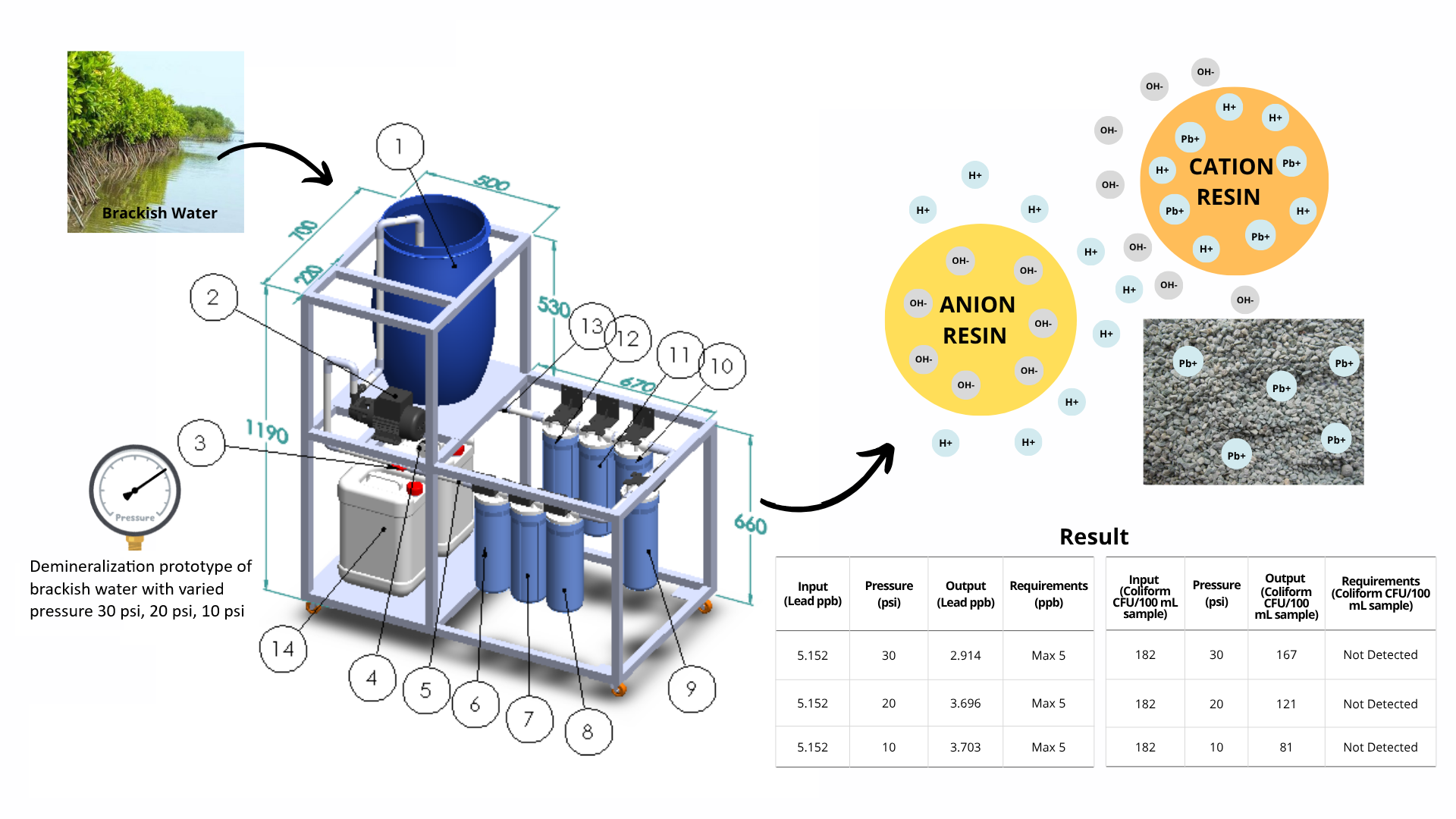
Brackish water is a mixture of freshwater and seawater and typically exhibits intermediate physicochemical characteristics. Cilacap City is located in a coastal area, resulting in the mixing of freshwater from river systems with seawater intrusion, thereby producing brackish water with relatively high mineral content. Demineralization is a water purification method that can be applied to treat this type of water or wastewater, producing water with significantly reduced mineral content suitable for various uses. Therefore, this research aimed to investigate the effects of operating pressure on turbidity, pH levels, lead (Pb) concentration, and coliform content during the demineralization of brackish water. This research was carried out from March to June, and the sample of brackish water was obtained from the Northern Cilacap Payau Forest Tour Area. Purification method of demineralization process consists of the filtering of silica sand, zeolite adsorption, membrane filtration, and ion exchange with anion resin and cation resin repeatedly. The best result obtained was a pressure of 10 psi with a pH level of 5.9, decreasing turbidity of 90.81%, lead level content of 28.125%, and coliform bacteria of 55.49%

References
[1] Astani, L. P., Supraba, I., & Jayadi, R. (2021). Analisis Kebutuhan Air Bersih Domestik dan Non Domestik. Jurnal Teknologi Sipil, 5(November), 34–41.
[2] Hilmi, E., Sari, L. K., & Amron. (2019). Distribusi Sebaran Mangrove Dan Faktor Lingkungan Pada Ekosistem Mangrove Segara Anakan Cilacap. Prosiding Seminar Nasional dan Call for Papers ”Pengembangan Sumber Daya Perdesaan dan Kearifan Lokal Berkelanjutan IX”, 2(November), 23–33. Retrieved from http://jurnal.lppm.unsoed.ac.id/ojs/index.php/Prosiding/article/view/1023
[3] Ardana, P. D. H., Soriarta, I. K., Pamungkas, T. H., & Made, I. (2022). Identifikasi Intrusi Air Laut Di Daerah Pesisir Pantai Mertasari- Sanur dengan Metode Vertical Elektrikal Sounding ( VES ) Interpretasi data Intrusi air laut. Konteks 16, 1179–1188. Retrieved from http://repo.unr.ac.id/id/eprint/798
[4] Munawar, M., Zulkifli, Z., & Sari, R. (2020). Pelatihan Perakitan Desalinator Sederhana Untuk Masyarakat Di Pemukiman Air Payau. Jurnal Vokasi, 5(1), 58. doi: 10.30811/vokasi.v4i2.1923
[5] Irawan, F. (2022). Penentuan Kualitas Mikrobiologis pada Proses Produksi Air Minum Dalam Kemasan (AMDK) Demineal PT. Segra Murni Utama Felicia Irawan, Dr. Dian Anggraini Suroto, S.T.P., M.P., M.Eng.; Ahmad Rilo Pambudi, S.T.P. Universitas Gadjah Mada. Retrieved from https://etd.repository.ugm.ac.id/penelitian/detail/207688
[6] BSN. (2015). Air Demineral. Badan Standardisasi Nasional Indonesia, 67–160.
[7] Pratiwi, I., Kurniasari, D., & Azaliyah, D. S. (2022). Efektivitas Kulit Udang (Metapenaeus Monoceros) Sebagai Biokoagulan Pada Air Sungai Kelekar Menjadi Air Bersih (Studi Kasus : Air Sungai Kelekar Sebagai Air Bersih Di Intake Water Plant Pltgu Indralaya). Jurnal KINETIKA, 3(1), 1–11. Retrieved from https://jurnal.polsri.ac.id/index.php/
[8] Hapis, A. A., & Sanuddin, M. (2021). Penjernihan Air Payau Sungai Serdang dengan Limbah Sekam Padi Sebagai Bahan Dasar Zeolit dalam Menurunkan Kadar Logam Besi (Fe) Dan Mangan (Mn) di Kabupaten Tanjung Jabung Barat. Jurnal Ilmiah Universitas Batanghari Jambi, 21(1), 14–17. doi: 10.33087/jiubj.v21i1.1299
[9] Naibaho, A. A., Harefa, M. S., Nainggolan, R. S., & Alfiaturahmah, V. L. (2022). Investigasi Pemanfaatan Hutan Mangrove dan Dampaknya Terhadap Daerah Pesisir di Pantai Mangrove Paluh Getah, Tanjung Rejo. J-CoSE: Journal of Community Service & Empowerment, 1(1), 22–33. doi: 10.58536/j-cose.v1i1.3
[10] BSN. (2009). Standar Nasional Indonesia Air dan air limbah-Bagian 8: Cara uji timbal (Pb) dengan Spektrofotometri Serapan Atom (SSA)-nyala Badan Standardisasi Nasional.
[11] BSN. (2015). SNI 6241:2015 Air Demineral. Jakarta: Badan Standar Nasional Indonesia.
[12] BSN. (2005). Standar Nasioanal Indonesia Air dan air limbah - Bagian 25 : Cara uji kekeruhan dengan nefelometer. Badan Standarisasi Nasioanal.
[13] Subagyo, R., & Isworo, H. (2020). Membrane Filtration Study With Variation in The Number On Peat Water Media. Eastern-European Journal of Enterprise Technologies, 107.
[14] Mangallo, B., Alfontus, R., Novitasari, A.D. (2023). Efektivitas metode sand filter dalam menurunkantingkat kekeruhan dan kadar E. Coliform pada air sumur. Jurnal Natural, 19(1), 89–93.
[15] Suryani, F., & Moulita, R. A. N. (2022). Analisis Pengaruh Waktu Dan Tekanan Terhadap Demineralisasi Air Buangan Ac Dengan Metode Reverse Osmosis. Jurnal Redoks, 7, 1–9. Retrieved from https://jurnal.univpgri-palembang.ac.id/index.php/redoks/article/view/7924
[16] Desmiarti, R. (2017). Kombinasi Proses Filtrasi dan Ion Exchange Secara Kontinu pada Pembuatan Aquadm (Demineralized Water). CHEMICA: Jurnal Teknik Kimia, 4(1), 27. doi: 10.26555/chemica.v4i1.6730
[17] Trianah, Y., & Sani, S. (2023). Keefektifan Metode Filtrasi Sederhana Dalam Menurunkan Kadar Mn (Mangan) Dan (Fe) Besi Air Sumur di Kelurahan Talang Ubi Kabupaten Musi Rawas. Jurnal Deformasi, 8(1), 90–99. doi: 10.31851/deformasi.v8i1.11454
[18] Akbar, D. R., Kuspambudijaya, A. D., & Utami, I. (2020). Demineralisasi Air Ac Dengan Membrane Reverse Osmosis. Jurnal Teknik Kimia, 15(1), 28–33. doi: 10.33005/jurnal_tekkim.v15i1.2300
[19] Said, I. (2012). Analisis Logam Timbal ( Pb ) dan Besi ( Fe ) dalam Air Laut di Wilayah Pesisie Pelabuhan Ferry Taipa Kecamatan Palu Utara The Analysis of Lead ( Pb ) and Iron (Fe) Metals in The Sea Water of Coastal Area of Taipa ’ s Ferry Harbor Subdistrict of North Pa. Jurnal Akademia Kimia, 1(November), 181–186.
Downloads
Published
How to Cite
Issue
Section
License
Copyright (c) 2025 CHEESA: Chemical Engineering Research Articles

This work is licensed under a Creative Commons Attribution-NonCommercial-ShareAlike 4.0 International License.
- Previous License: Creative Commons Attribution-NonCommercial-ShareAlike (CC BY-NC-SA)
- New License: Creative Commons Attribution (CC BY 4.0)
Previous copyright: With the receipt of the article by CHEESA Editorial Board and the decision to be published, the copyright regarding the article will be transferred to CHEESA Journal. CHEESA has the right to multiply and distribute the article and every author is not allowed to publish the same article that was published in this journal.
New Copyright: Authors who publish with this journal agree to the following terms:
Authors retain copyright and grant the journal right of first publication with the work simultaneously licensed under a Creative Commons Attribution License (CC BY 4.0) that allows others to share the work with an acknowledgement of the work's authorship and initial publication in this journal.


