The Antibacterial Potential of Ethyl Acetate Fraction from Plectranthus amboinicus Leaves and Identification of Active Compounds Using LC-MS
DOI:
https://doi.org/10.25273/cheesa.v7i1.13826.15-23Keywords:
Keywords, Antibacterial activity, Ethyl acetate fraction, LC-MS, Plectranthus AmboinicusAbstract
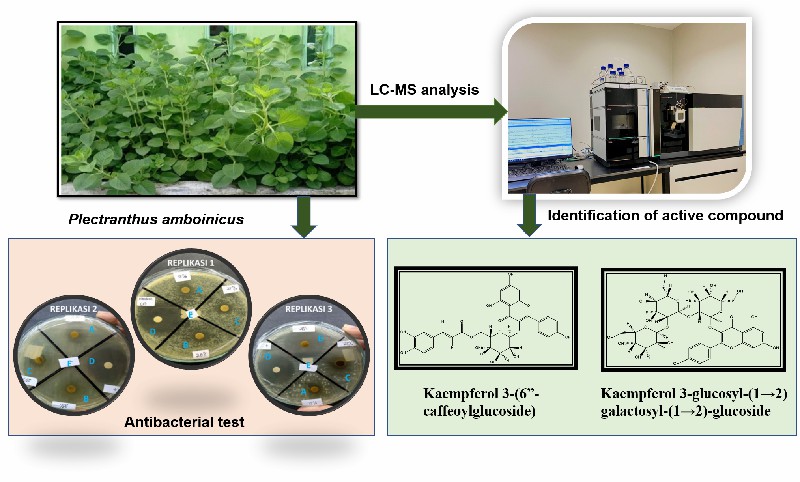
The Indian Borage plant (Plectranthus amboinicus) is a traditional medicinal ingredient in Indonesia, containing flavonoids, alkaloids, polyphenols, saponins, and essential oils. Therefore, this study aimed to determine the antibacterial activity of P. amboinicus leaves ethyl acetate fraction using the disc diffusion method and identify the composition with LC-MS. The antibacterial activity test was conducted with concentration variations of 15%, 20%, and 25% with Chloramphenicol 500 mg and 5% DMSO as a positive and negative control, respectively. The results showed that the ethyl acetate fraction at a concentration of 20% had the largest inhibition zone diameter, with an average of 30 mm. The LC-MS results identified 115 compounds, and the highest concentration values were found in kaempferol 3-(6-caffeoylglucoside) and kaempferol 3-glucosyl-(1?2) galactosyl-(1?2)-glucoside, with a composition of 3.26109% and 3.26141%, respectively.

References
[1] Alaydrus, S. (2020). Tingkat Pengetahuan Masyarakat Terhadap Pembuatan Dan Penggunaan Obat Tradisional Di Desa Sunju Rt Ii Kecamatan Marawola Kabupaten Sigi Provinsi Sulawesi Tengah. Jurnal farmasi UIN Alauddin Makassar, 8(2), 46-53. [Sources]
[2] Yuniarachmah, A., Roviq, M., & Nihayati, E. (2019). Respon Pertumbuhan dan Kandungan Flavonoid Tanaman Bangun-Bangun (Plectranthus amboinicus Lour.) pada Berbagai Kerapatan Naungan dan Dosis Pupuk Nitrogen Response of Growth and Flavonoid Content of Plectranthus amboinicus Lour at Various Shade Density and. Jurnal Produksi Tanaman, 7(12), 2206-2214.
[3] Agustianasari, I., Mulqie, L., & Choesrina, R. (2016). Uji Aktivitas Antibakteri Ekstrak dan Fraksi Biji Jinten Hitam ( Nigella sativa L .) terhadap Bakteri Bacillus subtilis dan Escherichia coli Test Antibacterial Extract Activity and Biji Jinten Hitam Fraction ( Nigella sativa L .) Divisi: Magnoliophyta Ke. Prosiding Farmasi, 682-690.
[4] Munawaroh, S., & Prima Astuti, H. (2010). Ekstraksi Minyak Daun Jeruk Purut dengan Pelaruit Etanol dan n-Heksan. Jurnal Kompetensi Teknik, 1-23.
[5] Suryati, N., Bahar, E., & Ilmiawati, I. (2018). Uji Efektivitas Antibakteri Ekstrak Aloe vera Terhadap Pertumbuhan Escherichia coli Secara In Vitro. Jurnal Kesehatan Andalas, 6(3), 518-522. DOI: 10.25077/jka.v6i3.732
[6] Ratnawati, D. (2011). Preliminary Test of Determination of Alkoloid and Steroid Compounds and Bioassay on Some Vegetable Plant Extract. Jurnal Gradien, 7(7), 692-696.
[7] Shahdadi, F., Mirzaei, H.O., & Garmakhany, A. . (2015). Study of phenolic compound and antioxidant activy of date fruit as a function of ripering stages and drying proceess. Journal of Food Science and Tehnology, 52, 1814-1819.
[8] Zalfiatri, Y., Hamzah, F., & Simbolon, M. T. (2018). Pembuatan Sabun Transparan Dengan Penambahan Ekstrak Batang Pepaya Sebagai Antibakteri. Chempublish Journal, 3(2), 57-68. DOI: 10.22437/chp.v3i2.5713
[9] Wardhani, R. R. A. A. K., Akhyar, O., & Prasiska, E. (2018). Analisis skrining fitokimia, kadar total fenol-flavonoid dan aktivitas antioksidan ekstrak etanol kulit kayu tanaman galam rawa gambut (Melaleuca cajuputi roxb). Al Ulum: Jurnal Sains Dan Teknologi, 4(1), 39. DOI: 10.31602/ajst.v4i1.1589
[10] Harborne, J. B. (2006). Metode Fitokimia Penentuan Cara Modern Menganalisis Tumbuhan. ITB.
[11] Ukoha, P.O., Cemaluk, E.A.C., Nnamdi, O. L., & Madus, E. P. (2011). Tannins and other phytochemical of the samannea saman pods and their antimicrobial activities. African Journal of Pure and Applied Chemistry, 5(8), 237-244.
[12] Kabense R., Ginting E.V., Wullur S., Kawung J.N., Losung F., & Tombokan. J. L. (2019). Penapisan Bakteri Proteolitik yang Bersimbiosis dengan Alga Gracillaria sp. Jurnal Ilmiah Platax, Fakultas Perikanan dan Kelautan, 7(2), 413-418.
[13] Fatimah, F., Martha, R. D., & Kusumawati, A. (2020). Deteksi dan Identifikasi Senyawa Flavonoid Ekstrak Etanol Kulit Batang Tanaman Majapahit (Crescentia cujete) dengan LCMS. CHEESA: Chemical Engineering Research Articles, 3(2), 88-98. DOI: 10.25273/cheesa.v3i2.7688.88-98
[14] Fatimah, F., Martha, R. D., & Danar, D. (2022). Analisis toksisitas dan potensi antikanker ekstrak metanol daun Majapahit (Crescentia cujete) dengan metode Brine Shrimp Lethality Test. Jurnal Penelitian Saintek, 27(1), 24-30.
[15] Hatupea. (1994). Metode Fitokimia. ITB Press: Bandung.
[16] Wardhani R.R.A.A.K., Akhyar O., & Prasiska. E. (2018). Analisis Skrining Fitokimia, Kadar Total Fenol-Flavonoid dan Aktivitas Antioksidan Ekstrak Etanol Kulit Kayu Tanaman Galam Rawa Gambut(Melaleucea cajuputi roxb). Al Ulum Sains dan Teknologi, 4(1).
Downloads
Published
How to Cite
Issue
Section
License
Copyright (c) 2024 CHEESA: Chemical Engineering Research Articles

This work is licensed under a Creative Commons Attribution-NonCommercial-ShareAlike 4.0 International License.
- Previous License: Creative Commons Attribution-NonCommercial-ShareAlike (CC BY-NC-SA)
- New License: Creative Commons Attribution (CC BY 4.0)
Previous copyright: With the receipt of the article by CHEESA Editorial Board and the decision to be published, the copyright regarding the article will be transferred to CHEESA Journal. CHEESA has the right to multiply and distribute the article and every author is not allowed to publish the same article that was published in this journal.
New Copyright: Authors who publish with this journal agree to the following terms:
Authors retain copyright and grant the journal right of first publication with the work simultaneously licensed under a Creative Commons Attribution License (CC BY 4.0) that allows others to share the work with an acknowledgement of the work's authorship and initial publication in this journal.