Deteksi dan Identifikasi Senyawa Flavonoid Ekstrak Etanol Kulit Batang Tanaman Majapahit (Crescentia cujete) dengan LCMS
DOI:
https://doi.org/10.25273/cheesa.v3i2.7688.88-98Keywords:
antikanker, Crescentia cujete, ekstrak etanol, flavonoid, LCMSAbstract
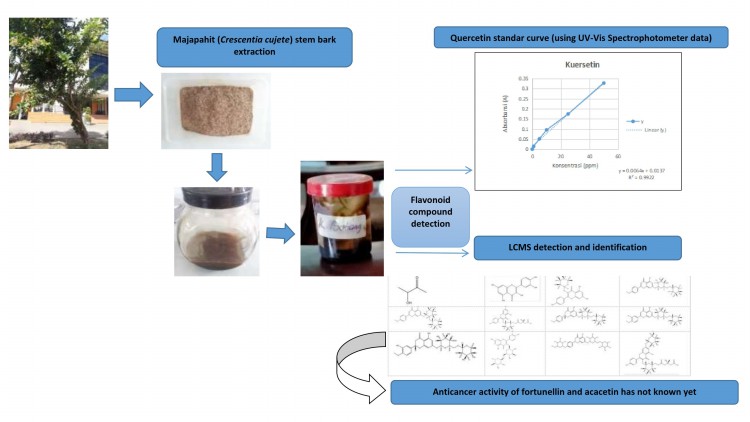
Tanaman Majapahit (Crescentia cujete) merupakan salah satu tanaman yang banyak tersebar di Indonesia. Namun, tanaman ini kurang mendapatkan perhatian, karena kurangnya informasi mengenai potensi tanaman tersebut. Flavonoid merupakan salah satu kelompok senyawa terbesar yang terdapat pada tanaman yang memiliki beberapa fungsi farmakologis dan medisinal, salah satunya anti kanker. Dalam penelitian ini, dilakukan deteksi dan identifikasi senyawa flavonoid pada ekstrak etanol kulit batang tanaman majapahit menggunakan LCMS, untuk mengetahui potensi tanaman majapahit sebagai salah satu kandidat tanaman potensial antikanker. Berdasarkan hasil deteksi menggunakan LCMS diketahui terdapat sekitar 88 senyawa yang terdeteksi, termasuk didalamnya 12 senyawa flavonoid. Senyawa flavonoid yang ditemukan, yaitu; acetoin, quercetine, kaempferol-3-O-rhamnoside, acacetin7-rutinoside, fortunellin, kaempferol 3-[6"-(3-hydroxy-3-methylglutaryl) glucoside], didymin, diosmin, hesperidin, rutin, narirutin 4'-glucoside, kaempferol 3-[6"-(3-hydroxy-3-methylglutaryl) glucoside]-7-glucoside. Kaempferol-3 -O-rhamnoside merupakan flavonoid dengan komposisi terbesar yakni, sebesar 4,072%. Keseluruhan flavonoid yang teridentifikasi memiliki potensi sebagai antikanker, kecuali acetoin dan fortunellin.

References
Abotaleb, M., Samuel, S. M., Varghese, E., Varghese, S., Kubatka, P., Liskova, A., & Busselberg, D. (2019). Flavonoids in Cancer and Apoptosis. Cancer, 11(1), 28-66, DOI: 10.3390/cancers11010028 DOI: https://doi.org/10.3390/cancers11010028
Agati, G., Azzarello, E., Pollastri, S. & Tattini, M. (2012). Flavonoids as Antioxidants in Plants: Location and Functional Signifificance. Plant Science, 196(2012), 67-76, DOI: 10.1016/j.plantsci.2012.07.014 DOI: https://doi.org/10.1016/j.plantsci.2012.07.014
Alghazeer, R., Elgahmasi, S., Elnfati, A, H., Elhensheri, M., Al-Griw, M. A., Awayn., N. & El-Nami, M. (2018). Antioxidant Activity and Hepatoprotective Potential of Flavonoids from Arbutus pavarii Against CCl4 Induced Hepatic Damage. Biotechnology Journal International, 21(1), 1-12, DOI: 10.9734/BJI/2018/39528 DOI: https://doi.org/10.9734/BJI/2018/39528
Araujo, J. R., Goncalvez., P. & Martel, F. (2011). Chemopreventive Effect of Dietary Polyphenols in Colorectal Cancer Cell lines. Nutrition Research, 31(2), 77-87, DOI: 10.1016/j.nutres.2011.01.006 DOI: https://doi.org/10.1016/j.nutres.2011.01.006
Das, N., Islam, M. E., Jahan, N., Islam, M. S., Khan, A., Islam, M. R. & Parvin, M. S. (2014). Antioxidant Activities of Ethanol Extracts and Fractions of Crescentia cujete Leaves and Stembark and The Involvement of Phenolic Compounds. BMC Complentary and Alternative Medicine, 14(1), 45, DOI: 10.1186/1472-6882-14-45 DOI: https://doi.org/10.1186/1472-6882-14-45
Devi, K. P., Rajavel, T., Nabavi, S. F., Setzer, W. N., Ahmadi, A., Mansouri, K., & Nabavi, S. M. (2015). Hesperidin: A Promising Anticancer Agent. Industrial Crops and Products, 6(2015), 582-589, DOI: 10.1016/j.indcrop.2015.07.051 DOI: https://doi.org/10.1016/j.indcrop.2015.07.051
Diab, K.. A. E., Shafik, R. E. S. & Yasuda, S. (2015). In Vitro Antioxidant and Antiproliferative Activities of Novel Orange Peel Extract and It's Fractions on Leukemia HL-60 Cells. Asian Pacific Journal of Cancer Prevention, 16(16), 7053-7060, DOI: 10.7314/apjcp.2015.16.16.7053 DOI: https://doi.org/10.7314/APJCP.2015.16.16.7053
Diab, Y., Atalla, K. & Elbanna, K., (2012). Antimicrobial Screening of Some Egyptian Plants and Active Flavones from Lagerstroemia indica Leaves. Drug Discovery Therapeutic, 6(4), 212-217, DOI: 10.5582/ddt.2012.v6.4.212 DOI: https://doi.org/10.5582/ddt.2012.v6.4.212
Diantini, A., Subarnas, A., Lestari, K., Halimah, E., Susilawati, Y., Supriyatna., Julaeha, E., Achmad, T. H., Suradji, E. W., Yamazaki, C., Kobayashi, K., & Abdulah, R. (2011). Kaempferol-3-O-rhamnoside Isolated From The Leaves of Schima wallichii Korth. Inhibits MCF-7 Breast Cancer Cell Proliferation Through Activation of The Caspase Cascade Pathway. Oncology Letters, 3(2012), 1069-1072, DOI: 10.3892/ol.2012.596 DOI: https://doi.org/10.3892/ol.2012.596
Grassi, D., Desideri, G. & Ferri, C. (2010). Flavonoids: Antioxidants Againts Atherosclerosis. Nutrients, 2(8), 889-902, DOI: 10.3390/nu2080889 DOI: https://doi.org/10.3390/nu2080889
Greenwell, M. & Rahman, P. K. S. M. (2015). Medicinal Plants: Their Use in Anticancer Treatment. International Journal of Pharmaceutical Sciences and Research, 6(4), 4103-4112, DOI: 10.13040/IJPSR.0975-8232.6(10).4103-12 DOI: https://doi.org/10.13040/IJPSR.0975-8232.6(10).4103-12
Imran, M., Salehi, B., Sharifi-Rad, J., Gondal, T. A. Saeed, F., S., Imran, A.., Shahbaz, M., Fokou, P. V. T., Arshad, M. U., Khan, H., Guerreiro, S. G., Matrins, N., & Estevinho, L. M. (2019). Kaempferol: A Key Emphasis to Its Anticancer Potential. Molecules, 24(12), 2277-2283, DOI: 10.3390/molecules24122277 DOI: https://doi.org/10.3390/molecules24122277
Kim, W. K., Bang, M. H., Kim, E. S., Kang, N. E., Jung, K. C., Cho, H. J. & Park, J. H. Y. (2005). Quercetin Decreases The Expression of ErbB2 and ErbB3 Proteins in HT-29 Human Colon Cancer Cells. The Journal of Nutritional Biochemistry, 16(3), 155-162, DOI: 10.1016/j.jnutbio.2004.10.010 DOI: https://doi.org/10.1016/j.jnutbio.2004.10.010
Kumar, S., & Pandey, A. K. (2013). Chemistry and Biological Activities of flavonoids: An Overview. The Scientific World Journal, 2013(29), 1-16, DOI: 10.1155/2013/162750 DOI: https://doi.org/10.1155/2013/162750
Lalani, S., & Poh, C. L. (2020). Flavonoids as Antiviral Agents for Enterovirus A71 (EV-A71). Viruses, 12(2), 184-219, DOI: 10.3390/v12020184 DOI: https://doi.org/10.3390/v12020184
Lee, K-A., Lee, S-H., Lee, Y-J., Baeg, S. M. & Shim, J-H. (2012). Hesperidin Induces Apoptosis by Inhibiting Sp1 and Its Regulatory Protein MSTO-211H Cells. Biomolecules & Therapeutics, 20(3), 273-279, DOI: 10.4062/biomolther.2012.20.3.273 DOI: https://doi.org/10.4062/biomolther.2012.20.3.273
Lewinska, A., Siwak, J., Rzeszutek, I. & Wnuk, M. (2015). Diosmin Induces Genotoxicity and Apoptosis in DU145 Prostate Cancer Cell line. Toxicology in Vitro, 29(3), 417-425, DOI: 10.1016/j.tiv.2014.12.005 DOI: https://doi.org/10.1016/j.tiv.2014.12.005
Mota, K. S. D. L., Dias, G. E. N., Pinto, M. E. F., Luiz-Fereira, A., Souza-Brito, A. R. M., Hiruma-Lima, C. A., Barbosa-Filho, J. M., & Batista, L. M. B. (2009). Flavonoids with Gastroprotective Activity. Molecules, 14(3), 979-1012, DOI: 10.3390/molecules14030979 DOI: https://doi.org/10.3390/molecules14030979
Panche, A. N., Diwan, A. D., & Chandra, S. R. (2016). Flavonoids: An Overview. Journal of Nutritional Science, 5(47), 1-15, DOI: 10.1017/jns.2016.41 DOI: https://doi.org/10.1017/jns.2016.41
Perumal, S & Langeswaran, K. (2019). Diosmin Anti-Tumor Efficacy Against Hepatocellular Carcinoma. Biomedical Research, 30(6), 1-10.
Saibaba, S. V., Kumar, M. S., & Shanmuga, P. (2016). Mini Review on LC/MS Techniques. World Journal of Pharmacy and Pharmaceutical Science, 5(4), 2381-2395
Sghaier, M. B., Pagano, A., Mousslim, M., Ammari, Y., Kovacic, H. & Luis, J. (2016). Rutin Inhibits Proliferation, Attenuates Superoxide Production and Decreases Adhesion and Migration of Human Cancerous Cells. Biomedicine & Pharmacotheraphy, 84(2016), 1972-1978, DOI: 10.1016/j.biopha.2016.11.001 DOI: https://doi.org/10.1016/j.biopha.2016.11.001
Singh, R. P., Agrawal, P., Yim, D., Agarwal, C. & Agarwal, R. (2005). Acacetin Inhibits Cell Growth and Cell Progression, and Induces Apoptosis in Human Prostate Cancer Cells: Structure-Activity Relationship with Linarin and Linarin Acetate. Carcinogenesis, 26(4), 845-854, DOI: 10.1093/carcin/bgi014 DOI: https://doi.org/10.1093/carcin/bgi014
Singhal, S. S., Singhal, S., Singhal, P., Singhal, J., Horne, D. & Awasthi, S. (2017). Didymin: An Orally Active Citrus Flavonoid for Targeting Neuroblastoma. Oncotarget, 8(17), 29428-29441, DOI: 10.18632/oncotarget.15204 DOI: https://doi.org/10.18632/oncotarget.15204
Smith, B. A & Dollear, F. G. (1947). Oil From Calabash Seed, Crescentia cujete, L. The Journal of The American Oil Chemist Society, 24(2), 52-54, DOI: 10.1007/BF02642127 DOI: https://doi.org/10.1007/BF02642127
Spagnuolo, C., Moccia, S. & Russo, G. L. (2017). Anti-inflammatory Effects of Flavonoids in Neurodegenerative Disorders. European Journal of Medicinal Chemistry, 153(30), 105-115, DOI: 10.1016/j.ejmech.2017.09.001 DOI: https://doi.org/10.1016/j.ejmech.2017.09.001
Stankovic, M. S., Niciforovic, N., Topuzovic, M., & Slavica, S. (2011). Total Phenolic Content, Flavonoid Concentrations and Antioxidant Activity of The Whole Plant And Plant Extracts From Teucrium Montanum L. var Montanum, F. Supinum (L.) Reichen B. Biotechnology and Biotechnology Equipment, 25(1), 2222-2227, DOI: 10.5504/BBEQ.2011.0020 DOI: https://doi.org/10.5504/BBEQ.2011.0020
Tattini, M., Gravanno, E., Pinelli, P., Mulinacci, N., & Romani, A. (2000). Flavonoids Accumulate in Leaves and Glandular Trichomes of Phillyrea latifolia Exposed to Excess Solar Radiation. New Phytologist, 148(1), 69-77, DOI: 10.1046/j.1469-8137.2000.00743.x DOI: https://doi.org/10.1046/j.1469-8137.2000.00743.x
Weston, L. A., & Mathesius, U. (2013). Flavonoids: Their Structure, Biosynthesis, and Role in the Rhizosphere, Including Allelopathy. Journal of Chemical Ecology, 39(2), 283-297, DOI: 10.1007/s10886-013-0248-5 DOI: https://doi.org/10.1007/s10886-013-0248-5
Woodman, O. L., Meeker, W. F. & Boujaoude, M. (2005). Vasorelaxant and Antioxidant Activity of Flavonols and Flavones: Structure Activity Relationship. Journal Cardiovascular Pharmacology, 46(3), 302-309, DOI: 10.1097/01.fjc.0000175431.62626.07 DOI: https://doi.org/10.1097/01.fjc.0000175431.62626.07
Xiao, Z & Lu, J. R. (2014). Generation of Acetoin and Its Derivatives in Foods. Journal of Agricultural and Food Chemistry, 62(28), 6487-6497, DOI: 10.1021/jf5013902 DOI: https://doi.org/10.1021/jf5013902
Xiong, Y., Qiu, J., Li, C., Qiu, Y., Guo, L., Liu, Y., Wan, J., Li, Y., Wu, G., Wang, L., Zhou, Z., Dong, J., Du, C., Chen, D. & Guo, H. (2018). Fortunellin-Induced Modulation of Phosphatase and Tensin Homolog by MicroRNA-374a Decreases Inflammation and Maintains Intestinal Barrier Function in Colitis. Frontiers in Immunology, 9(83), 1-11, DOI: 10.3389/fimmu.2018.00083 DOI: https://doi.org/10.3389/fimmu.2018.00083
Yang, F., Song, L., Wang, H., Wang, J., Xu, Z. & Xing, N. (2015). Quercetin in Prostate Cancer: Cheotherapeutic and Chemopreventive Effects, Mechanism and Clinical Application Potentian (Review). Oncology Reports, 33(6), 2659-2668, DOI: 10.3892/or.2015.3886 DOI: https://doi.org/10.3892/or.2015.3886
Downloads
Published
How to Cite
Issue
Section
License
Copyright (c) 2020 CHEESA: Chemical Engineering Research Articles

This work is licensed under a Creative Commons Attribution-NonCommercial-ShareAlike 4.0 International License.
- Previous License: Creative Commons Attribution-NonCommercial-ShareAlike (CC BY-NC-SA)
- New License: Creative Commons Attribution (CC BY 4.0)
Previous copyright: With the receipt of the article by CHEESA Editorial Board and the decision to be published, the copyright regarding the article will be transferred to CHEESA Journal. CHEESA has the right to multiply and distribute the article and every author is not allowed to publish the same article that was published in this journal.
New Copyright: Authors who publish with this journal agree to the following terms:
Authors retain copyright and grant the journal right of first publication with the work simultaneously licensed under a Creative Commons Attribution License (CC BY 4.0) that allows others to share the work with an acknowledgement of the work's authorship and initial publication in this journal.