Silica Adsorption from Boiler Effluent Using Activated Charcoal Derived from Palm Oil Fibre Waste with H3PO4 Activator
DOI:
https://doi.org/10.25273/cheesa.v7i2.17500.75-83Keywords:
activated charcoal; adsorption; fibre waste; phosphoric acid; pyrolysisAbstract
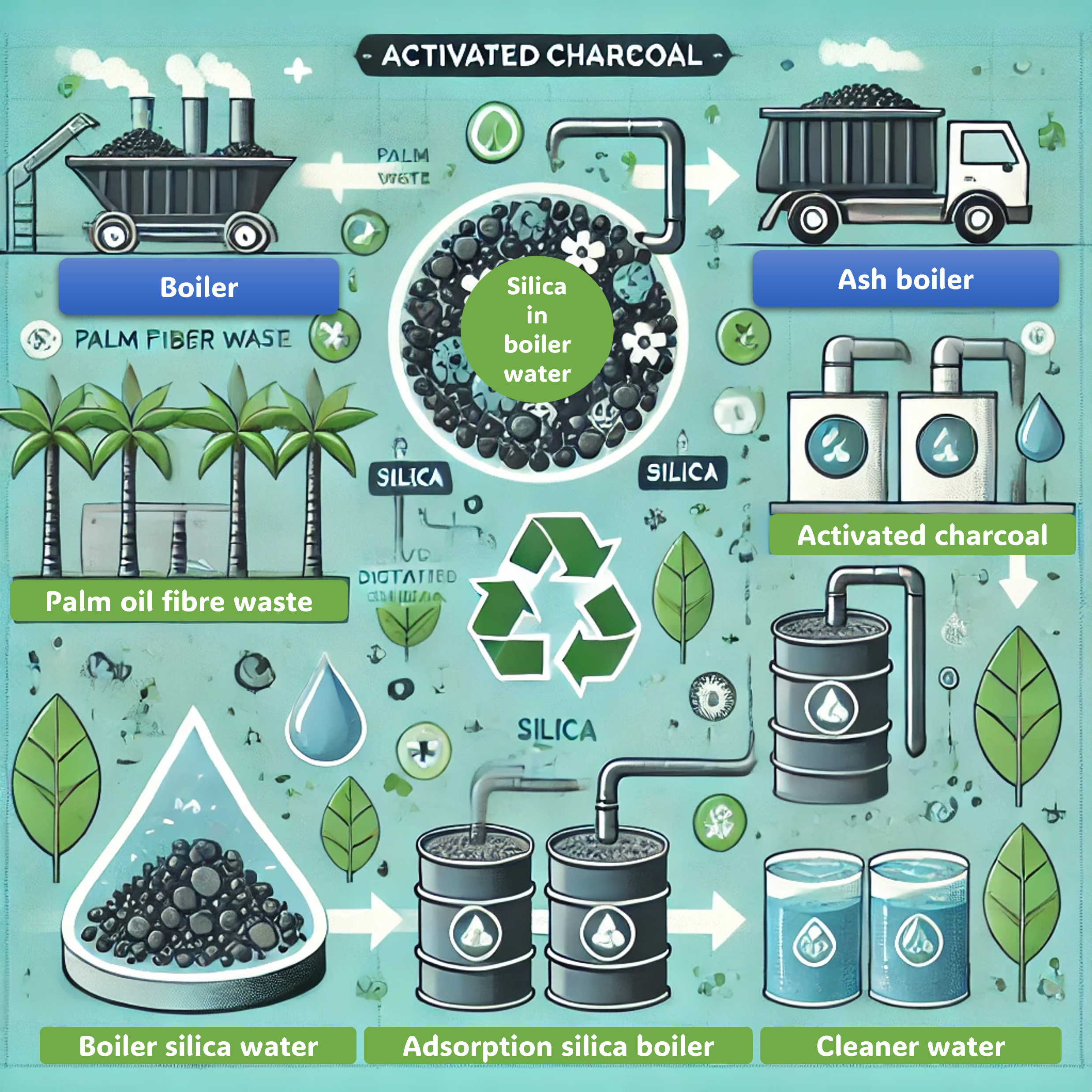
Most waste from palm oil processing can be repurposed, such as using palm fibre waste to create activated charcoal. This study aimed to assess the effectiveness of activated charcoal, produced by activating palm fibre with H?PO?, in removing silica from boiler output water. The production process involved pyrolysis at 200ºC for 2.5 hours. A completely randomized design was employed to test the effects of different H?PO? concentration (with 1 to 2 M) and reaction times (30, 60, and 90 min). Results revealed that the moisture content of the activated charcoal ranged from 1.96% to 2.42%, ash content from 9.82% to 21.63%, and iodine adsorption from 366.43 to 457.87 mg/g. The highest silica adsorption capacity (3.5 g/g) was achieved with 2 M H?PO? for 90 min. This indicates that palm fibre-derived activated charcoal is effective for silica removal, highlighting it is potential for enhancing environmental sustainability in industrial sector.

References
[1] Haryanti, A., Norsamsi, N., Fanny Sholiha, P. S., & Putri, N. P. (2014). Studi Pemanfaatan Limbah Padat Kelapa Sawit. Konversi, 3 (2), 20-20. DOI: 10.20527/k.v3i2.161
[2] Shivashankar, S., Suresh, K., Anitha, P., & Sathish, A. (2024). Chapter-6 Processing of Oil Palm Bunches and Valorization of Oil Palm Biomass. Practices Research, 97. https://doi.org/10.22271/ed.book.2607
[3] Chen, Y., Su, N., Zhang, K., Zhu, S., Zhu, Z., Qin, W., Yang, Y., Shi, Y., Fan, S., & Wang, Z. (2018). Effect of fibre surface treatment on structure, moisture absorption and mechanical properties of luffa sponge fibre bundles. Industrial Crops and Products, 123 341-352. https://doi.org/10.1016/j.indcrop.2018.06.079
[4] Fine, F. S., Charloq, & Ferry, E. T. S. (2016). Penambahan Sabut Kelapa pada Media Tanam dan Frekuensi Penyiraman terhadap Pertumbuhan Kecambah Kelapa Sawit (Elaeis quineensis Jacq.) diPre Nursery. Jurnal Agroteknologi FP USU, 6 (3), 1-23. https://doi.org/10.32734/joa.v6i3.2403
[5] Widodo, L. U., Najah, S., & Istiqomah, C. (2020). Pembuatan Adsorben Berbahan Baku Tanah Liat Dari Limbah Industri Pencucian Pasir Silika Dengan Perbedaan Konsentrasi Hcl Dan Waktu Aktivasi. Journal of Research and Technology, 6 (1), 10-15. https://doi.org/10.55732/jrt.v6i1.134
[6] Herlambang, M. J., Ramandani, A. A., Cendekia, D., Rhea, L., & Efendi, M. N. (2023). Optimization and Characterization of Adsorbent from Palm Kernel Shell Waste Using H3PO4 Activator. CHEESA: Chemical Engineering Research Articles, 6 (2), 118-125. http://dx.doi.org/10.25273/cheesa.v6i2.15906.118-125
[7] Sholikhah, H. I., Putri, H. R., & Inayati, I. (2021). Pengaruh Konsentrasi Aktivator Asam Fosfat (H3PO4) pada Pembuatan Karbon Aktif dari Sabut Kelapa terhadap Adsorpsi Logam Kromium. Equilibrium Journal of Chemical Engineering, 5 (1), 45-45. https://doi.org/10.20961/equilibrium.v5i1.53572
[8] Gao, Y., Yue, Q., Gao, B., & Li, A. (2020). Insight into activated carbon from different kinds of chemical activating agents: A review. Sci. Total Environ., 746 141094. https://doi.org/10.1016/j.scitotenv.2020.141094
Downloads
Published
How to Cite
Issue
Section
License
Copyright (c) 2024 CHEESA: Chemical Engineering Research Articles

This work is licensed under a Creative Commons Attribution-NonCommercial-ShareAlike 4.0 International License.
- Previous License: Creative Commons Attribution-NonCommercial-ShareAlike (CC BY-NC-SA)
- New License: Creative Commons Attribution (CC BY 4.0)
Previous copyright: With the receipt of the article by CHEESA Editorial Board and the decision to be published, the copyright regarding the article will be transferred to CHEESA Journal. CHEESA has the right to multiply and distribute the article and every author is not allowed to publish the same article that was published in this journal.
New Copyright: Authors who publish with this journal agree to the following terms:
Authors retain copyright and grant the journal right of first publication with the work simultaneously licensed under a Creative Commons Attribution License (CC BY 4.0) that allows others to share the work with an acknowledgement of the work's authorship and initial publication in this journal.


