Kinetika Ekstraksi Minyak Atsiri Lada Hitam (Piper nigrum) Secara Hidrodistilasi
DOI:
https://doi.org/10.25273/cheesa.v3i2.7388.63-70Keywords:
ekstraksi, hidrodistilasi, kinetika, lada hitam, orde duaAbstract
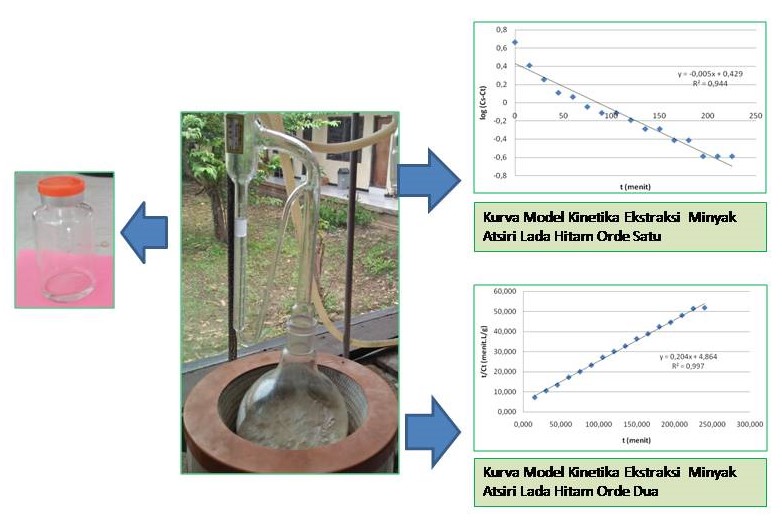
Lada hitam dikenal dengan nama King of Spices yang merupakan salah satu komoditi unggulan ekspor asal Provinsi Lampung. Lada hitam memiliki aroma dan rasa pedas yang khas. Kontribusi aroma berasal dari senyawa volatile yang terkandung pada minyak atsiri dalam lada hitam. Minyak atsiri lada diperoleh dari ekstraksi pelarut, hidrodistilasi, distilasi uap, distilasi fluida super kritik dan hidrodistilasi menggunakan microwave. Nilai konsentrasi minyak atsiri selama ekstraksi serta laju ekstraksi dapat diprediksi dari model kinetika. Tujuan penelitian ini adalah mempelajari ekstraksi minyak atsiri lada hitam dan mengetahui model kinetika ekstraksi minyak atsiri lada hitam secara hidrodistilasi. Hidrodistilasi dilaksanakan selama 5 jam dengan pengambilan data setiap 15 menit. Hasil penelitian memperlihatkan kinetika ekstraksi lada hitam mengikuti model kinetika ekstraksi orde kedua. Nilai parameter kinetika orde kedua dari ekstraksi minyak atsiri lada hitam yaitu kapasitas ekstraksi minyak atsiri lada,Cs, laju awal ekstraksi, h, dan konstanta laju ekstraksi, k masing-masing adalah 4,9 gL-1, 0,206 g L-1menit-1 dan 0,0086 g-1L menit-1 dan nilai determinasi sebesar 99,97%. Hasil eksperimen didapat perolehan ekstraksi sebesar 5,14%.
References
Alara O. R. & Abdurahman N. H. (2019). Kinetics Studies On Effects Of Extraction Techniques On Bioactive Compounds From Vernonia cinerea Leaf. J Food Sci Technol., 56, 580-588. DOI: 10.1007/s13197-018-3512-4
Andras, C.D., Volf, I., Salamon R.,V., Barabas, I., & Szep, A. (2015). Influence of Extraction Methods On Caraway (carum carvi l.) Essential Oil Yield And Carvone/Limonene Ratio. Environmental Engineering and Management Journal, 14(2), 341-347. DOI: 10.30638/eemj.2015.034
Anggraini, R., Jayuska, A., & Alimuddin, A.H. (2018). Isolasi dan Karakterisasi Minyak Atsiri Lada Hitam (Piper nigrum l.) Asal Sajingan Kalimantan Barat. Jurnal Kimia Khatulistiwa, 7(4), 124-133.
Cassel, E.,Vargas, R.M.F., Martinez, N.,Lorenz, D. & Dellacassa, E. (2009). Steam Distillation Modeling for Essential Oil Extraction Process. Industrial Crops And Products, 29(1), 171-176. DOI: 10.1016/j.indcrop.2008.04.017
Filly, A., Fernandez. X., Minuti, M., Chemat, F., Visinoni, F., & Cravotto, G. (2014). Solvent-free Microwave Extraction Of Essential Oil From Aromatic Herbs : From Laboratory to Pilot And Industrial Scale. Food Chemistry, 1(150), 193-198. DOI: 10.1016/j.foodchem.2013.10.139
Izadifar, M., & Abdolahi F. (2006). Comparison Between Neural Network and Mathematical Modeling Of Supercritical CO2 Extraction Of Black Pepper Essential Oil. J. of Supercritical Fluids, 38(1), 37-43. DOI: 10.1016/j.supflu.2005.11.012
Kumoro, A. C., Hasan, M. & Singh, H. (2010). Extraction of Sarawak Black Pepper Essential Oil Using Supercritical Carbon Dioxide. The Arabian Journal for Science and Engineering, 35(2B), 7-16. LINK
Kusuma, H. S., & Mahfud, M. (2015). Preliminary Study: Kinetics of Oil Extraction from Sandalwood by Microwave-assisted Hydrodistillation. ASEAN Journal of Chemical Engineering, 15(2), 62-69. DOI: 10.22146/ajche.49687
Kusuma, H.S., Rohadi, T.I., Daniswara, E.F., Altway, A. & Mahfud. (2017). Preliminary Study: Comparison of Kinetic Models of Oil Extraction from Vetiver (Vetiveria Zizanioides) by Microwave Hydrodistillation. Korean Chem. Eng. Res., 55(4), 574-577. DOI: 10.9713/kcer.2017.55.4.574
Maharaj, S. & McGaw, D. (2020). Mathematical Model for the Removal of Essential Oil Constituents during Steam Distillation Extraction. Processes, 8(400), 2-13. DOI: 10.3390/pr8040400
Downloads
Published
How to Cite
Issue
Section
License
Copyright (c) 2020 CHEESA: Chemical Engineering Research Articles

This work is licensed under a Creative Commons Attribution-NonCommercial-ShareAlike 4.0 International License.
- Previous License: Creative Commons Attribution-NonCommercial-ShareAlike (CC BY-NC-SA)
- New License: Creative Commons Attribution (CC BY 4.0)
Previous copyright: With the receipt of the article by CHEESA Editorial Board and the decision to be published, the copyright regarding the article will be transferred to CHEESA Journal. CHEESA has the right to multiply and distribute the article and every author is not allowed to publish the same article that was published in this journal.
New Copyright: Authors who publish with this journal agree to the following terms:
Authors retain copyright and grant the journal right of first publication with the work simultaneously licensed under a Creative Commons Attribution License (CC BY 4.0) that allows others to share the work with an acknowledgement of the work's authorship and initial publication in this journal.