Pemanfaatan Lignin Serai Wangi Sebagai Lignin Resorsinol Formaldehida (LRF) Menggunakan Ultrasonic Microwave-Assisted Extraction (UMAE)
DOI:
https://doi.org/10.25273/cheesa.v5i1.10348.40-48Keywords:
delaminasi, lignin, LRF, metode ekstraksi, serai wangiAbstract
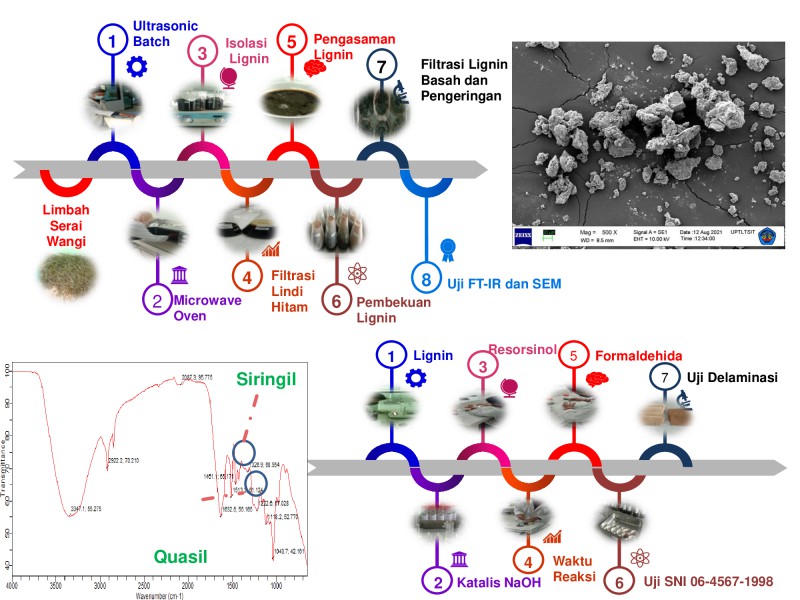
Limbah padat serai wangi mengandung lignin cukup tinggi yang dapat berpotensi untuk dikembangkan menjadi berbagai produk komersial, salah satunya adalah perekat. Tujuan dari penelitian ini adalah untuk mendapatkan kondisi optimum dalam pembuatan lignin resorsinol formaldehida (LRF) dari limbah serai wangi menggunakan metode Ultrasonic Microwave-Assisted Extraction (UMAE). Rancangan percobaan menggunakan response surface methodology (RSM) khususnya Box-Behnken Design (BBD). Variabel bebas dalam riset ini adalah volume NaOH (10, 13 dan 16 mL), waktu reaksi (10, 20 dan 30 menit), dan komposisi perekat (4, 6 dan 8 gram). Hasil penelitian menunjukkan perekat lignin LRF yang dihasilkan memenuhi SNI 06-4567-1998 untuk parameter berat jenis, waktu gelatinisasi, dan sisa penguapan. Daya tahan rekat (delaminasi) LRF yang dihasilkan memenuhi standar JAS 1996 yaitu rata rata 0%. Kondisi optimum pembuatan LRF dicapai pada penambahan NaOH 15,0561 mL, waktu reaksi 20 menit dan massa lignin 4 gram dengan daya tahan rekat (delaminasi) tertinggi yang dihasilkan 1 %.

References
Teng, H., Chen, L., Huang, Q., Wang, J., Lin, Q., Liu, M., ... Song, H. (2016). Ultrasonic-assisted extraction of raspberry seed oil and evaluation of its physicochemical properties, fatty acid compositions and antioxidant activities. PLoS ONE, 11(4), 1-17. DOI: 10.1371/journal.pone.0153457 DOI: https://doi.org/10.1371/journal.pone.0153457
Hadkar, U. B., Dhruv, N., Malode, Y., & Chavan, B. (2013). Microwave Assisted Extraction of Phytoconstituents. Asian Journal of Phytomedicine and Clinical Research, 2(3), 73-86.
Usmiati, S., Nurdjannah, N., & Sri Yuliani. (2012). Penyulingan Sereh Wangi Dan Nilam Sebagai Insektisida Pengusir Lalat Rumah (Musca domestica). J. Tek. Ind. Pert, 15(1), 10-16.
Sakdaronnarong, C. K., Onsrithong, N., Suwankrua, R., & Jonglertjunya, W. (2012). Improving enzymatic saccharification of sugarcane bagasse by biological/physico-chemical pretreatment using trametes versicolor and bacillus sp. BioResources, 7(3), 3935-3947. DOI: https://doi.org/10.15376/biores.7.3.3935-3947
Maysarah, S., & Herlina, N. (2015). Pembuatan Perekat Lignin Resorsinol Formaldehid Dari Natrium Lignosulfonat Tandan Kosong Kelapa Sawit. Jurnal Teknik Kimia USU, 4(4), 58-63. doi: 10.32734/jtk.v4i4.1514. DOI: https://doi.org/10.32734/jtk.v4i4.1514
Kusuma, H. S., & Mahfud, M. (2016). Preliminary study: Kinetics of oil extraction from sandalwood by microwave-assisted hydrodistillation. IOP Conference Series: Materials Science and Engineering, 128(1), 62-69. doi: 10.1088/1757-899X/128/1/012009 DOI: https://doi.org/10.1088/1757-899X/128/1/012009
Anuar, N., Mohd Adnan, A. F., Saat, N., Aziz, N., & Mat Taha, R. (2013). Optimization of extraction parameters by using response surface methodology, purification, and identification of anthocyanin pigments in melastoma malabathricum fruit. The Scientific World Journal, 2013. doi: 10.1155/2013/810547 DOI: https://doi.org/10.1155/2013/810547
Chadijah, S. (2011). Kinetika Delignifikasi Sabut Kelapa Dengan Proses Peroksida Alkali Pada Pembuatan Pulp. Teknosains: Media Informasi Sains dan Teknologi, 5(2), 223-231. Retrieved from https://journal.uin-alauddin.ac.id/index.php/teknosains/article/view/180
Minu, K., Jiby, K. K., & Kishore, V. V. N. (2012). Isolation and purification of lignin and silica from the black liquor generated during the production of bioethanol from rice straw. Biomass and Bioenergy, 39, 210-217. doi: 10.1016/j.biombioe.2012.01.007 DOI: https://doi.org/10.1016/j.biombioe.2012.01.007
Esse, I. (2018). Pemanfaatan Lignin Hasil Delignifikasi Ampas Tebu sebagai Perekat Lignin Resorsinol Formaldehida (LRF). Skripsi. Universitas Islam Negeri Alauddin Makassar. Retrieved from http://repositori.uin-alauddin.ac.id/11975/1/INDO ESSE.PDF.
Binoto, N. L. L., Rolan, S., & Ikhsan, D. (2010). Hidrolisis Ampas Tebu Secara Enzimatis Menggunakan Trichoderma reesei Novi. Seminar Tugas Akhir S1 Teknik Kimia UNDIP, Retrieved from http://eprints.undip.ac.id/16654/1/ARTIKEL_ILMIAH.pdf
Susilowati, Munandar, S., & Edahwati, L. (2013). Pemanfaatan Lignin dari Limbah Kulit Buah Kakao Menjadi Perekat. Jurnal Teknik Kimia, 8(1), 22-26. Retrieved from http://ejournal.upnjatim.ac.id/index.php/tekkim/article/view/710
Medynda, M., Sucipto, T., & Hakim, L. (2012). Pengembangan Perekat Likuida Dari Limbah Kulit Buah Kakao (Theobroma Cacao L.). Peronema Forestry Science Journal, 1(1).
Pawignya, H., Kusworo, T. D., & Pramudono, B. (2019). Optimization for Production Tert-Butyl Glycoside Nonionic Surfactant Using Response Surface Methodology. Journal of Physics: Conference Series, 1295(1). doi: 10.1088/1742-6596/1295/1/012003 DOI: https://doi.org/10.1088/1742-6596/1295/1/012003
Arsad, E. (2011). Sifat Fisik Kayu Lapis Berbahan Baku Kayu Akasia (Acacia Mangium Willd) dan Kelampayan (Anthocephalu spp). Jurnal Riset Industri Hasil Hutan, 3(2), 1. doi: 10.24111/jrihh.v3i2.1188 DOI: https://doi.org/10.24111/jrihh.v3i2.1188
Downloads
Published
How to Cite
Issue
Section
License
Copyright (c) 2022 CHEESA: Chemical Engineering Research Articles

This work is licensed under a Creative Commons Attribution-NonCommercial-ShareAlike 4.0 International License.
- Previous License: Creative Commons Attribution-NonCommercial-ShareAlike (CC BY-NC-SA)
- New License: Creative Commons Attribution (CC BY 4.0)
Previous copyright: With the receipt of the article by CHEESA Editorial Board and the decision to be published, the copyright regarding the article will be transferred to CHEESA Journal. CHEESA has the right to multiply and distribute the article and every author is not allowed to publish the same article that was published in this journal.
New Copyright: Authors who publish with this journal agree to the following terms:
Authors retain copyright and grant the journal right of first publication with the work simultaneously licensed under a Creative Commons Attribution License (CC BY 4.0) that allows others to share the work with an acknowledgement of the work's authorship and initial publication in this journal.


